15 Related Rates
15.1 Tsiolkovsky and the Rocket Equation
Consider a rocket in deep space, far from gravitational fields. At time t, it has mass m(t) and velocity v(t). As fuel burns, the rocket’s mass decreases: \frac{dm}{dt} < 0. The expelled exhaust carries momentum away, and by Newton’s third law, the rocket accelerates: \frac{dv}{dt} > 0. These two rates—the rate of mass loss and the rate of velocity gain—are not independent. They are related through the conservation of momentum.
Tsiolkovsky showed that for exhaust expelled at constant speed v_e relative to the rocket, m \frac{dv}{dt} = -v_e \frac{dm}{dt}.
This single equation contains the essence of spaceflight. As mass decreases (fuel burns), velocity must increase to conserve momentum. The rate at which speed increases depends on the rate of mass loss.
15.2 The Framework
Related rates problems arise whenever multiple time-dependent quantities satisfy a constraint. Gas pressure and temperature relate through thermodynamic laws. Wave frequency shifts as a source accelerates. Materials expand as temperature rises. Radioactive samples decay as time advances. A person’s shadow lengthens as they walk from a lamppost.
In each case, the mathematical structure is the same. Two or more quantities vary with time and satisfy a relation F(x, y, \ldots) = 0. Differentiating this constraint with respect to t transforms a geometric equation into a dynamic one—an equation relating rates of change. For static optimization problems where we find extrema, see ?sec-optimization.
Convention. In the spirit of mathematics, we assume appropriate units throughout but omit them during calculations. All physical quantities are understood to be measured in consistent units (SI or otherwise), and dimensional analysis is implicitly satisfied. This allows us to focus on the mathematical relationships without cluttering the notation.
If you are learning this material for the first time, omitting units is not generally a good idea. In practice—especially in engineering and physics—keeping track of units is essential for catching errors and ensuring dimensional consistency. Units serve as a sanity check: if your answer has the wrong dimensions, something went wrong.
The convention here is purely pedagogical, allowing us to emphasize mathematical structure over bookkeeping. In your own work, particularly when solving applied problems, always include units explicitly until you are thoroughly comfortable with the material.
Remark. The notation \frac{\partial F}{\partial x} denotes the partial derivative—the derivative of F with respect to x while holding other variables fixed. For functions of two variables, this reduces to the implicit differentiation developed in Section 12.1. The key insight is that Theorem 10.5, when applied to the composition F(x(t), y(t)), yields \frac{d}{dt} F(x(t), y(t)) = \frac{\partial F}{\partial x} \frac{dx}{dt} + \frac{\partial F}{\partial y} \frac{dy}{dt}.
In the language of differentials: the total differential dF_t captures how F changes as both x and y vary with time. This is the multivariable chain rule—the composition of the differential dF with the rate-of-change vector (\frac{dx}{dt}, \frac{dy}{dt}). Just as Theorem 10.5 says d(f \circ g) = df \circ dg for compositions of single-variable functions, here the differential of F(x(t), y(t)) decomposes into how F responds to changes in its inputs, weighted by how fast those inputs themselves change.
15.3 Clapeyron’s Ideal Gas Law
In 1834, Émile Clapeyron unified the empirical laws of Boyle, Charles, and Gay-Lussac into a single equation of state: PV = nRT, where P is pressure, V is volume, n is the number of moles (fixed for a sealed container), R is the universal gas constant, and T is absolute temperature.
This equation constrains three time-varying quantities. If we know how two change, we can determine the third. The mathematical structure is precisely that of Definition 15.1: a constraint among functions of time.
Example 15.1 (Isochoric Heating) A sealed rigid container holds one mole of an ideal gas. As the gas is heated, its temperature increases at rate 2. How fast is the pressure increasing when T = 300 and P = 2 \cdot 10^5?
Solution. Since the container is rigid, V is constant. With n = 1 and R constant, the gas law gives P = \frac{RT}{V}.
Differentiate both sides with respect to t. The left side: \frac{dP}{dt}.
The right side, by Theorem 10.5 and Theorem 10.2: \frac{d}{dt}\left(\frac{RT}{V}\right) = \frac{R}{V} \frac{dT}{dt}.
Thus, \frac{dP}{dt} = \frac{R}{V} \frac{dT}{dt}.
From the gas law at the specified instant, \frac{R}{V} = \frac{P}{T} = \frac{2 \cdot 10^5}{300}. Substituting \frac{dT}{dt} = 2, \frac{dP}{dt} = \frac{2 \cdot 10^5}{300} \cdot 2 = \frac{4}{3}\cdot 10^3 .
The pressure increases at approximately 1333. \square
Example 15.2 (Isothermal Compression) A piston compresses an ideal gas isothermally (constant temperature). The volume decreases at rate 0.01. How fast is the pressure changing when V = 0.5 and P = 10^5?
Solution. For isothermal processes, PV = nRT = c (constant). Differentiate implicitly with respect to t: \frac{d}{dt}(PV) = \frac{d}{dt}(c) = 0.
By Theorem 10.4, \frac{dP}{dt} \cdot V + P \cdot \frac{dV}{dt} = 0.
Given \frac{dV}{dt} = -0.01 (negative because volume is decreasing), substitute: \frac{dP}{dt} \cdot (0.5) + (10^5)(-0.01) = 0.
Solve for \frac{dP}{dt}: \frac{dP}{dt} = \frac{-10^5 \cdot (-0.01)}{0.5} = \frac{10^3}{0.5} = 2000.
As the volume compresses, the pressure increases at rate 2000. \square
Remark. The product rule appears naturally in related rates: when two changing quantities are multiplied in a constraint, their rates couple through the product rule. This is why Theorem 10.4 is essential to the method.
15.4 The Doppler Effect
In 1842, Christian Doppler proposed that the observed frequency of a wave depends on the relative motion of source and observer. His insight revolutionized astronomy: by measuring the shift in spectral lines from stars, one can determine their radial velocity—the foundation of modern cosmology.
For sound waves, if a source emitting frequency f_0 moves toward a stationary observer at speed v_s, the observed frequency is f = \frac{v}{v - v_s} f_0, where v is the speed of sound in the medium.
Example 15.3 (Decelerating Train Whistle) A train whistle emits a constant tone at frequency 500. The train approaches at speed 30 but decelerates at rate 2. How fast is the observed frequency changing? (Take the speed of sound v = 340.)
Solution. We have f = \frac{v f_0}{v - v_s}. Differentiate with respect to t. Since v and f_0 are constants, \frac{df}{dt} = v f_0 \cdot \frac{d}{dt}\left[(v - v_s)^{-1}\right].
By Theorem 10.5, \frac{d}{dt}\left[(v - v_s)^{-1}\right] = -(v - v_s)^{-2} \cdot \frac{d}{dt}(v - v_s) = -(v - v_s)^{-2} \cdot \left(-\frac{dv_s}{dt}\right).
Thus, \frac{df}{dt} = v f_0 \cdot \frac{1}{(v - v_s)^2} \cdot \frac{dv_s}{dt}.
Given \frac{dv_s}{dt} = -2 (negative because the train is slowing down), substitute: \frac{df}{dt} = \frac{(340)(500)}{(340 - 30)^2}(-2) = \frac{170000}{96100}(-2) \approx -3.54.
The observed pitch decreases at approximately 3.5 as the train decelerates. The listener hears the pitch dropping in real time. \square
15.5 The Shadow Problem
Example 15.4 (Shadow Length) Problem. A person of height 2 walks away from a lamppost of height 6 at speed 1.5. How fast is the tip of their shadow moving along the ground?
Solution. Let x(t) denote the person’s distance from the lamp, and s(t) the distance from the lamp to the shadow’s tip. We seek \frac{ds}{dt} given \frac{dx}{dt} = 1.5.
The geometry involves similar triangles. The lamppost casts light that passes over the person’s head and continues to the ground. The larger triangle has height 6 and base s; the smaller triangle has height 2 and base s - x. By similar triangles, \frac{6}{s} = \frac{2}{s - x}.
Cross-multiply to obtain the constraint: 6(s - x) = 2s \implies 6s - 6x = 2s \implies 4s = 6x \implies s = \frac{3x}{2}.
Differentiate both sides with respect to t: \frac{ds}{dt} = \frac{3}{2} \frac{dx}{dt}.
Substitute \frac{dx}{dt} = 1.5: \frac{ds}{dt} = \frac{3}{2}(1.5) = 2.25.
The shadow’s tip moves at 2.25—faster than the person walks. The shadow outruns them. \square
Generalization. If the lamppost has height H and the person has height h < H, the same reasoning gives s = \frac{H}{H - h} x \implies \frac{ds}{dt} = \frac{H}{H - h} \frac{dx}{dt}.
The ratio \frac{H}{H - h} amplifies the person’s speed. As h \to H, the denominator H - h \to 0, and \frac{ds}{dt} \to \infty—the shadow tip would recede infinitely fast if the person were as tall as the lamp. This limiting behavior reflects the geometry: when person and lamp have equal height, the light rays become parallel, and the shadow extends to infinity.
15.6 A Classical Example: Kepler’s Area Law
We have already drawn extensively on Kepler’s studies in the latter part of the chapter on differentiation, yet we return to them once more. We conclude with a deeper look at Kepler’s second law, which demonstrates how related rates connect geometry and physics once more.
Kepler’s Second Law (1609). A line segment joining a planet and the Sun sweeps out equal areas during equal intervals of time.
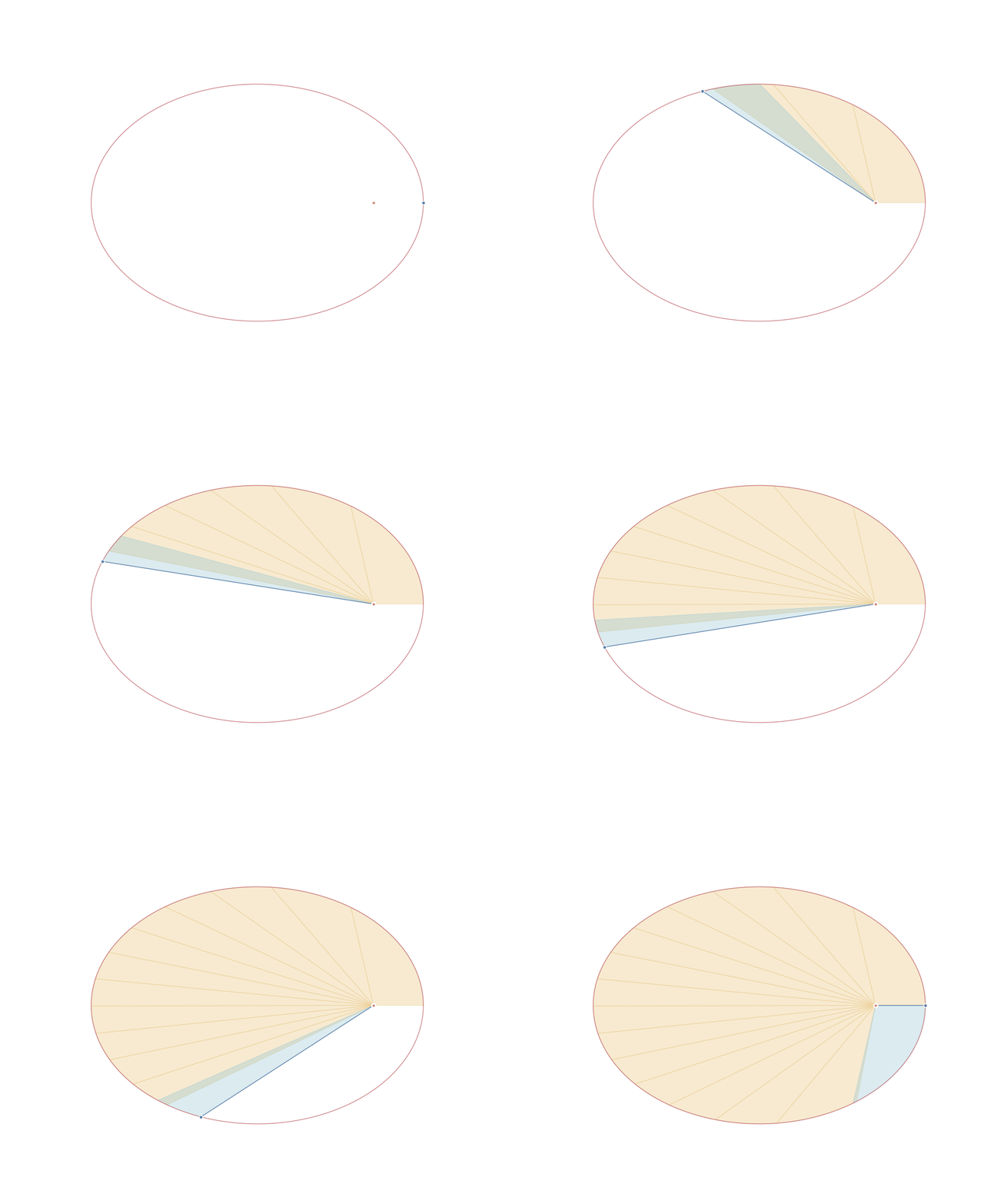
Consider a planet in elliptical orbit with the Sun at one focus. In polar coordinates, let r(t) be the planet’s distance from the Sun and \theta(t) the angle from some fixed direction. The area swept in time dt is approximately the area of a sector: dA \approx \frac{1}{2} r^2 \, d\theta.
Dividing by dt, \frac{dA}{dt} = \frac{1}{2} r^2 \frac{d\theta}{dt}.
Kepler’s law states \frac{dA}{dt} = \text{constant}. Call this constant \frac{L}{2}, where L is the angular momentum per unit mass. Then r^2 \frac{d\theta}{dt} = L.
When r is small (planet near Sun), \frac{d\theta}{dt} must be large to keep the product constant—the planet sweeps through larger angles per unit time, moving faster. When r is large (planet far from Sun), \frac{d\theta}{dt} decreases—the planet sweeps through smaller angles, moving slower.
This is conservation of angular momentum. Newton later proved that any central force (a force directed toward a fixed point) conserves angular momentum, explaining Kepler’s empirical law.
Related rates in physics. The equation r^2 \frac{d\theta}{dt} = L is a constraint relating r(t) and \theta(t). If we know \frac{dr}{dt} and the current values of r and \frac{d\theta}{dt}, we can determine \frac{d^2\theta}{dt^2} (the angular acceleration) by differentiating: \frac{d}{dt}\left(r^2 \frac{d\theta}{dt}\right) = 0 \implies 2r \frac{dr}{dt} \frac{d\theta}{dt} + r^2 \frac{d^2\theta}{dt^2} = 0.
Solve for \frac{d^2\theta}{dt^2}: \frac{d^2\theta}{dt^2} = -\frac{2}{r} \frac{dr}{dt} \frac{d\theta}{dt}.
15.7 Common Errors
Related rates problems admit several characteristic mistakes. Recognizing these patterns helps avoid them.
15.7.1 Substituting Before Differentiating
Incorrect approach: In the gas law example with P = \frac{nRT}{V} at constant volume, substitute T = 300 to obtain P = \frac{nR \cdot 300}{V} (a number), then differentiate to get \frac{dP}{dt} = 0.
Correct approach: Differentiate P = \frac{nRT}{V} symbolically to obtain \frac{dP}{dt} = \frac{nR}{V}\frac{dT}{dt}, then substitute T = 300 (via \frac{nR}{V} = \frac{P}{T}) and \frac{dT}{dt} = 2.
Why this matters: If you substitute numerical values before differentiating, you lose the functional dependence. Variables become constants, and their derivatives vanish. Always differentiate first, then evaluate at the specific instant.
15.7.2 Forgetting the Chain Rule
When differentiating r^3 with respect to t, remember that r itself depends on t: \frac{d}{dt}(r^3) = 3r^2 \frac{dr}{dt}, \quad \text{not merely } 3r^2.
This error appears constantly in related rates. Every geometric quantity—radius, height, angle—is implicitly a function of time, even if we don’t write r(t) explicitly. The chain rule must be applied to every term containing a time-varying quantity.
15.7.3 Sign Errors
If a quantity is decreasing, its rate is negative. Be explicit about signs:
- Volume decreasing: \frac{dV}{dt} < 0
- Distance shrinking: \frac{dx}{dt} < 0
- Velocity slowing (deceleration): \frac{dv}{dt} < 0
Include the sign from the start rather than adjusting at the end. For example, if water drains from a tank at rate 2, write \frac{dV}{dt} = -2, not \frac{dV}{dt} = 2 with a “minus because it’s decreasing” footnote.
15.7.4 Confusing Distance and Position
In problems involving motion, distinguish between:
- Position x(t): location along a line
- Distance d(t): magnitude of displacement from a reference point
The derivative \frac{dx}{dt} is velocity (which can be negative). The derivative \frac{dd}{dt} is the rate of change of distance (always relates to speed). Be clear which quantity the problem asks for.
15.8 Summary
Related rates problems involve multiple quantities changing with time, constrained by geometric or physical relationships. The solution method follows a systematic procedure:
- Identify all time-varying quantities and assign variables
- Write the constraint equation relating these quantities
- Differentiate implicitly with respect to time, applying Theorem 10.5 throughout
- Substitute known values and solve for the unknown rate
Key principles:
- The chain rule transforms spatial constraints into temporal relationships
- Differentiate before substituting numerical values
- Every variable in the constraint is implicitly a function of time
- Signs matter: decreasing quantities have negative rates
15.9 Problem Set
A point moves along the curve y = x^3 with horizontal velocity \frac{dx}{dt} = 2.
Find \frac{dy}{dt} in terms of x.
At what point on the curve is \frac{dy}{dt} = 24?
Find the speed v = \sqrt{(dx/dt)^2 + (dy/dt)^2} in terms of x, and compute \frac{dv}{dt} assuming \frac{dx}{dt} = 2 is constant.
This exercise establishes a differential identity for inverse functions using related rates.
Let f be strictly monotone and differentiable with f'(x) \neq 0. Define y = f(x) and x = f^{-1}(y).
Differentiate the identity f(f^{-1}(y)) = y with respect to t, treating both x and y as functions of time with y = f(x). Show that f'(x) \frac{dx}{dt} = \frac{dy}{dt}.
Suppose \frac{dy}{dt} = 1 (constant). Differentiate the equation from part (a) again with respect to t to obtain f''(x) \left(\frac{dx}{dt}\right)^2 + f'(x) \frac{d^2x}{dt^2} = 0.
Use parts (a) and (b) to prove that \frac{d^2x}{dt^2} = -\frac{f''(x)}{[f'(x)]^3}. Deduce that (f^{-1})''(y) = -\frac{f''(x)}{[f'(x)]^3} where x = f^{-1}(y).
Differentiate y = x^3 with respect to t: \frac{dy}{dt} = 3x^2 \frac{dx}{dt} = 3x^2 \cdot 2 = 6x^2.
Set \frac{dy}{dt} = 24: 6x^2 = 24 \implies x^2 = 4 \implies x = \pm 2. The points are (2, 8) and (-2, -8).
The speed is v = \sqrt{\left(\frac{dx}{dt}\right)^2 + \left(\frac{dy}{dt}\right)^2} = \sqrt{4 + 36x^4} = 2\sqrt{1 + 9x^4}. To find \frac{dv}{dt}, differentiate v^2 = 4 + 36x^4 with respect to t: 2v\frac{dv}{dt} = 144x^3\frac{dx}{dt} = 144x^3 \cdot 2 = 288x^3. Therefore: \frac{dv}{dt} = \frac{144x^3}{v} = \frac{144x^3}{2\sqrt{1 + 9x^4}} = \frac{72x^3}{\sqrt{1 + 9x^4}}.
Differentiate f(f^{-1}(y)) = y using the chain rule: f'(f^{-1}(y)) \cdot \frac{d(f^{-1}(y))}{dt} = \frac{dy}{dt}. Since x = f^{-1}(y), this becomes: f'(x) \frac{dx}{dt} = \frac{dy}{dt}.
Given \frac{dy}{dt} = 1, the equation from part (a) gives f'(x)\frac{dx}{dt} = 1. Differentiate both sides with respect to t. The left side requires the product rule: \frac{d}{dt}\left[f'(x)\frac{dx}{dt}\right] = \frac{d}{dt}[f'(x)] \cdot \frac{dx}{dt} + f'(x) \cdot \frac{d^2x}{dt^2}.
For the first term, apply the chain rule to f'(x(t)): \frac{d}{dt}[f'(x)] = f''(x) \frac{dx}{dt}.
Therefore: f''(x)\frac{dx}{dt} \cdot \frac{dx}{dt} + f'(x)\frac{d^2x}{dt^2} = 0,
which simplifies to:
f''(x)\left(\frac{dx}{dt}\right)^2 + f'(x)\frac{d^2x}{dt^2} = 0.
From part (a), \frac{dx}{dt} = \frac{1}{f'(x)} when \frac{dy}{dt} = 1. Substitute into part (b): f''(x) \cdot \frac{1}{[f'(x)]^2} + f'(x)\frac{d^2x}{dt^2} = 0.
Solve for \frac{d^2x}{dt^2}: \frac{d^2x}{dt^2} = -\frac{f''(x)}{[f'(x)]^3}.
Now, since we set \frac{dy}{dt} = 1, we have dt = dy. The second derivative of x with respect to y is: \frac{d^2x}{dy^2} = \frac{d}{dy}\left(\frac{dx}{dy}\right) = \frac{d}{dt}\left(\frac{dx}{dy}\right) \cdot \frac{dt}{dy}.
Since \frac{dx}{dy} = \frac{1}{f'(x)} and \frac{dt}{dy} = 1, we have: \frac{d^2x}{dy^2} = \frac{d^2x}{dt^2} = -\frac{f''(x)}{[f'(x)]^3}.
Therefore, for the inverse function g = f^{-1} with y = f(x): g''(y) = -\frac{f''(x)}{[f'(x)]^3} where x = g(y) = f^{-1}(y). \square