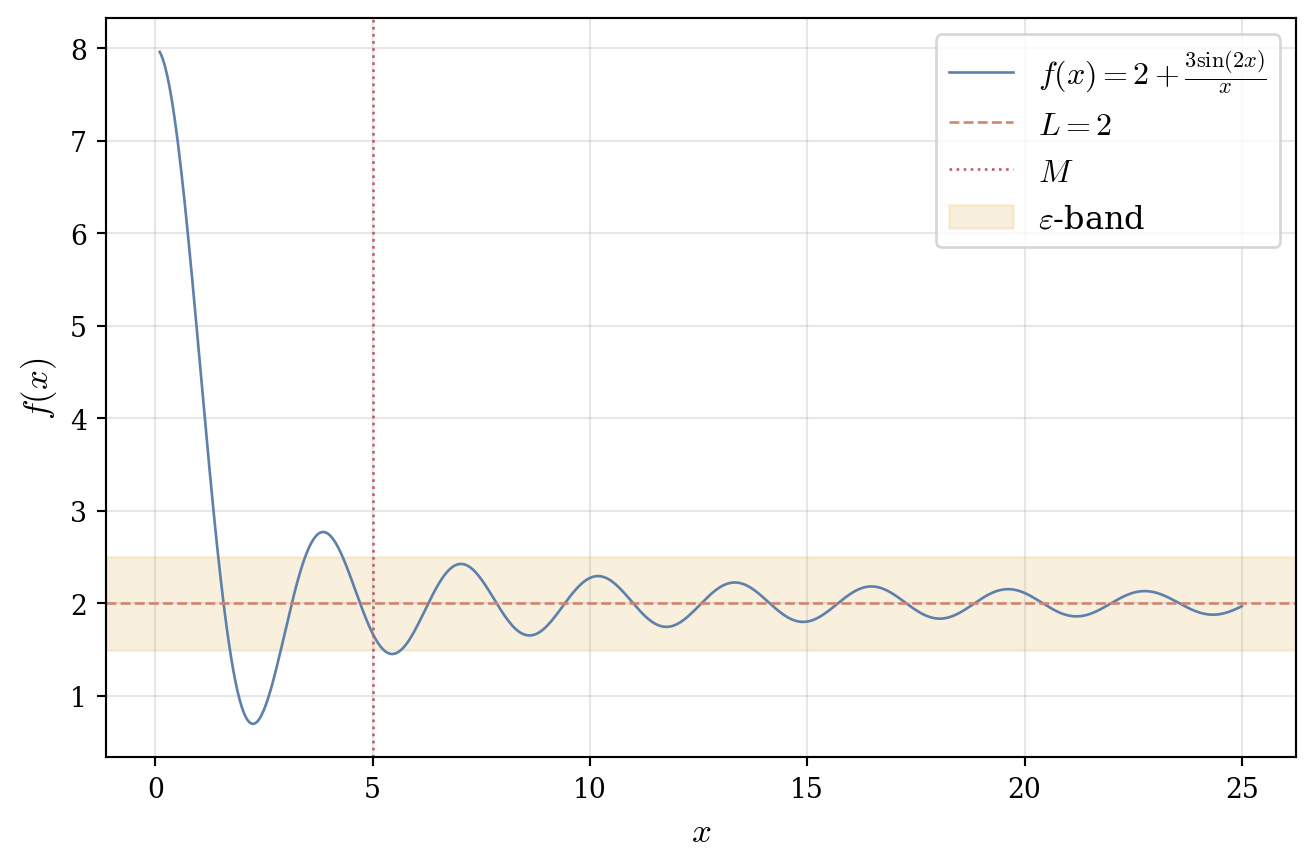
6 Asymptotics and Limits at Infinity
6.1 Motivation
The \varepsilon-\delta formalism treats limits as x approaches a finite point a. Many applications, however, require understanding the behavior of functions as the argument grows without bound.
Consider gravitational force. Newton’s law of universal gravitation states that the force between two masses m_1 and m_2 separated by distance r is
F(r) = \frac{Gm_1m_2}{r^2},
where G is the gravitational constant. As the distance r \to \infty, the force decays to zero—objects infinitely far apart exert no gravitational influence on each other. Similarly, other inverse square laws in physics—electrostatic and radiative intensity—exhibit the same limiting behavior. These observations demand a rigorous notion of limits at infinity.
Beyond computing such limits, we establish a growth hierarchy. Logarithmic functions grow slower than polynomial functions, which grow slower than exponential functions. This hierarchy is fundamental to algorithm analysis, asymptotic expansions, and the study of differential equations.
Finally, we introduce little-o notation, which provides concise language for comparing rates of growth. This formalism appears throughout analysis, probability, and numerical methods.
6.2 Limits at Infinity
Definition 6.1 (Limit at Infinity) We write \lim_{x \to \infty} f(x) = L if for every \varepsilon > 0, there exists M > 0 such that
x > M \implies |f(x) - L| < \varepsilon.
The definition replaces “|x - a| < \delta” with “x > M”, adapting the \varepsilon-\delta framework to infinite limits. Eventually, f(x) lies within \varepsilon of L.
Example 6.1 (Reciprocal Limit at Infinity) For f(x) = \frac{1}{x}, given \varepsilon > 0, choose M = \frac{1}{\varepsilon}. Then x > M implies
\left|\frac{1}{x}\right| < \frac{1}{M} = \varepsilon.
Hence \lim_{x \to \infty} \frac{1}{x} = 0.
Definition 6.2 (Limit at Negative Infinity) We write \lim_{x \to -\infty} f(x) = L if for every \varepsilon > 0, there exists M < 0 such that
x < M \implies |f(x) - L| < \varepsilon.
Remark. Limits as x \to \infty and x \to -\infty are independent; a function may possess one but not the other.
6.3 Infinite Limits
We formalize unbounded growth.
Definition 6.3 (Infinite Limit) We write \lim_{x \to a} f(x) = \infty if for every N > 0, there exists \delta > 0 such that
0 < |x - a| < \delta \implies f(x) > N.
Similarly, \lim_{x \to a} f(x) = -\infty if for every N < 0, there exists \delta > 0 such that
0 < |x - a| < \delta \implies f(x) < N.
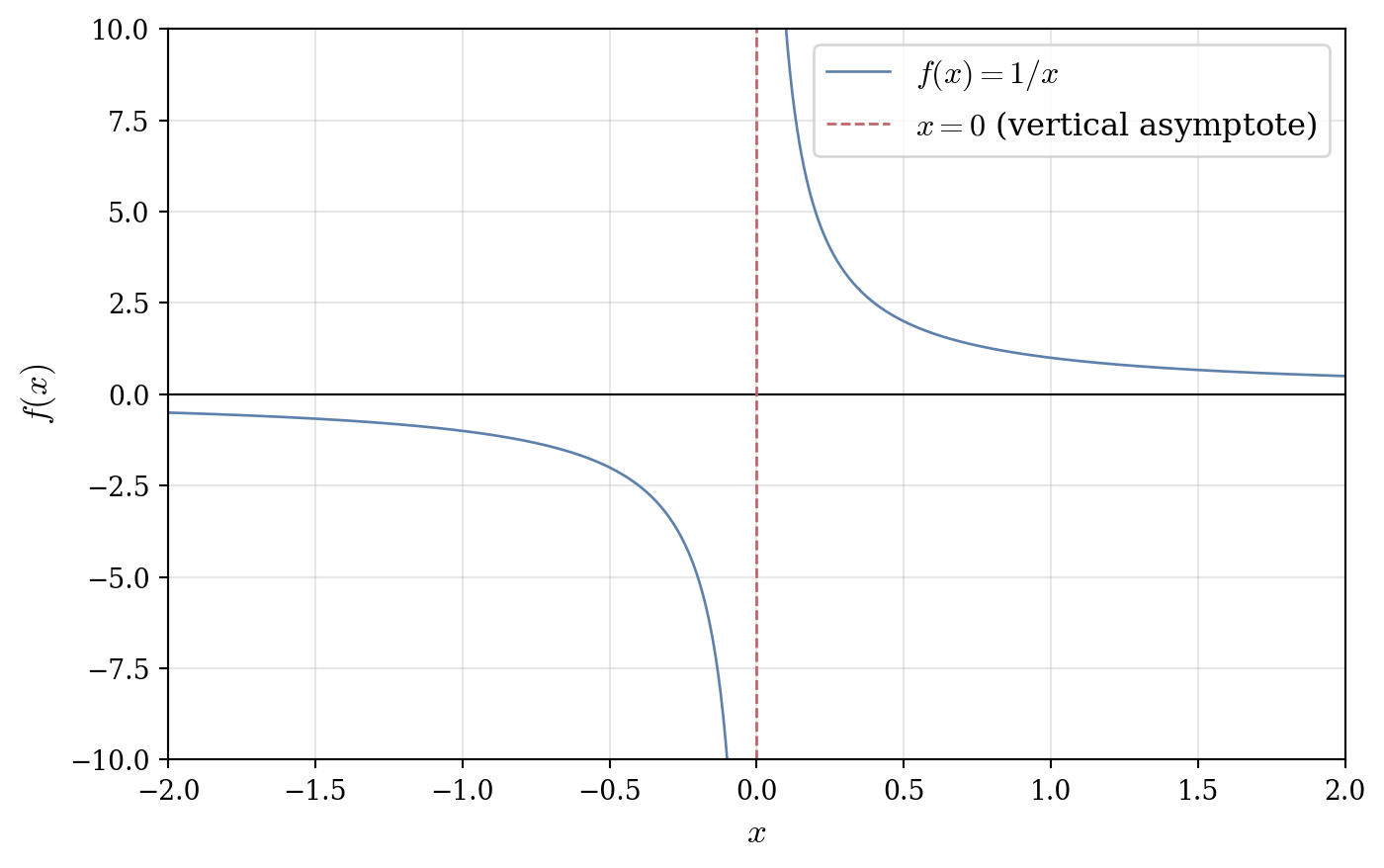
Example 6.2 (Vertical Asymptote) For f(x) = \frac{1}{(x-2)^2} and any N > 0, choose \delta = \frac{1}{\sqrt{N}}. Then 0 < |x - 2| < \delta implies
f(x) = \frac{1}{(x-2)^2} > \frac{1}{\delta^2} = N.
Hence \lim_{x \to 2} f(x) = \infty. We say x = 2 is a vertical asymptote. If \lim_{x \to \infty} f(x) = L, then y = L is a horizontal asymptote.
6.4 Asymptotic Behavior of Rational Functions
Limits of rational functions at infinity are determined by the degrees of numerator and denominator.
Theorem 6.1 (Rational Functions at Infinity) Let p(x) = a_n x^n + \cdots + a_0 and q(x) = b_m x^m + \cdots + b_0 with a_n, b_m \neq 0. Then
If n < m: \displaystyle \lim_{x \to \infty} \frac{p(x)}{q(x)} = 0.
If n = m: \displaystyle \lim_{x \to \infty} \frac{p(x)}{q(x)} = \frac{a_n}{b_m}.
If n > m: \displaystyle \lim_{x \to \infty} \frac{p(x)}{q(x)} = \pm \infty (sign determined by a_n, b_m).
TipProof
Factor out the highest powers:
\frac{p(x)}{q(x)} = x^{n-m} \frac{a_n + a_{n-1}/x + \cdots + a_0/x^n}{b_m + b_{m-1}/x + \cdots + b_0/x^m}.
As x \to \infty, all terms with 1/x^k vanish. The numerator approaches a_n, the denominator approaches b_m.
If n < m, then x^{n-m} \to 0, yielding limit 0.
If n = m, then x^{n-m} = 1, yielding limit a_n/b_m.
If n > m, then x^{n-m} \to \infty, yielding \pm\infty according to the signs of a_n and b_m. \square
Example 6.3 (Limit of a Rational Function) Evaluate \displaystyle \lim_{x \to \infty} \frac{3x^2 + 5x - 1}{2x^2 + 7}.
WarningSolution
The degrees are equal (n = m = 2), so by Theorem 6.1,
\lim_{x \to \infty} \frac{3x^2 + 5x - 1}{2x^2 + 7} = \frac{3}{2}.
Alternatively, divide numerator and denominator by x^2
\frac{3x^2 + 5x - 1}{2x^2 + 7} = \frac{3 + \frac{5}{x} - \frac{1}{x^2}}{2 + \frac{7}{x^2}}.
As x \to \infty, the fractions vanish
\lim_{x \to \infty} \frac{3 + \frac{5}{x} - \frac{1}{x^2}}{2 + \frac{7}{x^2}} = \frac{3 + 0 - 0}{2 + 0} = \frac{3}{2}. \quad \square
6.5 Growth Hierarchies
Functions exhibit different rates of growth as x \to \infty. We formalize this via dominance.
Definition 6.4 (Dominance) We say f dominates g as x \to \infty, written f \gg g, if
\lim_{x \to \infty} \frac{g(x)}{f(x)} = 0.
Theorem 6.2 (Standard Growth Rates) As x \to \infty:
For a > b > 0: x^a \gg x^b.
For any n \in \mathbb{N}: e^x \gg x^n.
For any a > 0: x^a \gg \ln x.
More explicitly,
\lim_{x \to \infty} \frac{\ln x}{x^a} = 0, \quad \lim_{x \to \infty} \frac{x^n}{e^x} = 0
Remark. These results are proved via L’Hôpital’s Rule in Section 13.6. The complete hierarchy is
\log(\log x) \ll \log x \ll x^{1/n} \ll x \ll x \log x \ll x^2 \ll x^n \ll e^x \ll e^{x^2} \ll e^{e^x}.
6.6 Indeterminate Forms at Infinity
Just as \frac{0}{0} is indeterminate at finite points, forms like \frac{\infty}{\infty}, 0 \cdot \infty, and \infty - \infty are indeterminate at infinity.
6.6.1 Type \frac{\infty}{\infty}
Example 6.4 (Type \frac{\infty}{\infty}) Evaluate \displaystyle \lim_{x \to \infty} \frac{5x^3 - x}{2x^3 + 7}.
WarningSolution
Divide by x^3:
\frac{5x^3 - x}{2x^3 + 7} = \frac{5 - \frac{1}{x^2}}{2 + \frac{7}{x^3}} \to \frac{5}{2}. \quad \square
6.6.2 Type 0 \cdot \infty
Example 6.5 (Type 0 \cdot \infty) Evaluate \displaystyle \lim_{x \to 0^+} x \ln x.
WarningSolution
Rewrite as x \ln x = \frac{\ln x}{1/x}, producing \frac{-\infty}{\infty}. L’Hôpital’s Rule (see Section 13.1) yields 0. \square
6.6.3 Type \infty - \infty
When two terms both approach infinity but with opposite signs, the limit is indeterminate. Techniques include finding a common denominator or using conjugate multiplication.
Example 6.6 (Indeterminate Form \infty - \infty) Evaluate \displaystyle \lim_{x \to \infty} \left(\sqrt{x^2 + x} - x\right).
WarningSolution
As x \to \infty, both terms approach \infty, giving \infty - \infty. Multiply by the conjugate
\begin{align*} \sqrt{x^2 + x} - x &= \left(\sqrt{x^2 + x} - x\right) \cdot \frac{\sqrt{x^2 + x} + x}{\sqrt{x^2 + x} + x} \\ &= \frac{(x^2 + x) - x^2}{\sqrt{x^2 + x} + x} \\ &= \frac{x}{\sqrt{x^2 + x} + x}. \end{align*}
Divide numerator and denominator by x (assuming x > 0)
\frac{x}{\sqrt{x^2 + x} + x} = \frac{1}{\sqrt{1 + \frac{1}{x}} + 1}.
As x \to \infty, \frac{1}{x} \to 0, so
\lim_{x \to \infty} \left(\sqrt{x^2 + x} - x\right) = \frac{1}{\sqrt{1 + 0} + 1} = \frac{1}{2}. \quad \square
6.7 Little-o Notation
Landau’s asymptotic notation provides concise language for relative growth rates.
Definition 6.5 (Little-o) Let f, g be functions and a \in \mathbb{R} \cup \{\pm\infty\}. We write
f(x) = o(g(x)) \quad \text{as } x \to a
if
\lim_{x \to a} \frac{f(x)}{g(x)} = 0.
6.7.0.1 Examples:
x^2 = o(x) as x \to 0. By definition, we must show \lim_{x \to 0} \frac{x^2}{x} = 0. Simplifying: \lim_{x \to 0} \frac{x^2}{x} = \lim_{x \to 0} x = 0.
\ln x = o(x) as x \to \infty. We must show \lim_{x \to \infty} \frac{\ln x}{x} = 0. This follows from the growth hierarchy (Theorem 13.3): logarithmic functions grow slower than any positive power of x.
e^{-x} = o(x^{-n}) as x \to \infty for any n. We must show \lim_{x \to \infty} \frac{e^{-x}}{x^{-n}} = 0. Rewrite: \frac{e^{-x}}{x^{-n}} = \frac{x^n}{e^x}. By the growth hierarchy, exponential functions dominate all polynomials, so \lim_{x \to \infty} \frac{x^n}{e^x} = 0.
Example 6.7 (Little-o and Thermal Equilibrium) Newton’s law of cooling states that the temperature difference T(t) - T_{\text{env}} between an object and its environment decays exponentially. For small time intervals near t = 0, we can approximate the exponential decay. Specifically, if an object starts at temperature T_0 in an environment at temperature T_{\text{env}}, the temperature difference satisfies
T(t) - T_{\text{env}} = (T_0 - T_{\text{env}})e^{-kt}
for some cooling constant k > 0. For small t, the exponential can be approximated: e^{-kt} \sim 1 - kt. The error in this approximation is o(t). Verify this.
WarningSolution
We must show that e^{-kt} - (1 - kt) = o(t) as t \to 0. By definition of little-o, this requires
\lim_{t \to 0} \frac{e^{-kt} - (1 - kt)}{t} = 0.
Rewrite the numerator. Let u = -kt, so as t \to 0, we have u \to 0. Then
\frac{e^{-kt} - (1 - kt)}{t} = \frac{e^u - (1 + u)}{t}.
Substituting u = -kt back and using t = -u/k:
\frac{e^u - 1 - u}{-u/k} = -k \cdot \frac{e^u - 1 - u}{u}.
We need \lim_{u \to 0} \frac{e^u - 1 - u}{u}. Note that e^u - 1 \sim u for small u (a standard limit), so e^u - 1 - u is smaller than u.
To see this more carefully, observe that e^u - 1 - u can be written as a series of positive terms when u > 0. For small u, we have e^u > 1 + u (since the exponential function is strictly convex), which means e^u - 1 - u > 0. Moreover, the difference e^u - 1 - u grows much slower than u itself.
By examining the behavior near zero using standard limit techniques, we find that
e^u - 1 - u = \frac{u^2}{2} \cdot \left(1 + \frac{u}{3} + \cdots\right),
where the additional terms all vanish as u \to 0. Thus
\frac{e^u - 1 - u}{u} = \frac{u}{2} \cdot \left(1 + \frac{u}{3} + \cdots\right) \to 0 \quad \text{as } u \to 0.
Therefore e^{-kt} = 1 - kt + o(t) as t \to 0, confirming that the linear approximation has error term of order smaller than t. This means the cooling is approximately linear for short time periods, with rapidly diminishing error. \square
6.8 Big-O Notation
While little-o captures functions that vanish relative to another, big-O describes functions that remain bounded by a constant multiple of another.
Definition 6.6 (Big-O) Let f, g be functions and a \in \mathbb{R} \cup \{\pm\infty\}. We write
f(x) = O(g(x)) \quad \text{as } x \to a
if there exist constants C > 0 and a neighborhood of a such that
|f(x)| \le C|g(x)|
for all x in that neighborhood (excluding a itself if a is finite).
Interpretation. The notation f(x) = O(g(x)) means “f grows no faster than g, up to a constant multiple.” Unlike little-o, which requires f to be negligible compared to g, big-O allows f and g to have comparable growth rates.
6.8.0.1 Examples:
- 3x^2 + 5x + 1 = O(x^2) as x \to \infty. For x \ge 1, we have |5x| \le 5x^2 and |1| \le x^2, so
|3x^2 + 5x + 1| \le 3x^2 + 5x^2 + x^2 = 9x^2.
Thus C = 9 suffices.
\sin x = O(1) as x \to \infty. Since |\sin x| \le 1 for all x, we have |\sin x| \le 1 \cdot |1|, so \sin x = O(1) with C = 1.
\ln x = O(x) as x \to \infty. From the growth hierarchy, \lim_{x \to \infty} \frac{\ln x}{x} = 0, so \frac{\ln x}{x} is eventually bounded. Hence there exists C such that |\ln x| \le C|x| for large x.
Contrast with little-o: If f(x) = o(g(x)), then f(x) = O(g(x)), but the converse is false. For instance, x = O(x) but x \neq o(x).
Remark. Big-O notation is ubiquitous in algorithm analysis, where it describes worst-case time complexity. Saying an algorithm runs in O(n^2) time means the number of operations is bounded by Cn^2 for some constant C.
6.9 Summary of Asymptotic Techniques
We conclude with an overview of techniques for computing limits at infinity.
| Indeterminate Form | Technique | Example |
|---|---|---|
| \frac{\infty}{\infty} | Divide by dominant term | \lim_{x \to \infty} \frac{3x^2}{2x^2+1} = \frac{3}{2} |
| 0 \cdot \infty | Rewrite as quotient | \lim_{x \to 0^+} x \ln x = 0 |
| \infty - \infty | Common denominator or conjugate | \lim_{x \to \infty} (\sqrt{x^2+x} - x) = \frac{1}{2} |
| Growth comparison | Use dominance hierarchy | \lim_{x \to \infty} \frac{\ln x}{x} = 0 |
WarningProblem Set
Consider the function f(x) = \frac{4x^2 - 3}{2x^2 + 5}.
Use the \varepsilon-M definition (Definition 6.1) to prove that \lim_{x \to \infty} \frac{1}{x} = 0 by finding an explicit value of M that works for \varepsilon = 0.01.
Determine \lim_{x \to \infty} f(x) using Theorem 6.1. State which case of the theorem applies.
Verify your answer from part (b) by dividing both numerator and denominator by the highest power of x and evaluating the limit directly.
Explain why \lim_{x \to \infty} \frac{4x^2 - 3}{2x^2 + 5} \neq \lim_{x \to \infty} \frac{4x^2}{2x^2}, even though both expressions seem to simplify to \frac{4}{2} = 2.
Evaluate the following limits involving indeterminate forms.
Show that \lim_{x \to \infty} \left(\sqrt{x^2 + 4x} - x\right) has the indeterminate form \infty - \infty.
Use conjugate multiplication (as in Example 6.6) to evaluate the limit from part (a).
After rationalizing, explain why dividing the numerator and denominator by x (not x^2) is the correct choice for evaluating the limit as x \to \infty.
Use a similar technique to evaluate \lim_{x \to \infty} \left(\sqrt{9x^2 + x} - 3x\right). Does your answer depend on whether we consider x \to +\infty or x \to -\infty?
Consider the growth hierarchy and asymptotic notation.
Using Theorem 13.3, determine which function grows faster as x \to \infty: x^{100} or e^x. Write your answer using the dominance notation \gg from Definition 6.4.
Use the definition of little-o notation (Definition 6.5) to verify that x^2 = o(x^3) as x \to \infty by computing the appropriate limit.
Evaluate \lim_{x \to \infty} \frac{3x^2 + \ln x}{x^2} by first explaining which term dominates the numerator.
WarningSolutions
Proof. Let \varepsilon = 0.01. We must find M > 0 such that x > M \implies \left|\frac{1}{x} - 0\right| < 0.01.
The inequality \left|\frac{1}{x}\right| < 0.01 simplifies to \frac{1}{x} < 0.01 (for x > 0), which gives x > \frac{1}{0.01} = 100.
Therefore, choose M = 100. Then for all x > M = 100, \left|\frac{1}{x}\right| = \frac{1}{x} < \frac{1}{100} = 0.01 = \varepsilon.
This verifies the definition with \varepsilon = 0.01 and M = 100. \square
The numerator has degree n = 2 and leading coefficient a_2 = 4. The denominator has degree m = 2 and leading coefficient b_2 = 2. Since n = m (equal degrees), we apply case 2 of Theorem 6.1: \lim_{x \to \infty} \frac{4x^2 - 3}{2x^2 + 5} = \frac{a_2}{b_2} = \frac{4}{2} = 2.
Divide both numerator and denominator by x^2 (the highest power appearing): \frac{4x^2 - 3}{2x^2 + 5} = \frac{x^2(4 - 3/x^2)}{x^2(2 + 5/x^2)} = \frac{4 - 3/x^2}{2 + 5/x^2}.
As x \to \infty, we have \frac{3}{x^2} \to 0 and \frac{5}{x^2} \to 0. Therefore, \lim_{x \to \infty} \frac{4 - 3/x^2}{2 + 5/x^2} = \frac{4 - 0}{2 + 0} = \frac{4}{2} = 2.
This confirms our answer from part (b).
The expression \frac{4x^2}{2x^2} ignores the constant terms -3 and +5. While this simplification might seem valid, it’s only justified after properly dividing by the highest power.
More formally, the limit laws require that we evaluate limits of well-defined expressions. The function \frac{4x^2 - 3}{2x^2 + 5} is not equal to \frac{4x^2}{2x^2} for any x—they differ by the terms involving the constants.
However, after dividing by x^2, the terms \frac{3}{x^2} and \frac{5}{x^2} vanish as x \to \infty, which is why the limit equals \frac{4}{2}. The key is that we must use the limit laws properly: we cannot simply “drop” terms before taking the limit. The correct procedure is to factor out the highest power and then apply the limit laws to each term.
As x \to \infty, both \sqrt{x^2 + 4x} and x grow without bound: \lim_{x \to \infty} \sqrt{x^2 + 4x} = \infty, \quad \lim_{x \to \infty} x = \infty.
Therefore, the expression has the form \infty - \infty, which is indeterminate. We cannot conclude anything about the limit without further analysis.
Multiply by the conjugate: \begin{align*} \sqrt{x^2 + 4x} - x &= \left(\sqrt{x^2 + 4x} - x\right) \cdot \frac{\sqrt{x^2 + 4x} + x}{\sqrt{x^2 + 4x} + x} \\ &= \frac{(x^2 + 4x) - x^2}{\sqrt{x^2 + 4x} + x} \\ &= \frac{4x}{\sqrt{x^2 + 4x} + x}. \end{align*}
After rationalization, we have \frac{4x}{\sqrt{x^2 + 4x} + x}.
As x \to \infty, both numerator and denominator approach infinity (form \frac{\infty}{\infty}). The dominant term in the denominator comes from \sqrt{x^2 + 4x} \sim \sqrt{x^2} = |x| = x (for x > 0). The denominator behaves like x + x = 2x for large x.
If we divided by x^2, we would get: \frac{4x/x^2}{\sqrt{x^2 + 4x}/x^2 + x/x^2} = \frac{4/x}{\sqrt{1/x^2 + 4/x^3} + 1/x}.
This is unnecessarily complicated. Dividing by x gives: \frac{4x/x}{\sqrt{x^2 + 4x}/x + x/x} = \frac{4}{\sqrt{1 + 4/x} + 1}.
As x \to \infty, we have 4/x \to 0, so \lim_{x \to \infty} \frac{4}{\sqrt{1 + 4/x} + 1} = \frac{4}{\sqrt{1 + 0} + 1} = \frac{4}{2} = 2.
The correct choice is x (not x^2) because the highest power in the denominator is effectively x^1 after simplifying the square root.
Following the same approach: \begin{align*} \sqrt{9x^2 + x} - 3x &= \frac{(9x^2 + x) - 9x^2}{\sqrt{9x^2 + x} + 3x} \\ &= \frac{x}{\sqrt{9x^2 + x} + 3x}. \end{align*}
For x \to +\infty, divide by x > 0: \frac{x/x}{\sqrt{9x^2 + x}/x + 3x/x} = \frac{1}{\sqrt{9 + 1/x} + 3} \to \frac{1}{\sqrt{9} + 3} = \frac{1}{3 + 3} = \frac{1}{6}.
For x \to -\infty, we have x < 0, so \sqrt{x^2} = |x| = -x. Dividing by x < 0 reverses signs: \frac{x/x}{\sqrt{9x^2 + x}/x + 3x/x} = \frac{1}{-\sqrt{9 + 1/x} + 3}.
As x \to -\infty, this becomes \frac{1}{-3 + 3} = \frac{1}{0}, which diverges.
Therefore, the answer depends on the direction: the limit is \frac{1}{6} as x \to +\infty and does not exist (diverges) as x \to -\infty.
By Theorem 13.3, part 2, exponential functions dominate all polynomial functions. Specifically, for any n \in \mathbb{N}, e^x \gg x^n.
Taking n = 100, we have e^x \gg x^{100}. The exponential function e^x grows faster than x^{100} as x \to \infty.
By Definition 6.5, we must verify that \lim_{x \to \infty} \frac{x^2}{x^3} = 0.
Simplifying: \frac{x^2}{x^3} = \frac{1}{x}.
As x \to \infty, we have \lim_{x \to \infty} \frac{1}{x} = 0.
Therefore, x^2 = o(x^3) as x \to \infty. \square
We compare the terms in the numerator. For large x, which term dominates: 3x^2 or \ln x?
By Theorem 13.3, part 3, polynomial functions dominate logarithmic functions: x^a \gg \ln x for any a > 0. In particular, x^2 \gg \ln x.
This means \lim_{x \to \infty} \frac{\ln x}{x^2} = 0, so \ln x is negligible compared to 3x^2 for large x. The numerator behaves like 3x^2.
Therefore, \lim_{x \to \infty} \frac{3x^2 + \ln x}{x^2} = \lim_{x \to \infty} \left(\frac{3x^2}{x^2} + \frac{\ln x}{x^2}\right) = \lim_{x \to \infty} 3 + \lim_{x \to \infty} \frac{\ln x}{x^2} = 3 + 0 = 3.