14 Optimization
The Extreme Value Theorem says that a continuous function on a closed bounded interval attains a largest and a smallest value. It does not say where. Searching all points of an interval is hopeless, and the derivative is what makes the search finite: at an interior maximum the graph can be neither rising nor falling, so the tangent must be horizontal. This chapter turns that observation into a method, proves that it works, and applies it.
14.1 Fermat’s Theorem and Critical Points
Theorem 14.1 (Fermat’s Theorem) Let \(f\) be defined on an interval \(I\) and suppose \(f\) has a local maximum or a local minimum at an interior point \(c\) of \(I\). If \(f\) is differentiable at \(c\), then \(f'(c) = 0\).
The argument is the one that appeared inside the proof of Rolle’s theorem (Theorem 9.2). We repeat it here, since it is now the main point.
TipProof
Suppose \(f\) has a local maximum at \(c\), so \(f(c+h) \le f(c)\) for all small \(|h|\). For small \(h > 0\), \[ \frac{f(c+h) - f(c)}{h} \le 0, \] so \(f'(c) \le 0\). For small \(h < 0\) the numerator is still \(\le 0\) and the denominator is negative, so the quotient is \(\ge 0\) and \(f'(c) \ge 0\). Hence \(f'(c) = 0\). For a local minimum, apply this to \(-f\). \(\square\)
The converse is false. For \(f(x) = x^3\) we have \(f'(0) = 0\), but \(f\) is increasing through \(0\) and has no extremum there. Fermat’s theorem gives a necessary condition, and the rest of the chapter is about sufficiency.
The theorem also says nothing about points where \(f\) is not differentiable, and extrema can occur there: \(|x|\) has its minimum at \(0\). So we collect both kinds of points.
Definition 14.1 (Critical Point) An interior point \(c\) of the domain of \(f\) is a critical point if \(f'(c) = 0\) or \(f'(c)\) does not exist.
An interior local extremum is therefore always at a critical point.
14.2 Extrema on a Closed Interval
Theorem 14.2 (The Closed Interval Method) Let \(f\) be continuous on \([a,b]\). Then the maximum and the minimum of \(f\) on \([a,b]\) are attained at points that are each either an endpoint or a critical point in \((a,b)\). Consequently, they are the largest and the smallest of the values of \(f\) at the endpoints and the critical points.
TipProof
By Theorem 7.5 the maximum is attained at some \(p \in [a,b]\). If \(p \in (a,b)\), then either \(f\) is differentiable at \(p\), in which case \(f'(p) = 0\) by Theorem 14.1, or it is not, and \(p\) is a critical point by definition. The minimum is handled the same way. \(\square\)
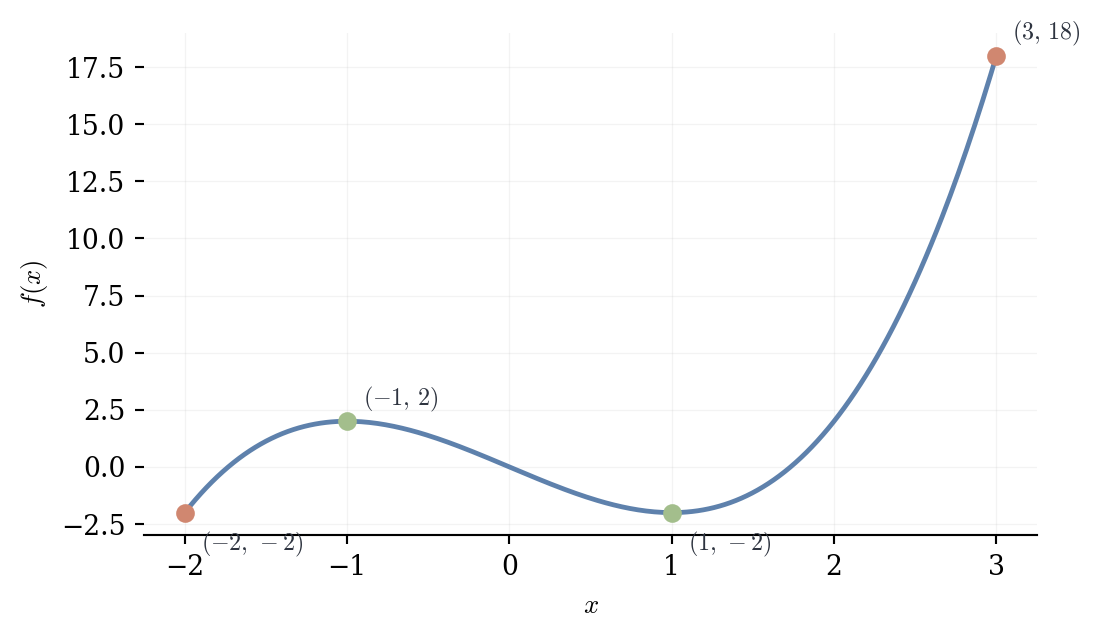
Example 1. Find the extreme values of \(f(x) = x^3 - 3x\) on \([-2, 3]\).
We have \(f'(x) = 3x^2 - 3 = 3(x-1)(x+1)\), so the critical points are \(x = \pm1\). The candidates are
| \(x\) | \(-2\) | \(-1\) | \(1\) | \(3\) |
|---|---|---|---|---|
| \(f(x)\) | \(-2\) | \(2\) | \(-2\) | \(18\) |
So the maximum is \(18\), attained at \(x = 3\), and the minimum is \(-2\), attained at both \(x = -2\) and \(x = 1\). The endpoints matter: the local maximum at \(x = -1\) is not the global one.
Example 2. Find the extreme values of \(f(x) = x^{2/3}\) on \([-1, 8]\).
For \(x \ne 0\) we have \(f'(x) = \dfrac{2}{3\sqrt[3]{x}}\) (the power rule for \(x > 0\), and evenness for \(x < 0\)), which is never \(0\). At \(x = 0\), the quotient \(\dfrac{f(h) - f(0)}{h} = h^{-1/3}\) is unbounded, so \(f'(0)\) does not exist and \(0\) is a critical point. The candidates are \(f(-1) = 1\), \(f(0) = 0\) and \(f(8) = 4\). So the minimum is \(0\) at \(x = 0\), a cusp, and the maximum is \(4\) at \(x = 8\). No equation \(f'(x) = 0\) would ever find the minimum.
14.3 Monotonicity and the First Derivative Test
To decide whether a critical point is a maximum, a minimum or neither, we look at how \(f'\) behaves around it. The tool is the connection between the sign of \(f'\) and the direction of \(f\), which is the Mean Value Theorem again.
Proposition 14.1 (Sign of the Derivative and Monotonicity) Let \(f\) be continuous on an interval \(I\) and differentiable at every interior point.
- If \(f' > 0\) at every interior point, then \(f\) is strictly increasing on \(I\).
- If \(f' < 0\) at every interior point, then \(f\) is strictly decreasing on \(I\).
- If \(f' \ge 0\) at every interior point, then \(f\) is nondecreasing on \(I\) (and similarly for \(f' \le 0\)).
TipProof
Let \(x < y\) in \(I\). By Theorem 9.3 on \([x,y]\) there is a \(\xi \in (x,y)\), an interior point of \(I\), with \(f(y) - f(x) = f'(\xi)(y - x)\). The sign of the right side is the sign of \(f'(\xi)\). \(\square\)
Continuity at the endpoints is what allows us to include them in \(I\). This is the statement we met as Problem 4(d) of the chapter on the derivative.
Theorem 14.3 (First Derivative Test) Let \(c\) be an interior point of an interval, let \(f\) be continuous at \(c\), and let \(f\) be differentiable on \((c - \delta, c) \cup (c, c+\delta)\) for some \(\delta > 0\).
- If \(f' > 0\) on \((c - \delta, c)\) and \(f' < 0\) on \((c, c+\delta)\), then \(f\) has a strict local maximum at \(c\).
- If \(f' < 0\) on \((c - \delta, c)\) and \(f' > 0\) on \((c, c+\delta)\), then \(f\) has a strict local minimum at \(c\).
- If \(f'\) has the same strict sign on both sides, then \(f\) has no local extremum at \(c\).
TipProof
- \(f\) is continuous on \((c-\delta, c]\) with \(f' > 0\) at the interior points, so it is strictly increasing there by Proposition 14.1, which gives \(f(x) < f(c)\) for \(x \in (c-\delta, c)\). Likewise \(f\) is strictly decreasing on \([c, c+\delta)\), so \(f(x) < f(c)\) for \(x \in (c, c+\delta)\). (2) is (1) applied to \(-f\). (3) If \(f' > 0\) on both sides, then \(f\) is strictly increasing on all of \((c-\delta, c+\delta)\) by Proposition 14.1, so \(f(x) < f(c) < f(y)\) for \(x < c < y\) and \(c\) is not an extremum. The case \(f' < 0\) is the same. \(\square\)
Neither \(f'(c) = 0\) nor even \(f'(c)\) existing is required, only continuity at \(c\). For \(f(x) = |x|\) we have \(f' = -1\) on the left and \(+1\) on the right, so \(0\) is a strict local minimum. For \(f(x) = x^3\) we have \(f' = 3x^2 > 0\) on both sides, so there is no extremum at \(0\), as we saw.
The same monotonicity argument also upgrades “local” to “global”.
Corollary 14.1 (Global Extremum from a Sign Change) Let \(f\) be continuous on an interval \(I\) and differentiable on its interior except possibly at \(c\). If \(f' < 0\) on the interior points of \(I\) to the left of \(c\) and \(f' > 0\) on those to the right, then \(f(x) > f(c)\) for all \(x \in I\), \(x \ne c\). The case with signs reversed gives a global maximum.
TipProof
By Proposition 14.1, \(f\) is strictly decreasing on \(I \cap (-\infty, c]\) and strictly increasing on \(I \cap [c, \infty)\). \(\square\)
14.4 The Second Derivative Test
If \(f'(c) = 0\) and \(f''(c)\) exists, the sign of \(f''(c)\) tells us how \(f'\) changes at \(c\), and so decides the first derivative test.
Theorem 14.4 (Second Derivative Test) Let \(f'(c) = 0\) and suppose \(f''(c)\) exists.
- If \(f''(c) > 0\), then \(f\) has a strict local minimum at \(c\).
- If \(f''(c) < 0\), then \(f\) has a strict local maximum at \(c\).
- If \(f''(c) = 0\), the test is inconclusive.
TipProof
Suppose \(f''(c) > 0\). Since \(f''(c)\) exists, \(f'\) is defined on a neighborhood of \(c\), and \(f\) is continuous at \(c\). Because \(f'(c) = 0\), \[ \frac{f'(c+h)}{h} = \frac{f'(c+h) - f'(c)}{h} \longrightarrow f''(c) > 0, \] so there is a \(\delta > 0\) such that \(\frac{f'(c+h)}{h} > 0\) for \(0 < |h| < \delta\). For \(h > 0\) this says \(f' > 0\) on \((c, c+\delta)\), and for \(h < 0\) it says \(f' < 0\) on \((c-\delta, c)\). By Theorem 14.3 (2), \(c\) is a strict local minimum. Case (2) is the same with \(-f\). \(\square\)
No continuity of \(f''\) is needed: only the existence of \(f''(c)\).
When \(f''(c) = 0\) anything can happen. The functions \(x^4\), \(-x^4\) and \(x^3\) all have \(f'(0) = f''(0) = 0\), and the origin is a minimum, a maximum and neither, respectively. In such cases one returns to the first derivative test.
14.4.1 Concavity Gives Global Information
In the chapter on differentiation techniques (Proposition 12.1) we saw that if \(f'' > 0\) on an interval, the graph lies strictly above each tangent line. At a critical point the tangent line is horizontal, which gives the following.
Corollary 14.2 (Critical Points of Convex and Concave Functions) Let \(f'' > 0\) on an interval \(I\) and let \(c \in I\) with \(f'(c) = 0\). Then \(f(x) > f(c)\) for all \(x \in I\), \(x \ne c\): \(c\) is the global minimum of \(f\) on \(I\). If \(f'' < 0\) on \(I\), then \(c\) is the global maximum.
TipProof
By Proposition 12.1 with \(a = c\), \(f(x) > f(c) + f'(c)(x - c) = f(c)\). The concave case is the same with \(-f\). \(\square\)
Unlike the second derivative test, this uses \(f''\) on the whole interval, and in return it gives a global answer with no endpoint analysis.
14.5 What Goes Wrong
A critical point need not be an extremum. \(x^3\) at \(0\) is the standard example, and the first derivative test (3) says when this happens.
Local is not global. The function \(x^3 - 3x\) has a local maximum at \(-1\) and a local minimum at \(1\), but on all of \(\mathbb{R}\) it has neither a largest nor a smallest value, since it tends to \(\pm\infty\). Theorem 14.2 compares candidates only on a closed bounded interval, where the Extreme Value Theorem guarantees that an optimum exists.
On other domains, the guarantee is gone. On \((0,\infty)\) the function \(f(x) = x\) has no minimum, and \(\frac1x\) has neither a maximum nor a minimum. When the domain is open or unbounded, we use Corollary 14.1 or Corollary 14.2, or compare with the behavior at the ends. An answer found as a critical point may not be an optimum, and that is a claim to be proved.
Ties. The maximum may be attained at more than one point, and the minimum in Example 1 is. The statement is about the value, which is unique.
Endpoints do not have to be critical. The derivative test does not apply to them, since \(f'\) at an endpoint is not an interior derivative. They must be checked separately, as in Example 1.
14.6 Optimization Problems
Most of the work in an applied problem is modeling, and the calculus step is the shortest part. The pattern is the same each time.
- Name the quantity to optimize and write it in terms of the variables.
- Use the constraints to reduce to a function of one variable, and find its domain.
- Find the critical points, and decide which gives the optimum. On a closed interval, compare with the endpoints. Otherwise use a sign change or concavity.
- Check that the answer makes sense in the original problem.
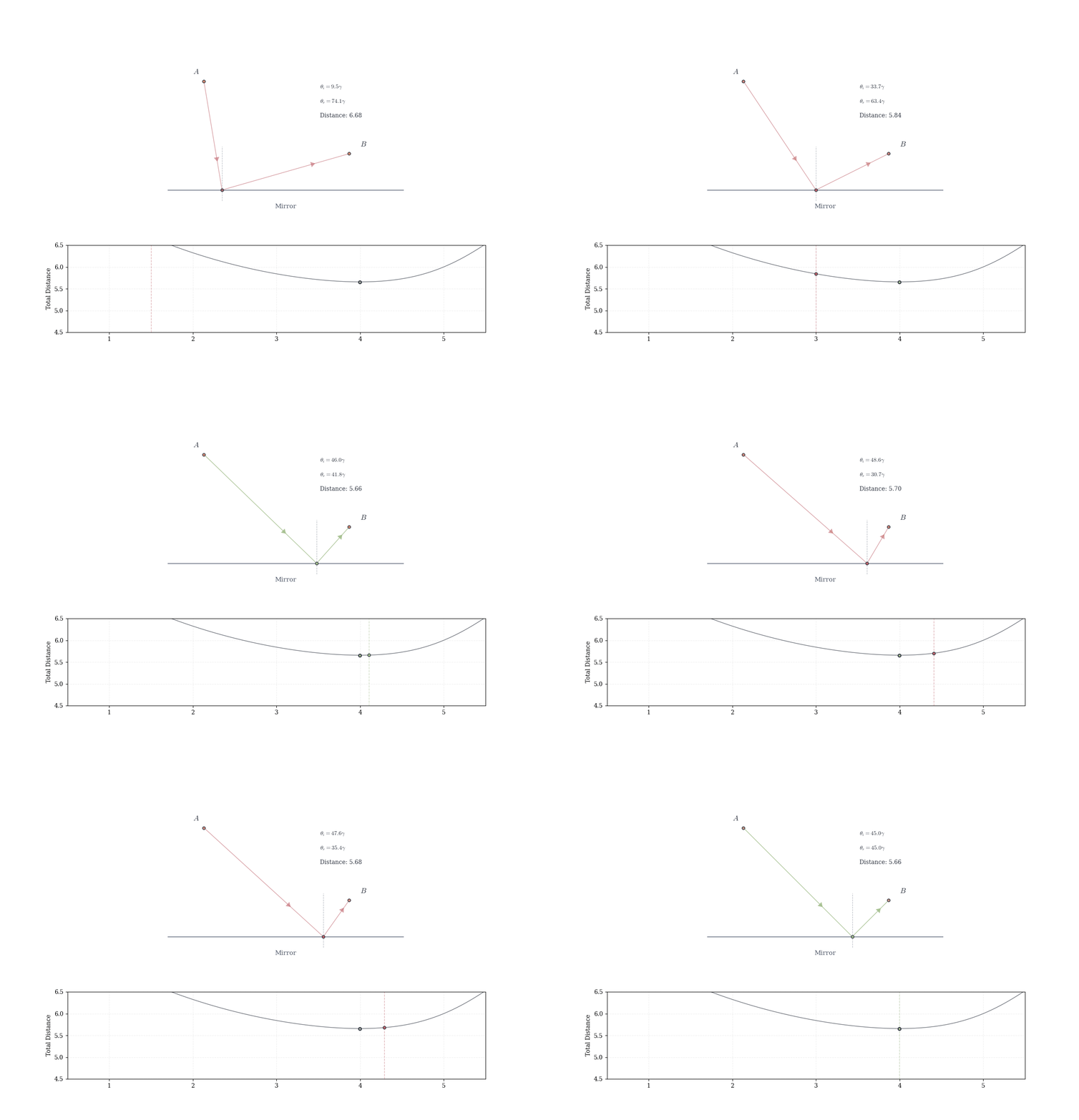
Example 3 (the shortest path by reflection). A point \(A = (0, a)\) and a point \(B = (d, b)\) lie above a mirror, the \(x\)-axis, with \(a, b > 0\). For which point \((x, 0)\) on the mirror is the path from \(A\) to \((x,0)\) to \(B\) shortest?
The length of the path is \[ T(x) = \sqrt{x^2 + a^2} + \sqrt{(d-x)^2 + b^2}, \qquad x \in \mathbb{R}. \] Differentiating, \[ T'(x) = \frac{x}{\sqrt{x^2 + a^2}} - \frac{d - x}{\sqrt{(d-x)^2 + b^2}}. \] Each fraction is the sine of the angle that the corresponding segment makes with the normal (the vertical) to the mirror, so \(T'(x) = \sin\theta_1 - \sin\theta_2\). Differentiating once more, \[ T''(x) = \frac{a^2}{(x^2+a^2)^{3/2}} + \frac{b^2}{((d-x)^2+b^2)^{3/2}} > 0. \] So \(T\) is convex, and by Corollary 14.2 its critical point is the global minimum. The critical point solves \(\sin\theta_1 = \sin\theta_2\), that is, the angle of incidence equals the angle of reflection.
As a check, take \(a = b = 1\) and \(d = 2\). The critical point is \(x = 1\) (by symmetry), with \(T(1) = 2\sqrt2 \approx 2.8284\), while \(T(0.9) = \sqrt{1.81} + \sqrt{2.21} \approx 2.8320\), which is larger.
This is the form in which Fermat stated the principle that light takes the path of least time: the reflection law is the shortest-path problem, and in Problem 4 the refraction law is the same computation with two speeds.
Example 4 (rectangles of fixed perimeter). Among rectangles of perimeter \(P\), which has the largest area?
With sides \(x\) and \(y\) we have \(y = \frac P2 - x\), and the area is \(A(x) = x\left(\frac P2 - x\right)\) for \(x \in \left(0, \frac P2\right)\). Then \(A'(x) = \frac P2 - 2x\), which vanishes at \(x = \frac P4\), and \(A'' = -2 < 0\) everywhere. By Corollary 14.2, \(x = \frac P4\) gives the global maximum on the interval. So the optimal rectangle is the square, with area \(\frac{P^2}{16}\).
As a check, take \(P = 8\): the square of side \(2\) has area \(4 = \frac{64}{16}\), while a \(1 \times 3\) rectangle has area \(3\).
The same conclusion says \(xy \le \left(\frac{x+y}{2}\right)^2\) for all \(x, y > 0\), which is an inequality between the arithmetic and the geometric mean (Problem 3).
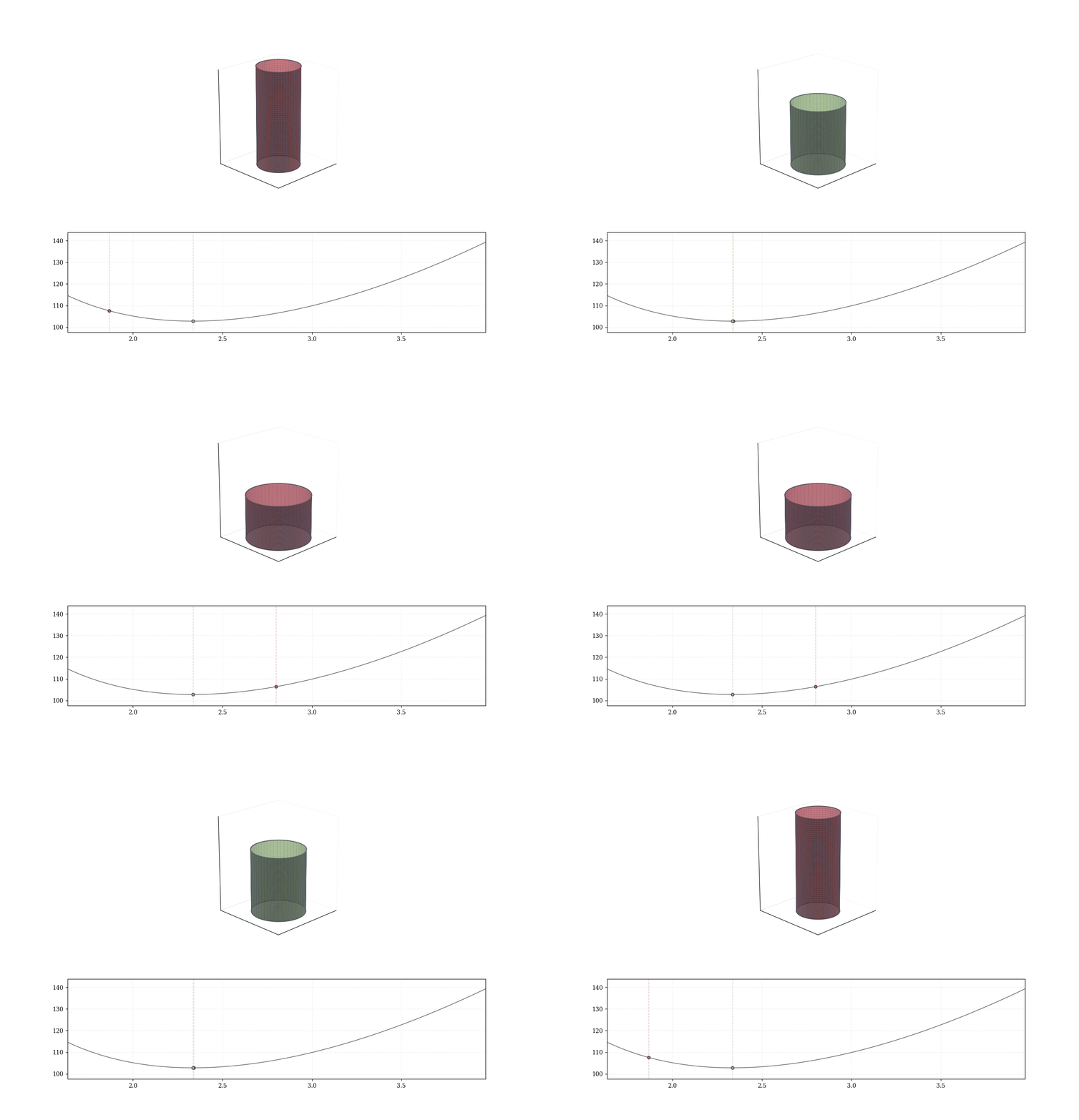
Example 5 (the can). A cylindrical can has volume \(V\). What radius and height minimize the surface area?
From \(\pi r^2h = V\) we get \(h = \frac{V}{\pi r^2}\), and the surface area (two ends and a side) is \[ S(r) = 2\pi r^2 + 2\pi rh = 2\pi r^2 + \frac{2V}{r}, \qquad r > 0. \] Then \(S'(r) = 4\pi r - \frac{2V}{r^2}\), which vanishes when \(r^3 = \frac{V}{2\pi}\), and \(S''(r) = 4\pi + \frac{4V}{r^3} > 0\) for all \(r > 0\). By Corollary 14.2, this is the global minimum. At this radius \(h = \frac{V}{\pi r^2} = \frac{2\pi r^3}{\pi r^2} = 2r\): the optimal can is as tall as it is wide.
As a check, with \(V = 2\pi\) we get \(r = 1\) and \(h = 2\), so \(S = 6\pi \approx 18.850\). At \(r = 1.1\) the area is \(\approx 19.026\), and at \(r = 0.9\) it is \(\approx 19.052\).
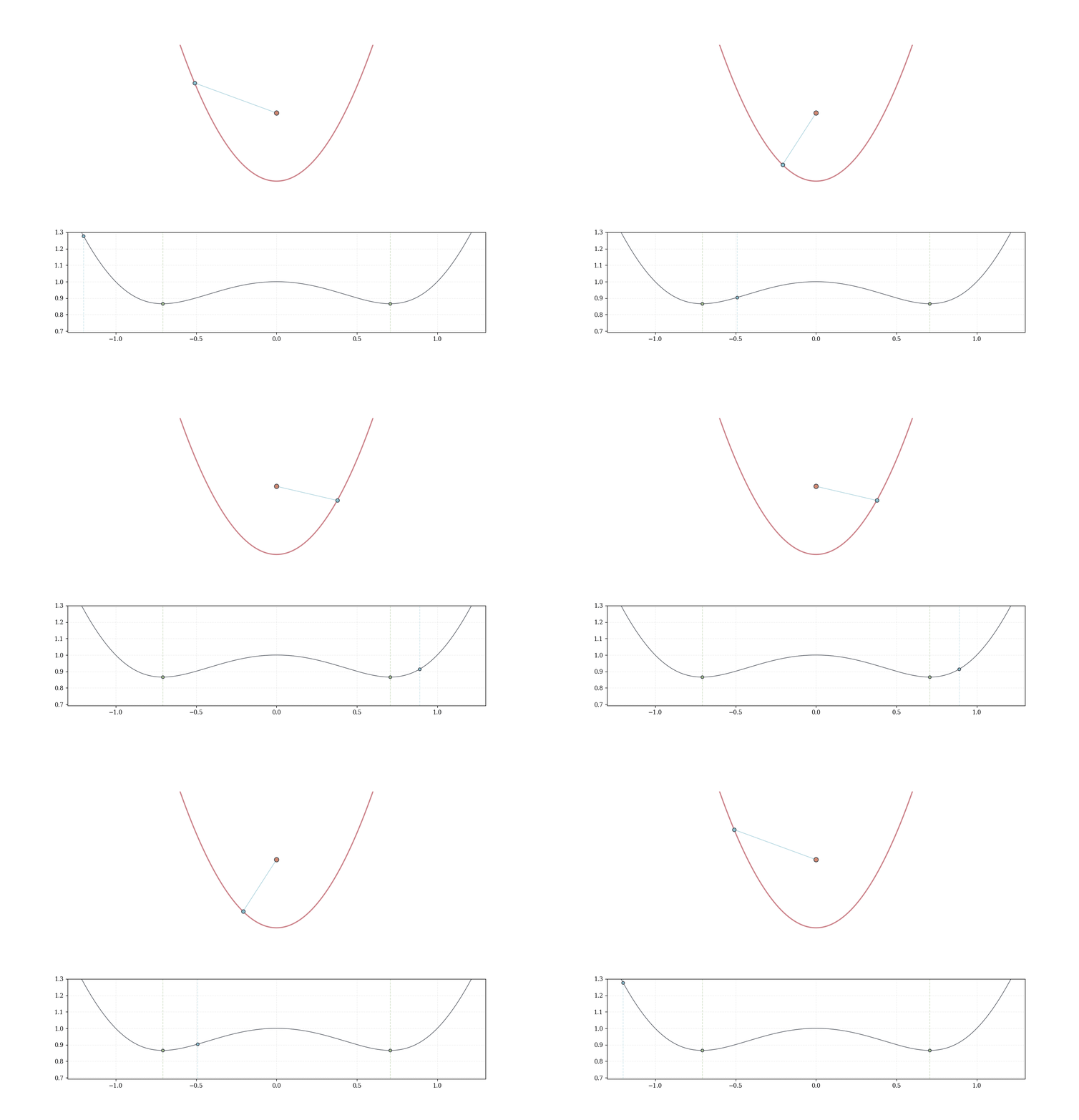
Example 6 (the nearest point). Find the point on the parabola \(y = x^2\) nearest to \((0, 1)\).
The squared distance from \((x, x^2)\) to \((0,1)\) is \[ g(x) = x^2 + (x^2 - 1)^2 = x^4 - x^2 + 1. \] Minimizing \(g\) is the same as minimizing the distance, because the square root is increasing. We have \(g'(x) = 4x^3 - 2x = 2x(2x^2 - 1)\), with critical points \(0\) and \(\pm\frac{1}{\sqrt2}\). Here \(g'' = 12x^2 - 2\) changes sign, so concavity does not decide things globally, and we use signs. The factor \(2x\) and the factor \(2x^2 - 1\) give
| \(x\) | \(< -\frac1{\sqrt2}\) | \(-\frac1{\sqrt2}\) to \(0\) | \(0\) to \(\frac1{\sqrt2}\) | \(> \frac1{\sqrt2}\) |
|---|---|---|---|---|
| sign of \(g'\) | \(-\) | \(+\) | \(-\) | \(+\) |
So \(g\) decreases, increases, decreases, increases. By Corollary 14.1 applied on \((-\infty, 0]\) and on \([0, \infty)\) separately, the smallest value on each half-line is \(g\left(\pm\frac{1}{\sqrt2}\right) = \frac14 - \frac12 + 1 = \frac34\), and \(g(0) = 1\) is a local maximum. The nearest points are \(\left(\pm\frac{1}{\sqrt2}, \frac12\right)\), at distance \(\frac{\sqrt3}{2}\).
The answer has a geometric meaning. For a point \((x_0,y_0)\) and a curve \(y = y(x)\), the squared distance has derivative \(2(x - x_0) + 2(y - y_0)y' = 0\) at a critical point: the vector from \((x_0,y_0)\) to the curve is perpendicular to the tangent \((1, y')\). Here the vector from \((0,1)\) to \(\left(\frac{1}{\sqrt2}, \frac12\right)\) is \(\left(\frac{1}{\sqrt2}, -\frac12\right)\) and the tangent is \((1, \sqrt2)\), and their dot product is \(\frac{1}{\sqrt2} - \frac{\sqrt2}{2} = 0\).
14.7 Where This Leads
Optimization uses the derivative to find where a quantity is extremal. The next chapter uses it to compare how two quantities change when they are tied by an equation: a ladder sliding down a wall, a balloon filling with air. The tool is implicit differentiation, with time as the variable.
TipKey Ideas
- The Extreme Value Theorem gives existence of extrema on \([a,b]\), and the derivative makes the search finite: an interior extremum is at a critical point, where \(f' = 0\) or \(f'\) does not exist (Fermat).
- On a closed bounded interval, compare \(f\) at the endpoints and the critical points (Theorem 14.2). Extrema can occur at endpoints and at points where \(f\) is not differentiable.
- The sign of \(f'\) controls monotonicity (by the Mean Value Theorem). A change of sign from \(+\) to \(-\) gives a maximum, from \(-\) to \(+\) a minimum, and no change gives neither.
- If \(f'(c) = 0\) and \(f''(c) \ne 0\), the second derivative test decides. If \(f''(c) = 0\) it is silent.
- If \(f'' > 0\) on a whole interval, a critical point is the global minimum there. This is the quickest way to settle most applied problems.
- A critical point is a candidate. Local is not global, and on open or unbounded domains the existence of an optimum has to be argued.
WarningProblem Set
Extreme values.
Find the maximum and minimum of \(f(x) = x^3 - 6x^2 + 9x\) on \([0, 5]\).
Find the maximum and minimum of \(f(x) = |x^2 - 1|\) on \([-2, 2]\).
Show that \(f(x) = x^3 - 3x\) has a local maximum and a local minimum on \(\mathbb{R}\), but no global maximum or minimum.
A rectangle is inscribed in a semicircle of radius \(R\) with one side on the diameter. Find the dimensions that maximize its area.
The arithmetic–geometric mean inequality. Let \(a, b > 0\) and \(f(x) = x + \dfrac{ab}{x}\) for \(x > 0\).
Find the critical point of \(f\) and show that it is the global minimum.
Deduce that \(\dfrac{a+b}{2} \ge \sqrt{ab}\), with equality if and only if \(a = b\).
Find the point on the curve \(xy = 1\), \(x > 0\), nearest to the origin, and the distance.
The box. A square sheet of side \(L\) has a square of side \(x\) cut from each corner, and the sides are folded up to form a box without a lid. Find the \(x\) that maximizes the volume, and the maximal volume.
An open-top cylindrical can (a base and a side, no lid) has volume \(V\). Find the ratio \(h/r\) that minimizes the surface area.
When the second derivative test fails. Suppose \(f'(c) = f''(c) = 0\) and \(f'''(c) > 0\). Show that \(f\) has no local extremum at \(c\). (Hint: use the sign of \(f''\) near \(c\) to find the sign of \(f'\) near \(c\).)
WarningSolutions
\(f'(x) = 3x^2 - 12x + 9 = 3(x-1)(x-3)\), so the critical points are \(1\) and \(3\). The values are \(f(0) = 0\), \(f(1) = 4\), \(f(3) = 0\), \(f(5) = 20\). The maximum is \(20\) at \(x = 5\), and the minimum is \(0\) at \(x = 0\) and \(x = 3\).
\(f(x) = |x^2 - 1|\) equals \(x^2 - 1\) for \(|x| \ge 1\) and \(1 - x^2\) for \(|x| < 1\). At \(x = \pm1\) the function is not differentiable (the one-sided derivatives are \(\pm2\)), so these are critical points. At \(x = 0\), \(f' = -2x = 0\). The values are \(f(\pm2) = 3\), \(f(\pm1) = 0\), \(f(0) = 1\). The maximum is \(3\) at \(x = \pm2\) and the minimum is \(0\) at \(x = \pm1\).
\(f' = 3(x-1)(x+1)\) is positive for \(x < -1\), negative on \((-1,1)\) and positive for \(x > 1\), so by the first derivative test \(x = -1\) is a local maximum and \(x = 1\) a local minimum. But \(f(x) \to \infty\) as \(x \to \infty\) and \(f(x) \to -\infty\) as \(x \to -\infty\), so there is no global maximum or minimum.
Let the rectangle have width \(2x\) and height \(y = \sqrt{R^2 - x^2}\) for \(x \in (0, R)\). The area is \(A(x) = 2x\sqrt{R^2 - x^2}\), with \[ A'(x) = 2\sqrt{R^2 - x^2} - \frac{2x^2}{\sqrt{R^2 - x^2}} = \frac{2R^2 - 4x^2}{\sqrt{R^2 - x^2}}. \] This is positive for \(x < \frac{R}{\sqrt2}\) and negative after, so by Corollary 14.1 the maximum is at \(x = \frac{R}{\sqrt2}\). The rectangle has width \(R\sqrt2\) and height \(\frac{R}{\sqrt2}\), and the maximal area is \(R^2\).
\(f'(x) = 1 - \frac{ab}{x^2}\) vanishes at \(x = \sqrt{ab}\), and \(f''(x) = \frac{2ab}{x^3} > 0\) on \((0,\infty)\). By Corollary 14.2, \(\sqrt{ab}\) is the global minimum, with \(f(\sqrt{ab}) = 2\sqrt{ab}\).
Take \(x = a\) in \(f(x) \ge f(\sqrt{ab})\): \(a + b \ge 2\sqrt{ab}\). Equality holds only at the minimizer, so \(a = \sqrt{ab}\), i.e. \(a = b\). Conversely, if \(a = b\) both sides equal \(a\).
Minimize \(d^2 = x^2 + \frac{1}{x^2}\) for \(x > 0\). Then \((d^2)' = 2x - \frac{2}{x^3}\) vanishes when \(x^4 = 1\), i.e. \(x = 1\), and \((d^2)'' = 2 + \frac{6}{x^4} > 0\). By Corollary 14.2, \(x = 1\) is the global minimum. The point is \((1,1)\) and the distance is \(\sqrt2\).
The volume is \(V(x) = x(L - 2x)^2\) on \([0, \frac L2]\). Then \[ V'(x) = (L - 2x)^2 - 4x(L - 2x) = (L - 2x)(L - 6x), \] with critical points \(x = \frac L6\) and \(x = \frac L2\) (an endpoint). Since \(V(0) = V(\frac L2) = 0\) and \(V\!\left(\frac L6\right) = \frac L6\cdot\frac{4L^2}{9} = \frac{2L^3}{27} > 0\), the maximum is at \(x = \frac L6\) by Theorem 14.2, with volume \(\frac{2L^3}{27}\). As a check, with \(L = 6\): \(x = 1\) and \(V = 1\cdot 16 = 16 = \frac{2\cdot216}{27}\).
From \(h = \frac{V}{\pi r^2}\), \(S(r) = \pi r^2 + 2\pi rh = \pi r^2 + \frac{2V}{r}\). Then \(S'(r) = 2\pi r - \frac{2V}{r^2}\) vanishes at \(r^3 = \frac V\pi\), and \(S'' = 2\pi + \frac{4V}{r^3} > 0\), so it is the global minimum. There \(h = \frac{V}{\pi r^2} = \frac{\pi r^3}{\pi r^2} = r\), so \(\frac hr = 1\).
Since \(f'''(c) = \lim_{h\to0}\frac{f''(c+h) - f''(c)}{h} = \lim\frac{f''(c+h)}{h} > 0\), there is \(\delta > 0\) with \(f'' < 0\) on \((c-\delta, c)\) and \(f'' > 0\) on \((c, c+\delta)\). By Proposition 14.1 applied to \(f'\) (which is continuous at \(c\), being differentiable there), \(f'\) is strictly decreasing on \((c-\delta, c]\) and strictly increasing on \([c, c+\delta)\). Since \(f'(c) = 0\), this gives \(f' > 0\) on both sides of \(c\). By Theorem 14.3 (3), \(f\) has no local extremum at \(c\). (The case \(f'''(c) < 0\) is the same with signs reversed.)