3 Convergence of Sequences
The previous chapter asked what a sequence does in the long run and answered with pictures and a challenge-and-response game. This chapter turns the game into a definition, and the definition into theorems. The definition looks fussy, and the fussiness is the point: it is what allows limits, derivatives and integrals to be proved rather than believed.
3.1 Definition and Convergence
3.1.1 Measuring Closeness
Convergence needs exactly one thing from the real line: a way to say how far apart two numbers are. For \(p, q \in \mathbb{R}\) we use \[ d(p, q) = |p - q|, \] which has three properties:
- Non-negativity: \(d(p, q) \ge 0\), with equality if and only if \(p = q\).
- Symmetry: \(d(p, q) = d(q, p)\).
- Triangle inequality: \(d(p, r) \le d(p, q) + d(q, r)\).
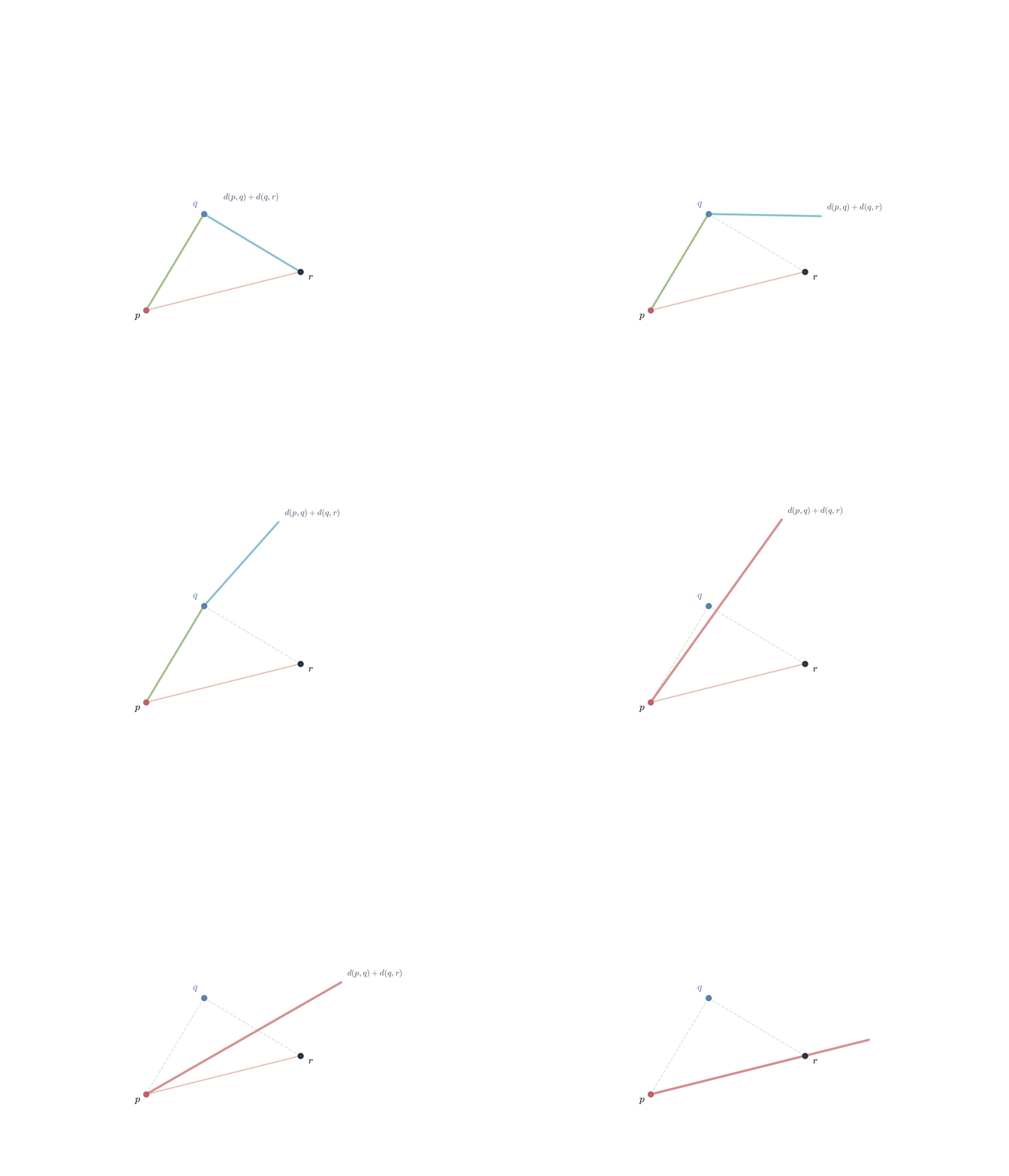
The third does the work: a detour through \(q\) is never shorter than going straight from \(p\) to \(r\). Nearly every proof in this chapter is a triangle inequality in disguise. The definition below, and the first few theorems, use nothing else about \(\mathbb{R}\). Replace the line by the plane and \(|p-q|\) by the usual distance, and they go through word for word.
3.1.2 Formalizing Closeness
Fix a candidate limit \(a\). In the game, an adversary names a tolerance \(\varepsilon > 0\), and you must reply with a starting point \(N\) after which every term lies within \(\varepsilon\) of \(a\). If you can always reply, however small the tolerance, the sequence converges to \(a\).
Definition 3.1 (Convergence) A sequence \((a_n)\) converges to \(a \in \mathbb{R}\) if for every \(\varepsilon > 0\) there is an \(N \in \mathbb{N}\) such that \[ |a_n - a| < \varepsilon \qquad \text{for all } n \ge N. \] We write \(a_n \to a\) or \(\lim_{n\to\infty} a_n = a\). A sequence that converges to no real number diverges.
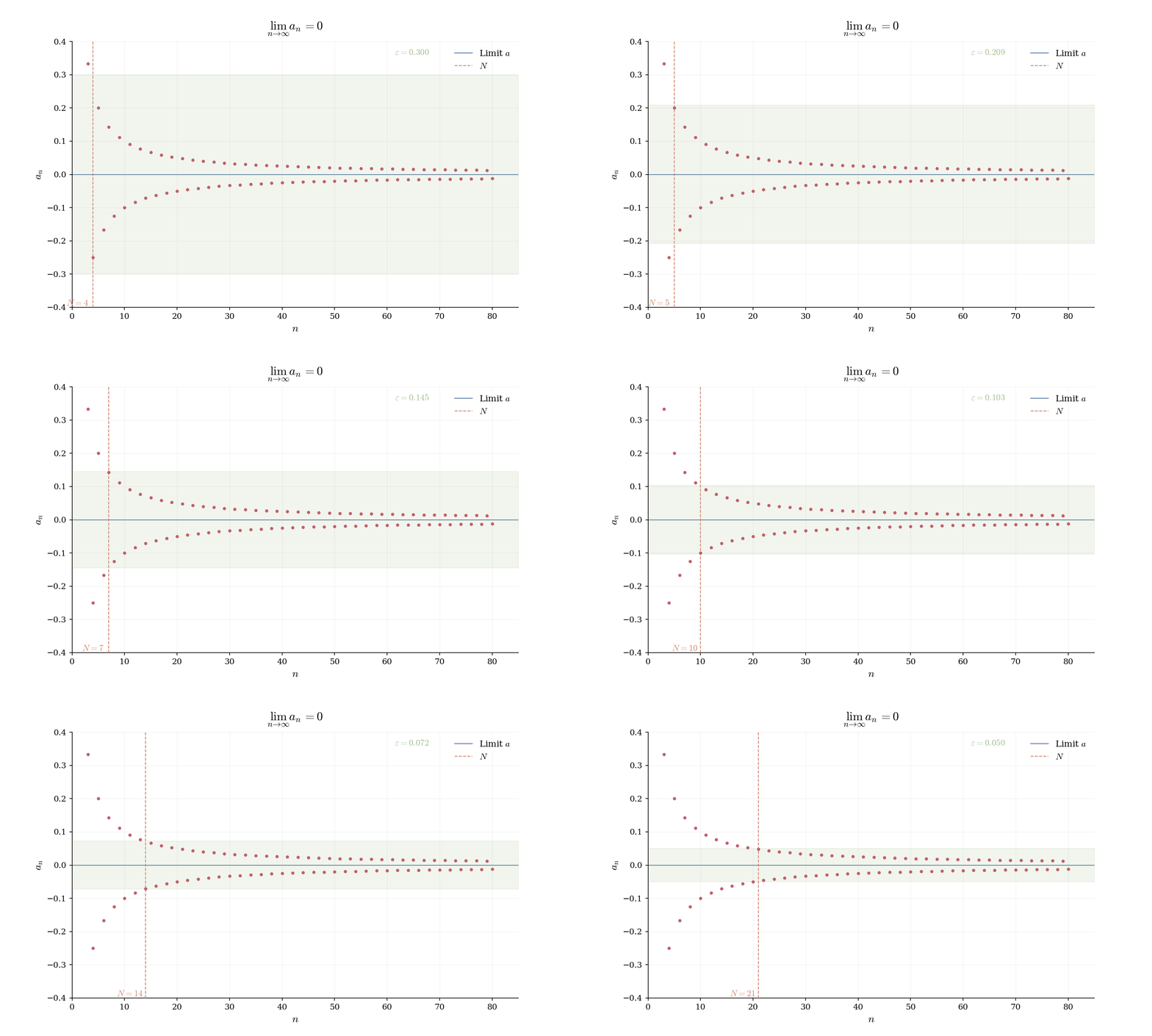
In the language of the last chapter: for every \(\varepsilon > 0\), eventually \(|a_n - a| < \varepsilon\). The order of the quantifiers matters. The adversary moves first, and \(N\) may depend on \(\varepsilon\); it usually must, since a smaller tolerance demands a later start.
An equivalent formulation is often easier to picture: \(a_n \to a\) if and only if every interval \((a-\varepsilon, a+\varepsilon)\) contains all but finitely many terms. Two consequences follow. Changing finitely many terms changes neither whether a sequence converges nor its limit, since you can always choose \(N\) beyond the changes. And convergence is a statement about the tail, so no finite amount of data can establish it.
Example 1. \(\tfrac1n \to 0\).
Scratch work. We want \(\tfrac1n < \varepsilon\), which happens exactly when \(n > \tfrac1\varepsilon\). So \(N\) should be any integer above \(\tfrac1\varepsilon\).
TipProof
Let \(\varepsilon > 0\) and choose an integer \(N > 1/\varepsilon\). For \(n \ge N\), \[ \left|\tfrac1n - 0\right| = \tfrac1n \le \tfrac1N < \varepsilon. \qquad \square \]
(That such an integer exists is the Archimedean property: no real number exceeds every integer.) The proof is the scratch work run backwards: solve for \(N\) first, then present the answer as if it were obvious. Most \(\varepsilon\)–\(N\) proofs work this way.
Example 2. \(a_n = \dfrac{3n-1}{n+2} \to 3\).
TipProof
\(|a_n - 3| = \dfrac{7}{n+2} < \dfrac7n\), so it suffices that \(n > 7/\varepsilon\). Given \(\varepsilon > 0\), take an integer \(N > 7/\varepsilon\). Then \(|a_n - 3| < \varepsilon\) for all \(n \ge N\). \(\square\)
The exact answer is a little better than this bound. For \(\varepsilon = 0.5\) the sharpest choice is \(N = 13\), and the picture shows the tail entering the band and staying there.
To show a sequence does not converge to \(a\), negate the definition: there is some \(\varepsilon > 0\) such that for every \(N\) there is an \(n \ge N\) with \(|a_n - a| \ge \varepsilon\). One bad tolerance, and the terms keep escaping it forever.
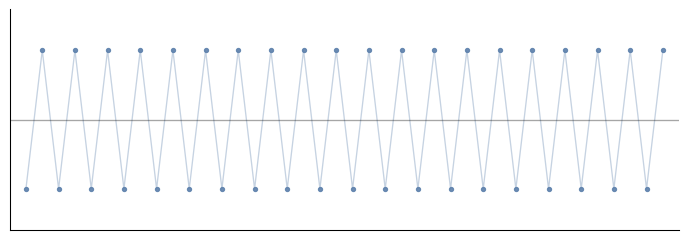
Example 3. \(\big((-1)^n\big)\) diverges.
TipProof
Suppose \(a_n \to a\). Taking \(\varepsilon = 1\), there is an \(N\) with \(|a_n - a| < 1\) for all \(n \ge N\). Then for \(n \ge N\), \[ 2 = |a_{n+1} - a_n| \le |a_{n+1} - a| + |a - a_n| < 2, \] which is absurd. \(\square\)
3.1.3 Uniqueness and Boundedness
A definition that speaks of “the limit” had better deliver only one.
Theorem 3.1 (Uniqueness of Limits) If \(a_n \to a\) and \(a_n \to a'\), then \(a = a'\).
TipProof
Suppose \(a \ne a'\) and put \(\varepsilon = \tfrac12 |a - a'| > 0\). There are \(N_1, N_2\) with \(|a_n - a| < \varepsilon\) for \(n \ge N_1\) and \(|a_n - a'| < \varepsilon\) for \(n \ge N_2\). For \(n \ge \max(N_1, N_2)\) both hold, and \[ |a - a'| \le |a - a_n| + |a_n - a'| < 2\varepsilon = |a - a'|, \] a contradiction. \(\square\)
The proof is a picture in words: two intervals of radius \(\varepsilon\) around different points, chosen small enough not to overlap, cannot both contain the whole tail.
Next, what does convergence say about the terms themselves? Recall that \((a_n)\) is bounded if some \(M\) satisfies \(|a_n| \le M\) for all \(n\).
Theorem 3.2 (Convergent Sequences are Bounded) If \(a_n \to a\), then \((a_n)\) is bounded.
TipProof
Take \(\varepsilon = 1\): there is an \(N\) with \(|a_n - a| < 1\), hence \(|a_n| < |a| + 1\), for all \(n \ge N\). The finitely many terms before \(N\) cannot escape either, so \[ M = \max\big(|a_1|, \dots, |a_{N-1}|,\ |a| + 1\big) \] bounds every term. \(\square\)
The proof has the same structure as the definition: control the tail with \(\varepsilon\), handle the finite remainder by brute force. The converse is false, and Example 3 is the counterexample: \((-1)^n\) is bounded and diverges. The contrapositive is useful, though: an unbounded sequence cannot converge.
3.2 Algebra of Limits
Limits would be of little use if each one required an \(\varepsilon\)–\(N\) proof. The limit laws say they don’t: limits pass through arithmetic as one would hope.
Theorem 3.3 (Limit Laws) Let \(a_n \to a\) and \(b_n \to b\). Then
- \(a_n \pm b_n \to a \pm b\).
- \(a_n b_n \to ab\).
- \(c\,a_n \to c\,a\) for every \(c \in \mathbb{R}\).
- If \(b \neq 0\), then \(b_n \ne 0\) for all large \(n\), and \(a_n / b_n \to a / b\).
Every proof below makes the same move: split \(\varepsilon\) among the sources of error and take \(N\) to be the largest threshold involved. The one place needing care is the product, where an error in \(b_n\) gets multiplied by \(a_n\). That is why boundedness was proved first.
TipProof
Given \(\varepsilon > 0\), choose \(N_1, N_2\) with \(|a_n - a| < \varepsilon/2\) for \(n \ge N_1\) and \(|b_n - b| < \varepsilon/2\) for \(n \ge N_2\). For \(n \ge \max(N_1, N_2)\), \[ |(a_n \pm b_n) - (a \pm b)| \le |a_n - a| + |b_n - b| < \varepsilon. \]
By Theorem 3.2 there is \(M > 0\) with \(|a_n| \le M\) for all \(n\). Then \[ |a_n b_n - ab| = |a_n(b_n - b) + (a_n - a)b| \le M\,|b_n - b| + |b|\,|a_n - a|. \] Given \(\varepsilon > 0\), choose \(N\) so that for \(n \ge N\) we have \(|b_n - b| < \dfrac{\varepsilon}{2M}\) and \(|a_n - a| < \dfrac{\varepsilon}{2(|b|+1)}\). The right side is then less than \(\varepsilon/2 + \varepsilon/2 = \varepsilon\).
The constant sequence \(c, c, c, \dots\) converges to \(c\), since \(|c - c| = 0 < \varepsilon\). Apply (2).
Apply the definition with \(\varepsilon = |b|/2\): for \(n \ge N_0\) we have \(|b_n - b| < |b|/2\), so \(|b_n| > |b|/2 > 0\). For such \(n\), \[ \left|\frac{1}{b_n} - \frac1b\right| = \frac{|b - b_n|}{|b_n|\,|b|} < \frac{2}{b^2}\,|b_n - b|, \] which is below \(\varepsilon\) once \(|b_n - b| < \varepsilon b^2/2\). So \(1/b_n \to 1/b\), and \(a_n / b_n = a_n \cdot \tfrac1{b_n} \to a/b\) by (2). \(\square\)
Corollary 3.1 (Powers) If \(a_n \to a\) and \(p \in \mathbb{N}\), then \(a_n^p \to a^p\).
TipProof
Induct on \(p\). The case \(p = 1\) is the hypothesis, and \(a_n^{p+1} = a_n^p \cdot a_n \to a^p \cdot a\) by the product law. \(\square\)
Example 4. With these tools, Example 2 takes one line: \[ \frac{3n-1}{n+2} = \frac{3 - 1/n}{1 + 2/n} \to \frac{3 - 0}{1 + 0} = 3. \] The laws are a conditional license: they apply only once you know each piece converges. Writing \(n \cdot \tfrac1n\) as “\(\infty \cdot 0\)” and concluding anything is the mistake they don’t protect you from. The product \(n \cdot \tfrac1n\) is constantly \(1\), while \(n \cdot \tfrac1{n^2} \to 0\) and \(n^2 \cdot \tfrac1n\) diverges.
3.3 Comparison Theorems
If one sequence stays below another, its limit should stay below the other’s limit.
Theorem 3.4 (Comparison Theorem) Suppose \(a_n \le b_n\) for all \(n\), with \(a_n \to a\) and \(b_n \to b\). Then \(a \le b\).
TipProof
Suppose instead \(a > b\) and let \(\varepsilon = \tfrac12(a-b) > 0\). For \(n\) large enough, both \(|a_n - a| < \varepsilon\) and \(|b_n - b| < \varepsilon\), so \[ a_n > a - \varepsilon = \frac{a+b}{2} = b + \varepsilon > b_n, \] contradicting \(a_n \le b_n\). \(\square\)
Strict inequalities do not survive: \(0 < \tfrac1n\) for every \(n\), yet both sequences tend to \(0\). One special case gets used constantly: taking one sequence constant shows that if \(a_n \ge m\) for all \(n\) and \(a_n \to a\), then \(a \ge m\) (and likewise for upper bounds).
The comparison theorem needs both limits to exist. The squeeze theorem drops that requirement for the middle sequence, at the price that the outer two must agree.
Theorem 3.5 (Squeeze Theorem) If \(a_n \le b_n \le c_n\) for all \(n\) and \(a_n \to a\) and \(c_n \to a\), then \(b_n \to a\).
TipProof
Given \(\varepsilon > 0\), choose \(N\) so that \(|a_n - a| < \varepsilon\) and \(|c_n - a| < \varepsilon\) for \(n \ge N\). For such \(n\), \[ a - \varepsilon < a_n \le b_n \le c_n < a + \varepsilon, \] so \(|b_n - a| < \varepsilon\). \(\square\)
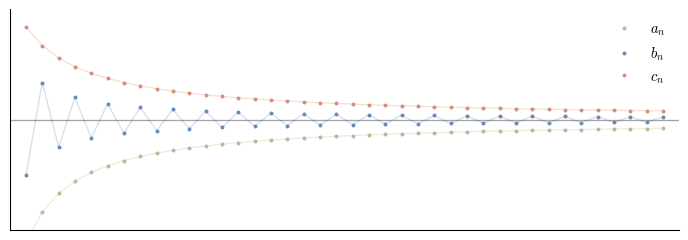
To show that an ugly sequence converges, you don’t need to understand it. You need two friendly sequences, one on each side, closing in on the same value.
Example 5. \(\dfrac{(-1)^n}{n} \to 0\), since \(-\tfrac1n \le \tfrac{(-1)^n}{n} \le \tfrac1n\) and both bounds tend to \(0\). The sequence is not monotone, so the theorem in the next section would not apply, but it converges anyway.
WarningSolution
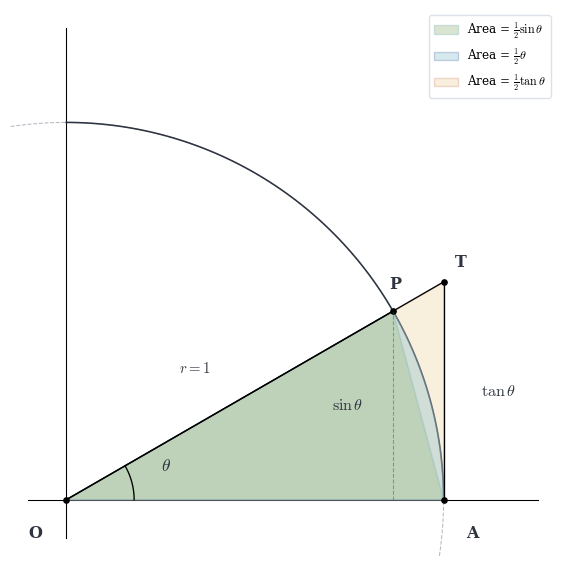
Write \(\theta = 1/n \in (0, 1]\); note \(1 < \pi/2\). In the unit circle let \(P = (\cos\theta, \sin\theta)\), \(A = (1, 0)\), and let \(T = (1, \tan\theta)\) be where the ray \(OP\) meets the tangent line \(x = 1\).
Triangle \(OAP\) lies inside the sector, which lies inside triangle \(OAT\). Their areas are \(\tfrac12\sin\theta\), \(\tfrac12\theta\) and \(\tfrac12\tan\theta\), so \[ \sin\theta < \theta < \tan\theta. \] Dividing by \(\sin\theta > 0\) and taking reciprocals gives \[ \cos\theta < \frac{\sin\theta}{\theta} < 1. \] For the left side we need a lower bound we can control. Since \(1 - \cos\theta = 2\sin^2(\theta/2)\) and \(\sin(\theta/2) < \theta/2\), we get \(1 - \cos\theta < \theta^2/2\). Hence for every \(n\), \[ 1 - \frac{1}{2n^2} < \frac{\sin(1/n)}{1/n} < 1. \] The left side tends to \(1\) by the limit laws and \(\tfrac1n \to 0\), and the right side is constant. By Theorem 3.5, \(a_n \to 1\). \(\square\)
3.4 Monotone Convergence Theorem
Boundedness is necessary for convergence (Theorem 3.2) but not sufficient: \(\big((-1)^n\big)\) is bounded and diverges. What it lacks is direction. A sequence that can only move one way, and is bounded, has nowhere to go but toward a limit.
Recall from the previous chapter that \((a_n)\) is nondecreasing if \(a_{n+1} \ge a_n\) for all \(n\), nonincreasing if \(a_{n+1} \le a_n\) for all \(n\), and monotone if it is one or the other.
Theorem 3.6 (Monotone Convergence Theorem) A nondecreasing sequence that is bounded above converges, to its supremum. A nonincreasing sequence that is bounded below converges, to its infimum. In particular, every bounded monotone sequence converges.
TipProof
Let \((a_n)\) be nondecreasing and bounded above. The set \(\{a_n : n \in \mathbb{N}\}\) is nonempty and bounded above, so by the least upper bound property of \(\mathbb{R}\) it has a supremum \(M\). Let \(\varepsilon > 0\). Since \(M - \varepsilon\) is not an upper bound, there is an \(N\) with \(a_N > M - \varepsilon\). For \(n \ge N\), monotonicity gives \[ M - \varepsilon < a_N \le a_n \le M, \] so \(|a_n - M| < \varepsilon\). The nonincreasing case is the same with the infimum. \(\square\)
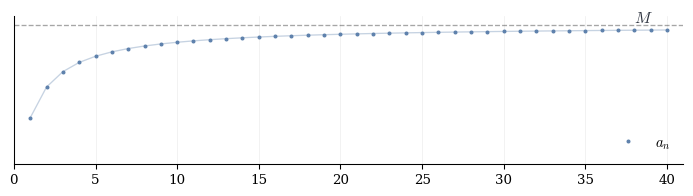
This is the first theorem in the course that produces a limit without being told what it is. Everything before it took a candidate \(a\) and checked it. Here the proof says only that a limit exists, and it is the completeness of \(\mathbb{R}\) (no gaps) that does the work. In \(\mathbb{Q}\) the theorem is false: the decimal approximations \(1,\ 1.4,\ 1.41,\ 1.414,\ \dots\) to \(\sqrt2\) are rational, increasing and bounded, but have no limit in \(\mathbb{Q}\). The hypotheses only concern the tail, so a sequence that is monotone from some index on is enough.
Example 3.1 (Heron’s Method Converges) Chapter 1 left a debt: for \(a_0 = 1\) and \(a_{n+1} = \tfrac12\left(a_n + \tfrac{2}{a_n}\right)\), if the limit exists then it is \(\sqrt2\). Now we can show it exists.
Claim. \((a_n)\) converges, and its limit \(L\) satisfies \(L > 0\) and \(L^2 = 2\).
TipProof
All terms are positive, by induction. Completing the square, \[ a_{n+1}^2 - 2 = \tfrac14\left(a_n - \tfrac{2}{a_n}\right)^2 \ge 0, \] so \(a_n^2 \ge 2\), and in particular \(a_n > 1\), for every \(n \ge 1\). Then for \(n \ge 1\), \[ a_{n+1} - a_n = \frac{2 - a_n^2}{2a_n} \le 0, \] so \((a_n)_{n \ge 1}\) is nonincreasing and bounded below by \(1\). (The full sequence is not monotone, since \(a_1 = 1.5 > a_0\), but the tail is, and the tail is all that matters.) By Theorem 3.6 it converges to some \(L\), and \(L \ge 1\) by comparison, so \(L \ne 0\). Since \(a_{n+1} \to L\) as well, the limit laws applied to the recursion give \[ L = \tfrac12\left(L + \tfrac2L\right) \quad\Longrightarrow\quad L^2 = 2. \qquad \square \]
Two things are worth pausing on. First, the identity for \(a_{n+1}^2 - 2\) shows that the squared error at each step is controlled by the square of the previous error, which is why the number of correct digits doubles. Second, this proves that a positive real number with square \(2\) exists. Every term of the sequence is rational but the limit is not, so it was completeness that produced \(\sqrt2\), not algebra.
Example 3.2 (The Number \(e\)) Suppose a quantity grows at rate \(100\%\) per unit time, in \(n\) equal steps, each adding \(1/n\) of the current amount. This is compound interest, or a crude chain reaction in which each neutron present yields new ones. After one unit of time the amount is \[ a_n = \left(1 + \tfrac1n\right)^n. \] Finer steps mean more frequent compounding, so the values should increase, but the increments per step shrink. Does the sequence blow up, or settle?
| \(n\) | 1 | 10 | 100 | 1000 |
|---|---|---|---|---|
| \(a_n\) | 2 | 2.5937 | 2.7048 | 2.7169 |
Claim. \((a_n)\) is increasing and bounded above by \(3\), so it converges.
TipProof
Increasing. By the binomial theorem and \(\binom nk = \dfrac{n(n-1)\cdots(n-k+1)}{k!}\), \[ a_n = \sum_{k=0}^{n} \frac{1}{k!}\left(1 - \tfrac1n\right)\left(1 - \tfrac2n\right)\cdots\left(1 - \tfrac{k-1}{n}\right). \] Passing from \(n\) to \(n+1\) adds one new positive term and replaces each factor \(1 - \tfrac jn\) by the larger \(1 - \tfrac{j}{n+1}\). So \(a_{n+1} > a_n\).
Bounded. Each factor \(1 - \tfrac jn\) is at most \(1\), and \(k! \ge 2^{k-1}\) for \(k \ge 1\) (by induction: \((k+1)! = (k+1)\,k! \ge 2\cdot 2^{k-1} = 2^k\)). Hence \[ a_n \le 1 + \sum_{k=1}^{n} \frac{1}{k!} \le 1 + \sum_{k=1}^{n} \frac{1}{2^{k-1}} < 1 + 2 = 3. \qquad \square \]
By Theorem 3.6 the sequence converges, and we denote its limit \[ e = \lim_{n\to\infty}\left(1 + \tfrac1n\right)^n. \] The argument tells us that \(2 \le e \le 3\) and nothing more. It does not give \(e \approx 2.71828\), or irrationality, or a way to compute it. That is typical of the theorem: it manufactures a number we could not otherwise name, and everything else we learn about \(e\) comes afterwards.
TipKey Ideas
- Convergence is a claim about the tail. To prove it, answer every \(\varepsilon\) with an \(N\). To refute it, exhibit one \(\varepsilon\) that no \(N\) can satisfy.
- Every proof in this chapter has the same shape: spend \(\varepsilon\) (\(\varepsilon/2\), \(\varepsilon/2M\), …), take \(N\) to be the largest threshold, apply the triangle inequality.
- Convergent implies bounded, but not conversely. Add monotonicity and the converse holds.
- The limit laws are conditional: they apply once you know each limit exists.
- The Monotone Convergence Theorem produces limits you cannot name in advance (\(\sqrt2\), \(e\)), and it does so by using the completeness of \(\mathbb{R}\).
3.5 Problem Set
You can download the problem set here: