15 Related Rates
A rate is a derivative. If \(x : I \to \mathbb{R}\) is a function of time, then \(x'(t_0)\) is the rate of change of \(x\) at the instant \(t_0\). Nothing in the theory depends on the variable being time, and the term “related rates” refers only to the following situation: two or more differentiable functions of \(t\) are connected by a relation, and we ask what the relation says about their derivatives.
The mathematics is short, and a few points in it are easy to get wrong, so we state it carefully. After that we need examples, and we borrow them from physics. Physics is a good source of relations that are believable but not obvious, and of independent checks: a unit that comes out wrong, or a conserved quantity that is not conserved, is an error we can detect without the answer in the back of the book. We take each physical law as a hypothesis. The statements below are of the form “if the model holds, then …”, and their proofs use only the calculus we have developed. Where a model is an approximation, we say so.
15.1 Rates Through a Relation
The simplest case is a quantity that is a function of another: \(y = g(x(t))\). By Theorem 10.3, if \(x\) is differentiable at \(t\) and \(g\) is differentiable at \(x(t)\), then \[ y'(t) = g'(x(t))\,x'(t). \] In the language of linear approximation, a change \(\Delta t\) produces a change of about \(x'\Delta t\) in \(x\), and a change \(\Delta x\) produces a change of about \(g'(x)\Delta x\) in \(y\). The number \(g'(x)\) is the exchange rate from \(x\) to \(y\).
The relations that arise in applications are usually not solved for \(y\). The ladder satisfies \(x^2 + y^2 = 25\), and we do not want to write \(y = \sqrt{25 - x^2}\) before differentiating. The next proposition says that we may differentiate the relation as it stands, and that the differentiability of \(y\) is part of the conclusion and need not be assumed.
Proposition 15.1 (Rates Through a Relation) Let \(I\), \(U\), \(W\) be open intervals. Let \(x : I \to U\) be differentiable, let \(\psi : U \to \mathbb{R}\) be differentiable, and let \(\varphi : W \to \mathbb{R}\) be differentiable with \(\varphi' > 0\) on \(W\) (or \(\varphi' < 0\) on \(W\)). Suppose \(y : I \to W\) satisfies \[ \varphi(y(t)) = \psi(x(t)) \qquad\text{for all } t \in I. \] Then \(y\) is differentiable on \(I\), and for every \(t \in I\), \[ \varphi'(y(t))\,y'(t) = \psi'(x(t))\,x'(t). \]
TipProof
Since \(\varphi' > 0\), the function \(\varphi\) is continuous and strictly increasing on \(W\) (Proposition 14.1), so it is a bijection onto the open interval \(\varphi(W)\). By Theorem 12.1, its inverse is differentiable at every point of \(\varphi(W)\), since \(\varphi' \ne 0\). The relation says \(y = \varphi^{-1}\circ\psi\circ x\), which is a composition of differentiable functions (the values of \(\psi \circ x\) lie in \(\varphi(W)\), because they equal \(\varphi(y(t))\)). So \(y\) is differentiable by Theorem 10.3. Now both sides of \(\varphi(y(t)) = \psi(x(t))\) are differentiable functions of \(t\) that are equal on \(I\), so their derivatives are equal, and the chain rule gives the stated formula. \(\square\)
When \(x'(t) \ne 0\), the formula can be written \[ \frac{y'(t)}{x'(t)} = \frac{\psi'(x(t))}{\varphi'(y(t))}. \] The right side depends only on the point \((x(t), y(t))\) at which the system is, and not on the function \(x(t)\). In particular, the ratio of the two rates does not depend on how fast the system is driven along the relation. Replace \(x(t)\) by \(x(2t)\), so that the same motion is performed twice as fast: both rates double and their ratio does not change. Related rates are statements about the relation, that is about the curve \(\{(x,y)\}\), and time enters only as a parameter.
15.1.1 Three Warnings
1. The relation must hold on an interval, and not only at an instant. Let \(x(t) = t\) and \(y(t) = t^2\). Then \(y = x\) at \(t = 0\) and at \(t = 1\), and nowhere else. “Differentiating” the relation \(y = x\) would give \(y' = x'\), that is \(2t = 1\), which is false at \(t = 1\), where \(y' = 2\) and \(x' = 1\). A relation at a single instant is a statement about numbers and has no derivative. This is the precise content of the rule that we substitute the numerical values of the instant after differentiating: the values at the instant are consequences of the relation, and cannot be used in place of it.
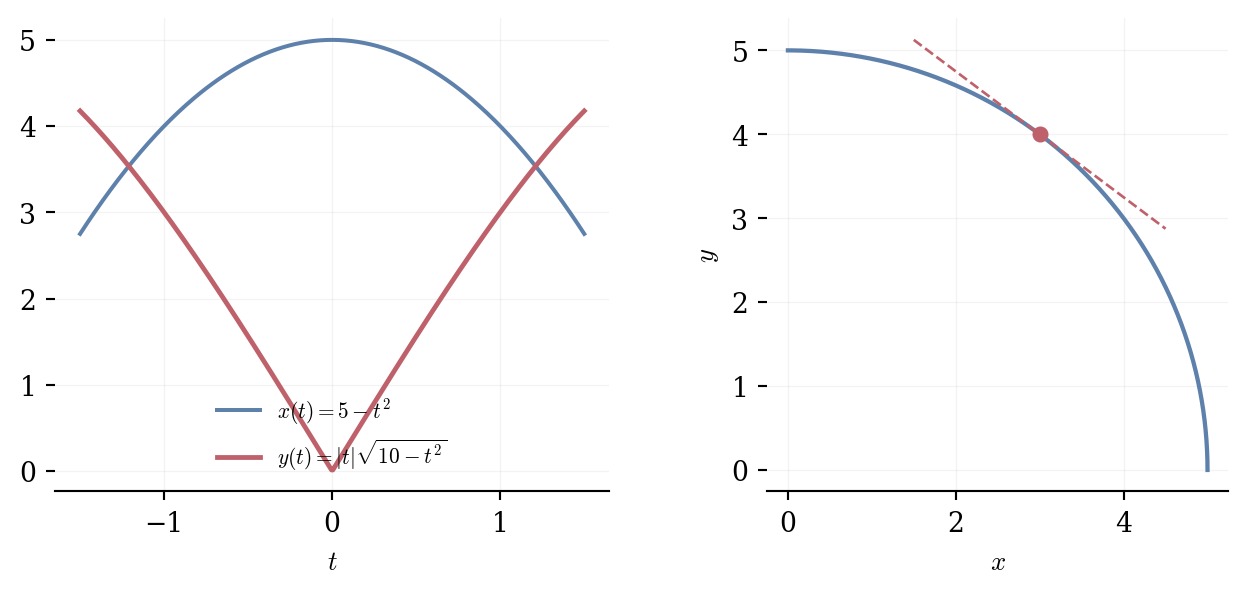
2. The hypothesis \(\varphi' \ne 0\) cannot be dropped. Let \(x(t) = 5 - t^2\) and \(y(t) = |t|\sqrt{10 - t^2}\) on \((-1,1)\). Then \[ x^2 + y^2 = (25 - 10t^2 + t^4) + (10t^2 - t^4) = 25, \] so the pair satisfies the ladder’s relation, with \(x\) smooth. But \(y\) has a corner at \(t = 0\), because \(\frac{y(h) - y(0)}{h} = \operatorname{sgn}(h)\sqrt{10 - h^2}\) has the two one-sided limits \(\pm\sqrt{10}\). At \(t = 0\) the relation has \(\varphi'(y) = 2y = 0\), and the differentiated relation \(2x\,x' + 2y\,y' = 0\) reads \(0 = 0\). It says nothing, and the quantity it concerns does not exist. This is the exchange rate \(-x/y\) of the ladder becoming infinite at the floor.
3. Differentiability of \(y\) does not need \(g'\) to exist. If \(x(t) = t^3\) and \(y = \sqrt[3]{x(t)} = t\), then \(y\) is differentiable at \(0\), while \(g(x) = \sqrt[3]{x}\) is not differentiable at \(x(0) = 0\). The chain rule is a sufficient condition and not a necessary one (Problem 1).
15.2 What the Differentiated Relation Remembers
Differentiating a relation discards something, and it is easy to say exactly what.
Proposition 15.2 (Equal Rates Mean Equal Up to a Constant) Let \(u, v : I \to \mathbb{R}\) be differentiable on an interval \(I\). Then \(u' = v'\) on \(I\) if and only if \(u - v\) is constant on \(I\).
TipProof
If \(u - v = c\) then \(u' - v' = 0\). Conversely, if \(u' - v' = 0\) on \(I\), then \(u - v\) is constant by Corollary 9.1. \(\square\)
So a relation \(u(t) = v(t)\) and its derivative \(u'(t) = v'(t)\) carry the same information except for one number, the value of the constant. Two consequences follow.
The rates of a relation do not know its constant. For a ladder of length \(L\) the relation is \(x^2 + y^2 = L^2\), and the differentiated relation \(xx' + yy' = 0\) is the same for every \(L\). The length of the ladder enters the answer only through the values of \(x\) and \(y\) at the instant, which is where the specific numbers are supplied.
A relation between rates can be integrated. If we know only the differentiated relation, we recover the relation up to a constant, and one measurement at one instant determines it. The most useful form is for relative rates. For positive differentiable functions \(a, b\) and a real number \(k\), \[ \frac{a'}{a} + k\,\frac{b'}{b} = 0 \text{ on } I \qquad\Longleftrightarrow\qquad a\,b^k \text{ is constant on } I, \] because the left side is \((\ln a + k\ln b)' = (\ln(ab^k))'\) and we apply Proposition 15.2. This says that a power-law relation between two quantities is the same thing as a proportionality between their relative rates. The sections below are examples of this pattern.
15.3 Models from Physics
Model 1: a ladder. A rigid ladder of length \(5\) (meters) has its top on a vertical wall and its bottom on the horizontal ground, in contact with both, with \(x(t)\) the distance of the bottom from the wall and \(y(t)\) the height of the top, so \(x^2 + y^2 = 25\) with \(x, y > 0\).
Claim. If \(x\) is differentiable, then \(y\) is differentiable and \(y' = -\dfrac{x}{y}\,x'\).
Apply Proposition 15.1 with \(\varphi(y) = y^2\) on \(W = (0,\infty)\) (where \(\varphi' = 2y > 0\)), \(\psi(x) = 25 - x^2\) and \(U = (0,5)\). Then \(2y\,y' = -2x\,x'\).
Check. Let the bottom slide at \(x' = 0.5\ \text{m/s}\) when \(x = 3\), so \(y = 4\) and \(y' = -\frac34(0.5) = -0.375\ \text{m/s}\). After \(0.01\ \text{s}\), \(x = 3.005\) and \(y = \sqrt{25 - 3.005^2} \approx 3.996245\), a drop of \(0.003755\ \text{m}\), about \(0.3755\ \text{m/s}\).
The pair \((x(t), y(t))\) moves along the circle \(x^2 + y^2 = 25\), and \(-x/y\) is the slope of the tangent to the circle at \((x, y)\). This is the statement of the proposition: the ratio of the rates is the slope of the curve, whatever the motion along it. At \(y \to 0\) the slope is unbounded, and by Warning 2 the model has no meaning there.
Model 2: a rocket. A rocket in empty space, with no external force, has mass \(m(t) > 0\) and velocity \(v(t)\). Exhaust leaves at the constant speed \(v_e > 0\) relative to the rocket. Conservation of momentum, a principle of mechanics that we borrow, gives the relation between the rates \[ m\,v' = -v_e\,m'. \] Since \(m' < 0\) (the rocket loses mass), \(v' > 0\).
Claim. If \(m, v\) are differentiable on an interval \(I\), then \(v(t) + v_e\ln m(t)\) is constant on \(I\). Consequently, for \(t_0, t_1 \in I\), \[ v(t_1) - v(t_0) = v_e\ln\frac{m(t_0)}{m(t_1)}. \]
By the chain rule, \(\big(v + v_e\ln m\big)' = v' + v_e\,\dfrac{m'}{m} = 0\), using the relation divided by \(m\). Now apply Proposition 15.2.
This is Tsiolkovsky’s rocket equation, and it is obtained with no integration. The fact that matters is that the time-dependence has disappeared: the gain in velocity depends on the initial and final masses and not on how the fuel was burned, slowly or fast, at a constant rate or not. This is the independence from the motion that we saw in the proposition.
Check. With \(v_e = 3000\ \text{m/s}\), a rocket that burns from \(1000\ \text{kg}\) to \(500\ \text{kg}\) gains \(3000\ln2 \approx 2079\ \text{m/s}\). To gain \(9400\ \text{m/s}\) with \(v_e = 4400\ \text{m/s}\) the mass must fall by the factor \(e^{9400/4400} \approx 8.47\): most of a rocket must be fuel (Problem 3).
Model 3: a gas. For a fixed amount of an ideal gas, the pressure \(P\) and the volume \(V\) (both positive) satisfy \(PV = c\) when the temperature is held constant, and \(PV^\gamma = c\) for a reversible process without heat exchange, where \(\gamma > 1\) is a constant of the gas (\(\gamma \approx 1.4\) for air). These are empirical laws, which we take as the models.
Claim. If \(P V^\gamma = c\) along a motion with \(P, V\) differentiable, then \[ \frac{P'}{P} = -\gamma\,\frac{V'}{V}, \] and conversely, this relation between relative rates implies \(PV^\gamma\) is constant.
This is the equivalence of the previous section with \(a = P\), \(b = V\), \(k = \gamma\). The case \(\gamma = 1\) is the isothermal one.
Check. Compress air so that the volume decreases by \(2\%\) per second: \(V'/V = -0.02\ \text{s}^{-1}\). If the process is isothermal then \(P'/P = 0.02\ \text{s}^{-1}\), and if it is adiabatic then \(P'/P = 1.4 \times 0.02 = 0.028\ \text{s}^{-1}\). In the adiabatic case the pressure rises faster, because the gas also warms. For a constant relative rate, \(V = e^{-0.02t}\) and \(P = V^{-1.4} = e^{0.028t}\), and after one second \(P = e^{0.028} \approx 1.0284\) times its initial value.
Model 4: the Doppler effect. A source that emits a tone of frequency \(f_0\) and moves directly toward a stationary observer at speed \(v_s\) is heard at frequency \[ f = \frac{v\,f_0}{v - v_s}, \] where \(v\) is the speed of sound. For a source whose speed changes with time we take \(f(t) = \dfrac{v f_0}{v - v_s(t)}\). This is a quasi-static approximation, valid when \(v_s\) changes little during the time it takes sound to reach the observer. It is a model of the situation and not an exact law of it.
Claim. If \(v_s\) is differentiable and \(v_s < v\), then \[ f' = \frac{v f_0}{(v - v_s)^2}\,v_s'. \] The exchange rate from \(v_s\) to \(f\) is the derivative of \(v_s \mapsto vf_0(v - v_s)^{-1}\).
Check. A train whistle of \(f_0 = 500\ \text{Hz}\) at \(v_s = 30\ \text{m/s}\), decelerating at \(v_s' = -2\ \text{m/s}^2\), with \(v = 340\ \text{m/s}\): \(f' = \dfrac{340\cdot500}{310^2}(-2) \approx -3.54\ \text{Hz/s}\). The units are \(\dfrac{(\text{m/s})\,\text{Hz}}{(\text{m/s})^2}\cdot\dfrac{\text{m}}{\text{s}^2} = \text{Hz/s}\), as they should be. As \(v_s \to v\) the exchange rate tends to \(\infty\), which is the model failing near the speed of sound, where shock waves form.
Model 5: an orbit. A planet moving under a central force, with polar coordinates \((r, \theta)\) relative to the center, has constant angular momentum per unit mass, \(L = r^2\theta'\). The derivation is Newton’s, and we borrow the result.
Claim. \(\dfrac{\theta''}{\theta'} = -2\,\dfrac{r'}{r}\), and conversely this relation gives \(r^2\theta'=\) constant.
With \(a = \theta'\), \(b = r\) and \(k = 2\) in the equivalence of the previous section. The planet’s angular speed is large when it is near the center and small when it is far.
Check. For the Earth the distance to the Sun is \(147.1\) million km at perihelion and \(152.1\) million km at aphelion, so the ratio of angular speeds is \(\left(\frac{152.1}{147.1}\right)^2 \approx 1.069\): the Earth moves in angle about \(7\%\) faster in early January than in early July.
15.4 What Goes Wrong
Substituting before differentiating. Put \(x = 3\) and \(y = 4\) into \(x^2 + y^2 = 25\) first. It becomes \(9 + y^2 = 25\), with derivative \(y\,y' = 0\), hence \(y' = 0\). The ladder would not move. By Warning 1, the relation holds for all times and the values only at one, and what we differentiate is the relation.
Differentiating through a constant that is not constant. A cone of water of depth \(h\) has volume \(V = \frac13\pi r^2h\). To find \(h'\) from \(V'\) we need \(r\) as a function of \(h\) (by similar triangles, \(r = h/2\) in a tank with top radius half its height), and this must be substituted before differentiating, because \(r\) changes as \(h\) does. Treating \(r\) as a constant gives an error: at \(h = 2\) it gives \(V' = \frac{\pi}{3}r^2h'\) with \(r = 1\), three times too large, as the correct \(V' = \frac\pi4h^2h'\) gives \(\pi h'\) and the wrong one \(\frac\pi3 h'\) (Problem 6).
Forgetting the chain factor. For \(r = r(t)\), \(\frac{d}{dt}r^3 = 3r^2r'\).
Degenerate exchange rates. A large or infinite \(g'(x)\) in \(y' = g'(x)x'\) says that the model is being asked to do something it cannot, as at the floor of the ladder or at Mach \(1\). A zero rate \(g'(x) = 0\) is a different warning: \(y\) does not respond to first order, and the rate can only be found from higher-order terms.
Signs and units. A decreasing quantity has a negative rate. In physical problems every rate has units of the quantity divided by time, and every answer should be checked against this.
15.5 Where This Leads
Related rates differentiate a relation. The reverse problem, recovering the relation from the rates, has appeared twice: the rocket and the gas were recovered from relations between rates by Proposition 15.2, and \(f' = f\) was solved by the Mean Value Theorem (Proposition 11.1). When the rate is a given function of time, \(y' = h(t)\), the problem of recovering \(y\) is the problem of integration.
TipKey Ideas
- A relation between functions of \(t\) may be differentiated in \(t\) if it holds on an interval. If it is solved for one quantity by a differentiable monotone function with nonvanishing derivative, then the differentiability of that quantity is a conclusion and not an assumption.
- The ratio of two related rates depends only on the point of the relation, and not on the motion. It is the slope of the curve.
- A relation that holds at a single instant cannot be differentiated. Substitute the numbers of the instant after differentiating.
- The differentiated relation determines the original up to an additive constant. For positive quantities, \(\frac{a'}{a} + k\frac{b'}{b} = 0\) is equivalent to \(ab^k\) being constant.
- The rocket equation \(\Delta v = v_e\ln(m_0/m_1)\) and the gas laws \(PV^\gamma = c\) are consequences of relations between rates, and their time-dependence disappears.
- Infinite or zero exchange rates signal that a model is failing, or that a higher-order analysis is needed.
WarningProblem Set
Let \(x(t) = t^3\) and \(y(t) = \sqrt[3]{x(t)}\).
Show that \(y\) is differentiable at \(t = 0\) with \(y'(0) = 1\).
Show that \(g(x) = \sqrt[3]{x}\) is not differentiable at \(x = 0\), and that for \(t \ne 0\) the formula \(y' = g'(x)x'\) gives \(1\).
Let \(x(t) = 5 - t^2\) and \(y(t) = |t|\sqrt{10 - t^2}\) on \((-1,1)\).
Verify that \(x^2 + y^2 = 25\) on \((-1,1)\).
Show that \(y\) is not differentiable at \(0\), although \(x\) is.
What does the differentiated relation \(xx' + yy' = 0\) say at \(t = 0\)? Where does Proposition 15.1 fail to apply?
Rockets.
A rocket with \(v_e = 3000\ \text{m/s}\) burns from \(1000\ \text{kg}\) to \(250\ \text{kg}\). Find its gain in velocity.
What mass ratio \(m_0/m_1\) is needed to gain \(9400\ \text{m/s}\) with \(v_e = 4400\ \text{m/s}\)?
Two rockets start with the same mass and end with the same mass, but burn fuel on different schedules. Compare their gains in velocity.
Gases.
Air is compressed adiabatically (\(\gamma = 1.4\)) and its volume decreases at the relative rate of \(5\%\) per second. At what relative rate does the pressure increase? Compare with the isothermal case.
Show that if \(\dfrac{P'}{P} = -\gamma\dfrac{V'}{V}\) on an interval, with \(P, V > 0\) differentiable, then \(PV^\gamma\) is constant on the interval.
A ladder of length \(5\) leans against a wall (Section 15.3, Model 1).
The top slides down at \(0.2\ \text{m/s}\). How fast is the bottom moving at the instant when the top is \(3\ \text{m}\) high?
At what position are the speeds of the top and of the bottom equal in magnitude?
Show that the relation \(x^2 + y^2 = L^2\) has the same differentiated relation for every \(L\). What does this say about the use of the length of the ladder?
A conical tank with the vertex down has height \(3\ \text{m}\) and top radius \(1.5\ \text{m}\), and is drained at \(0.1\ \text{m}^3/\text{min}\).
How fast is the water level falling when the depth is \(1\ \text{m}\)?
What happens to the rate as the tank empties? Is this a failure of the model?
An airplane flies horizontally at \(3000\ \text{m}\) altitude and \(200\ \text{m/s}\) toward an observer on the ground. How fast is the angle of elevation of the plane changing when the horizontal distance is \(4000\ \text{m}\)?
Orbits.
Show that \(r^2\theta' = L\) (constant) implies \(\theta''/\theta' = -2r'/r\), and that the converse holds when \(\theta' > 0\).
A comet has distance \(0.6\ \text{AU}\) at perihelion and \(35\ \text{AU}\) at aphelion. What is the ratio of its angular speeds at the two points?
Power laws. Let \(y = cx^k\) with \(c > 0\), \(x > 0\) and \(k\) real.
Show that \(\dfrac{y'}{y} = k\,\dfrac{x'}{x}\).
If the radius of a sphere grows at \(1\%\) per second, at what relative rate do its surface area and volume grow?
WarningSolutions
Since \(y(t) = t\), \(y'(0) = 1\).
\(\dfrac{g(h) - g(0)}{h} = h^{-2/3}\) is unbounded as \(h \to 0\), so \(g'(0)\) does not exist. For \(t \ne 0\), \(g'(x) = \frac13x^{-2/3} = \frac{1}{3t^2}\) and \(x' = 3t^2\), so \(g'(x)x' = 1\). At \(t = 0\) the product is of the form \(\infty\cdot0\).
\(x^2 = 25 - 10t^2 + t^4\) and \(y^2 = t^2(10 - t^2) = 10t^2 - t^4\), and these sum to \(25\).
\(x' = -2t\) exists everywhere. For \(y\), \(\dfrac{y(h) - y(0)}{h} = \dfrac{|h|\sqrt{10-h^2}}{h} = \operatorname{sgn}(h)\sqrt{10 - h^2}\), with one-sided limits \(\pm\sqrt{10}\), so \(y'(0)\) does not exist.
At \(t = 0\) we have \(x' = 0\) and \(y = 0\), so the relation reads \(0 = 0\). The proposition requires \(\varphi'(y) = 2y > 0\), which fails at \(y = 0\).
\(\Delta v = 3000\ln\frac{1000}{250} = 3000\ln4 \approx 4159\ \text{m/s}\).
\(\dfrac{m_0}{m_1} = e^{9400/4400} = e^{2.136} \approx 8.47\).
The gains are equal: \(v(t_1) - v(t_0) = v_e\ln\frac{m(t_0)}{m(t_1)}\) depends only on the two masses. The schedule enters only through \(m(t)\) at intermediate times.
\(\dfrac{P'}{P} = -1.4\cdot(-0.05) = 0.07\ \text{s}^{-1}\), that is, \(7\%\) per second. The isothermal case gives \(5\%\) per second.
\((\ln P + \gamma\ln V)' = \dfrac{P'}{P} + \gamma\dfrac{V'}{V} = 0\), so \(\ln P + \gamma\ln V = \ln(PV^\gamma)\) is constant by Corollary 9.1, and \(PV^\gamma = e^{\text{const}}\).
When \(y = 3\), \(x = 4\). From \(xx' + yy' = 0\), \(x' = -\dfrac{y}{x}y' = -\dfrac34(-0.2) = 0.15\ \text{m/s}\).
\(|y'| = |x'|\) when \(\left|\frac xy\right| = 1\), i.e. \(x = y = \frac{5}{\sqrt2} \approx 3.54\ \text{m}\).
\(\frac{d}{dt}(x^2 + y^2) = 2xx' + 2yy'\) for every \(L\), and \(\frac{d}{dt}L^2 = 0\). The differentiated relation does not contain \(L\). The length enters only through the values of \(x\) and \(y\) at the instant, which satisfy \(x^2 + y^2 = L^2\).
Similar triangles give \(r = \frac h2\), so \(V = \frac\pi{12}h^3\) and \(V' = \frac\pi4h^2h'\). With \(V' = -0.1\) and \(h = 1\), \(h' = -\dfrac{0.4}{\pi} \approx -0.127\ \text{m/min}\).
\(|h'| = \dfrac{0.4}{\pi h^2} \to \infty\) as \(h \to 0\). This is the degenerate exchange rate: \(V \approx h^3\) is flat near \(h = 0\), so a small volume corresponds to a large change of depth. It is not a failure of the formula, but the model of a smooth surface at constant flow fails when the last drops are reached.
With \(x\) the horizontal distance, \(\tan\theta = \dfrac{3000}{x}\), so \(\sec^2\theta\,\theta' = -\dfrac{3000}{x^2}x'\). At \(x = 4000\) we have \(\tan\theta = \frac34\), \(\cos^2\theta = \frac{16}{25}\), and \(x' = -200\), so \(\theta' = \dfrac{16}{25}\cdot\dfrac{3000\cdot200}{4000^2} = 0.024\ \text{rad/s}\).
\((\ln\theta' + 2\ln r)' = \dfrac{\theta''}{\theta'} + 2\dfrac{r'}{r}\), which vanishes exactly when \(\ln(r^2\theta')\) is constant, by Proposition 15.2.
\(\dfrac{\theta'_{\text{peri}}}{\theta'_{\text{aph}}} = \left(\dfrac{35}{0.6}\right)^2 \approx 3400\).
\(\ln y = \ln c + k\ln x\), so \(\dfrac{y'}{y} = k\dfrac{x'}{x}\).
The surface area \(4\pi r^2\) grows at \(2\%\) per second and the volume \(\frac43\pi r^3\) at \(3\%\) per second.