12 Differentiation Techniques
The rules of the last two chapters differentiate any function given by a formula in \(x\) built from elementary pieces. Four situations lie outside what they cover directly.
- A function may be defined as an inverse, as \(\arcsin\) is the inverse of \(\sin\).
- A curve may be defined by an equation, such as \(\frac{x^2}{a^2} + \frac{y^2}{b^2} = 1\), with no formula for \(y\).
- A function may be a long product of factors, or have the variable in both the base and the exponent. The rules apply but the bookkeeping is heavy.
- We may want to differentiate a derivative.
The first three are handled by the same idea: apply the chain rule to an identity and solve for the derivative we want. The fourth leads to the classification of functions by how many times they can be differentiated, and to the relation between the sign of \(f''\) and the shape of the graph.
12.1 The Derivative of an Inverse Function
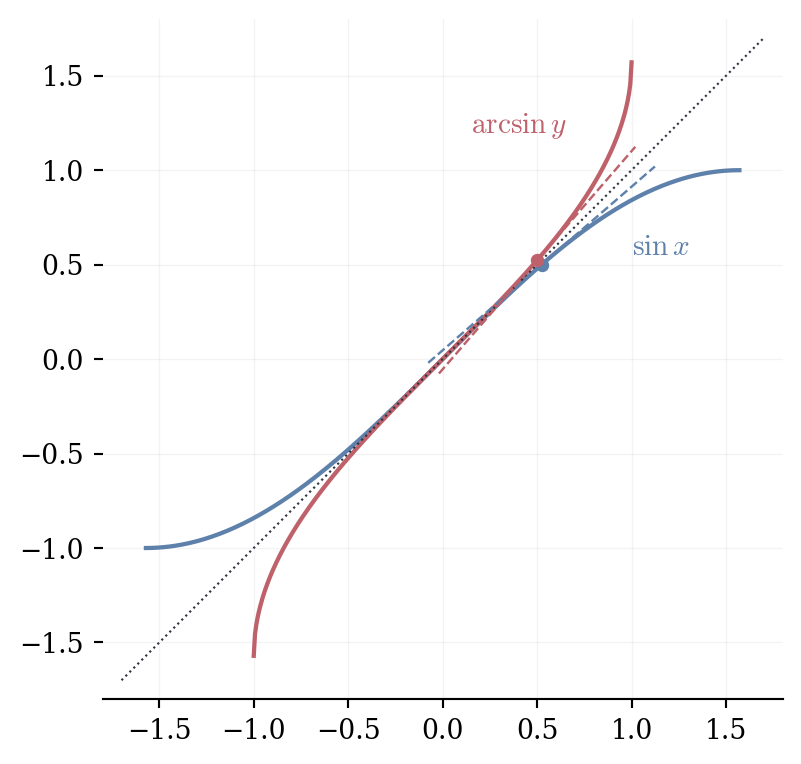
Let \(f\) be invertible and write \(g = f^{-1}\). Differentiating the identity \(g(f(x)) = x\) with the chain rule gives \[ g'(f(x))\,f'(x) = 1, \qquad\text{so}\qquad g'(f(x)) = \frac{1}{f'(x)}. \] Geometrically, the graph of \(g\) is the reflection of the graph of \(f\) in the diagonal \(y = x\), and reflecting a line exchanges its rise and its run, so a slope \(m\) becomes \(1/m\).
This computation assumes that \(g\) is differentiable, which is exactly what we want to prove. Two things have to be checked: that \(g\) is continuous (an inverse could in principle jump), and that its difference quotient converges.
Theorem 12.1 (Inverse Function Theorem (One Variable)) Let \(f : I \to \mathbb{R}\) be continuous and strictly monotone on an interval \(I\). Let \(a\) be an interior point of \(I\) at which \(f\) is differentiable with \(f'(a) \ne 0\), and put \(b = f(a)\). Then \(f^{-1}\) is differentiable at \(b\), and \[ (f^{-1})'(b) = \frac{1}{f'(a)}. \]
TipProof
Since \(f\) is continuous and strictly monotone, \(J = f(I)\) is an interval (Theorem 7.3) and \(f : I \to J\) is a bijection. Let \(g = f^{-1} : J \to I\). Since \(a\) is interior to \(I\), \(b\) is interior to \(J\).
Step 1: \(g\) is continuous. Suppose \(f\) is increasing, so \(g\) is increasing. Then \(g\) has one-sided limits at \(b\) with \(g(b^-) \le g(b) \le g(b^+)\). If \(g(b^-) < g(b)\), no value strictly between them would be attained by \(g\), yet \(g(J) = I\) is an interval and contains them. So \(g(b^-) = g(b)\), and likewise \(g(b^+) = g(b)\). The decreasing case is the same.
Step 2: the quotient. Let \(k \ne 0\) be small and put \(h = g(b+k) - a\). Then \(h \ne 0\) because \(g\) is injective, and \(h \to 0\) as \(k \to 0\) by Step 1. Moreover \(f(a + h) = b + k\), so \(k = f(a+h) - f(a)\), and \[ \frac{g(b+k) - g(b)}{k} = \frac{h}{f(a+h) - f(a)} = \left(\frac{f(a+h) - f(a)}{h}\right)^{-1} \longrightarrow \frac{1}{f'(a)}, \] because the quotient in parentheses tends to \(f'(a) \ne 0\) as \(h \to 0\). \(\square\)
Each hypothesis does work.
- \(f'(a) \ne 0\). For \(f(x) = x^3\) at \(a = 0\) the inverse is \(\sqrt[3]{y}\), whose difference quotient at \(0\) is \(y^{-2/3} \to \infty\). A horizontal tangent for \(f\) becomes a vertical tangent for \(f^{-1}\).
- Monotonicity. A nonzero derivative at a single point does not make \(f\) invertible near it. Let \(f(x) = x + 2x^2\sin(1/x)\) with \(f(0) = 0\). Then \(f'(0) = 1\) (the error is at most \(2h^2\)), but for \(x \ne 0\) we have \(f'(x) = 1 + 4x\sin(1/x) - 2\cos(1/x)\), and at \(x_n = \frac{1}{2n\pi}\) this equals \(-1\). A function that is nondecreasing near \(0\) has \(f' \ge 0\) there, so \(f\) is not monotone on any interval around \(0\).
- The usual situation. If \(f' > 0\) at every point of an interval, then \(f\) is strictly increasing by the Mean Value Theorem (Problem 4(d) of the chapter on the derivative), so the theorem applies at every point. The same holds for \(f' < 0\).

Example 1. For \(f(x) = x^2\) on \((0,\infty)\), the inverse is \(g(y) = \sqrt y\). At \(b = x^2\) the theorem gives \(g'(b) = \frac{1}{2x} = \frac{1}{2\sqrt b}\), the formula we found by hand. Likewise \(\ln\) is the inverse of \(e^x\), so \((\ln y)' = \frac{1}{e^x} = \frac1y\) with \(y = e^x\), which agrees with the computation from the previous chapter.
Example 2 (arcsine). The function \(\sin\) is continuous and strictly increasing on \([-\frac\pi2, \frac\pi2]\) with \(\sin'(x) = \cos x > 0\) on the open interval. For \(y = \sin x\) with \(x \in (-\frac\pi2,\frac\pi2)\), Theorem 12.1 gives \((\arcsin)'(y) = \frac{1}{\cos x}\). Since \(\cos x > 0\) there, \(\cos x = \sqrt{1 - \sin^2 x} = \sqrt{1 - y^2}\), so \[ (\arcsin y)' = \frac{1}{\sqrt{1 - y^2}}, \qquad -1 < y < 1. \] As a check, at \(x = \frac\pi6\) the slope of \(\sin\) is \(\cos\frac\pi6 = \frac{\sqrt3}{2}\), and the slope of \(\arcsin\) at \(y = \frac12\) is \(\frac{1}{\sqrt{1 - 1/4}} = \frac{2}{\sqrt3}\), the reciprocal, as in the figure. At \(y = \pm1\) the theorem does not apply, because \(\cos(\pm\frac\pi2) = 0\), and indeed the graph of \(\arcsin\) has vertical tangents at the endpoints.
Example 3 (arctangent). The function \(\tan\) is continuous and strictly increasing on \((-\frac\pi2, \frac\pi2)\) with \(\tan' = \sec^2 = 1 + \tan^2 > 0\). For \(y = \tan x\), \[ (\arctan y)' = \frac{1}{1 + \tan^2 x} = \frac{1}{1 + y^2}, \qquad y \in \mathbb{R}. \] As a check, at \(y = 1\) (\(x = \frac\pi4\)) the slope of \(\tan\) is \(2\) and the slope of \(\arctan\) is \(\frac12\).
Example 4 (arccosine). On \((-1,1)\) the sum \(\arcsin y + \arccos y\) has derivative \(\frac{1}{\sqrt{1-y^2}} + (\arccos y)'\). Rather than repeat the theorem, note that \(\arccos y = \frac\pi2 - \arcsin y\) (Problem 4(c)), so \((\arccos y)' = -\frac{1}{\sqrt{1 - y^2}}\).
12.2 Implicit Differentiation
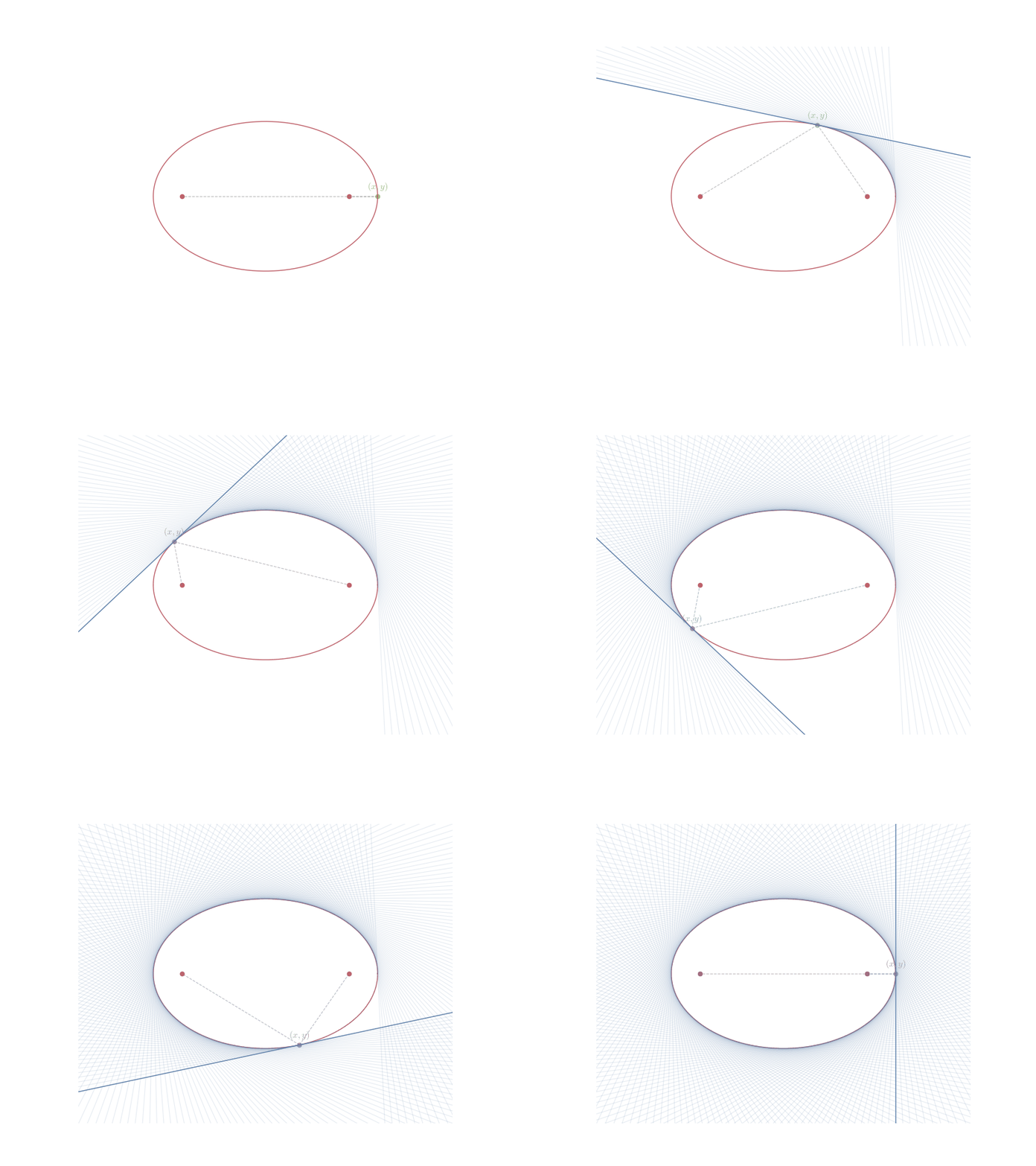
Many curves are given by an equation rather than a formula. The ellipse \[ \frac{x^2}{a^2} + \frac{y^2}{b^2} = 1 \] is not the graph of a function, since each \(x\) in \((-a,a)\) has two values of \(y\). But near a point where the tangent is not vertical, a piece of the curve is a graph, and we can ask for its slope.
Suppose \(y = y(x)\) is a differentiable function on an interval with \(F(x, y(x)) = 0\) for all \(x\) in the interval. The left side is a composition, so we can apply the chain rule to the identity, and then solve for \(y'\).
What is assumed. The computation presupposes that such a differentiable \(y(x)\) exists. That is a separate fact, the Implicit Function Theorem, which we can only state and prove once we have functions of several variables. Its one-variable special case is Theorem 12.1, where the equation is \(f(y) - x = 0\). Until then, implicit differentiation tells us what the slope must be if a differentiable branch exists, and for the curves below we can verify that branches do exist.
Example 5. On the ellipse, differentiate \(\frac{x^2}{a^2} + \frac{y(x)^2}{b^2} = 1\) with respect to \(x\): \[ \frac{2x}{a^2} + \frac{2y\,y'}{b^2} = 0 \qquad\Longrightarrow\qquad y' = -\frac{b^2}{a^2}\cdot\frac{x}{y} \quad (y \ne 0). \] As a check, the upper branch is \(y = b\sqrt{1 - x^2/a^2}\), and the chain rule gives \(y' = -\frac{b\,x}{a^2\sqrt{1 - x^2/a^2}}\). Since \(\sqrt{1 - x^2/a^2} = y/b\), this is \(-\frac{b^2 x}{a^2 y}\), as claimed.
Example 6. The Tschirnhausen cubic is \(y^2 = x^3 + 3x^2\). Differentiating, \(2y\,y' = 3x^2 + 6x\), so \[ y' = \frac{3x(x+2)}{2y}. \]
- Horizontal tangents need \(y' = 0\) with \(y \ne 0\): \(x = -2\), where \(y^2 = -8 + 12 = 4\). So the tangent is horizontal at \((-2, \pm2)\).
- Vertical tangents occur where \(y = 0\) and the numerator is not: \(y = 0\) forces \(x^3 + 3x^2 = 0\), so \(x = 0\) or \(x = -3\). At \(x = -3\) the numerator is \(9 \ne 0\), so the tangent is vertical at \((-3, 0)\).
- The origin gives \(\frac00\). The curve has two branches \(y = \pm x\sqrt{x+3}\) crossing there, with slopes \(\pm\sqrt3\). The formula is silent because no single slope exists.
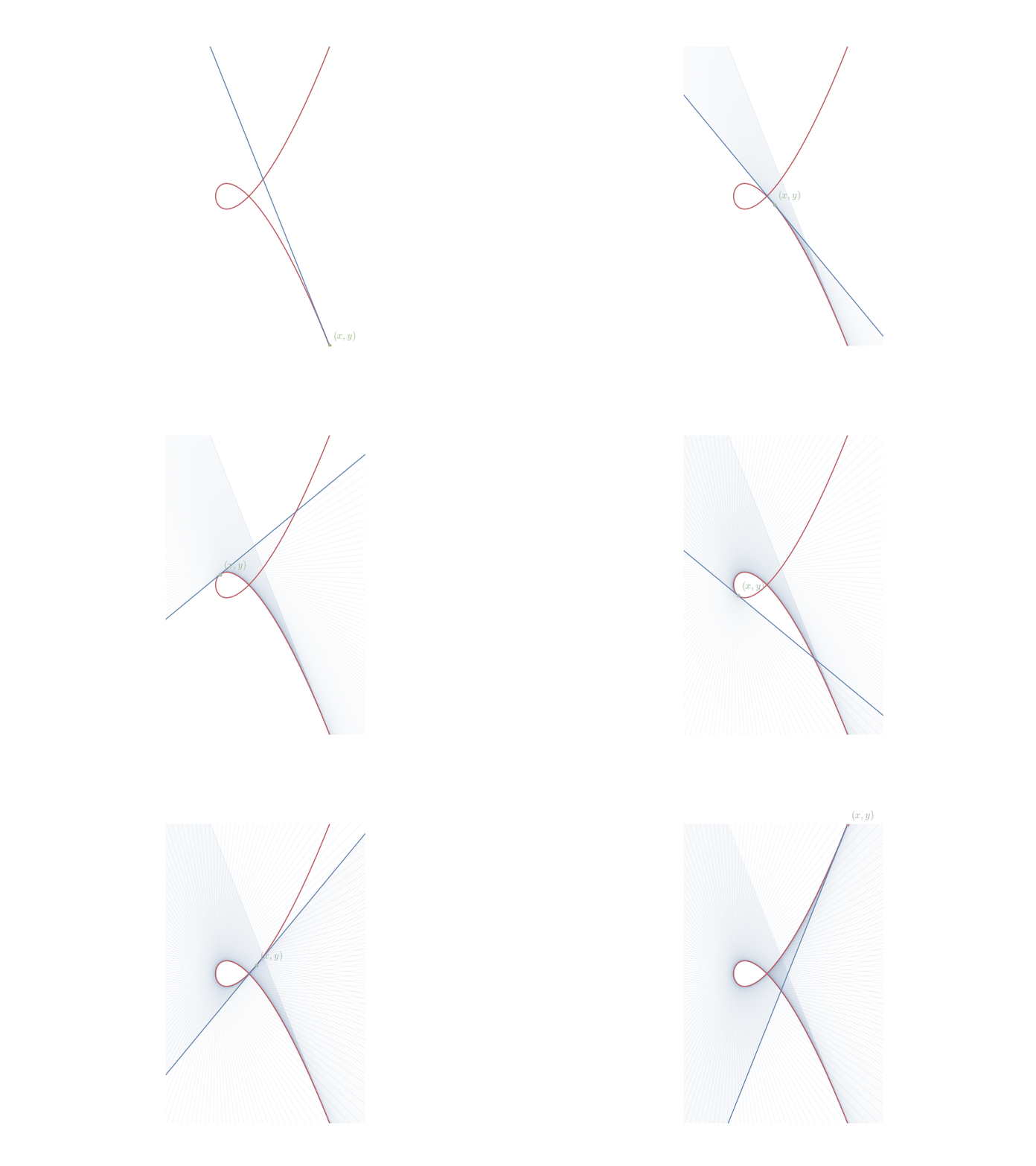
What goes wrong. The method divides by the coefficient of \(y'\). Where that coefficient vanishes (here \(y = 0\)), the curve may have a vertical tangent, as at \((\pm a, 0)\) on the ellipse and \((-3,0)\) on the cubic, or a more singular shape, as at the origin of the cubic. In those places there is no differentiable function \(y(x)\) to differentiate.
12.3 Logarithmic Differentiation
For a function \(f\) that does not vanish, the quantity \[ \frac{f'(x)}{f(x)} = \big(\ln|f(x)|\big)' \] is the relative rate of change: the fractional change of \(f\) per unit change in \(x\). The equality on the right is the chain rule together with \((\ln|u|)' = \frac1u\) (Problem 5 of the previous chapter), and it holds wherever \(f \ne 0\).
Relative rates of change add under multiplication. If \(f = uv\), then \(\frac{f'}{f} = \frac{u'}{u} + \frac{v'}{v}\), which is the product rule divided by \(uv\). Logarithmic differentiation is this observation used on purpose: take \(\ln|f|\), which turns products into sums and quotients into differences, differentiate, and multiply back by \(f\).
Example 7. Let \[ f(x) = \frac{(x+1)^3(x-2)^2}{(x^2+1)^4}. \] Then \(\ln|f| = 3\ln|x+1| + 2\ln|x-2| - 4\ln(x^2+1)\), so for \(x \ne -1, 2\), \[ f'(x) = f(x)\left(\frac{3}{x+1} + \frac{2}{x-2} - \frac{8x}{x^2+1}\right). \] As a check at \(x = 0\): \(f(0) = 4\) and the bracket is \(3 - 1 - 0 = 2\), so \(f'(0) = 8\). Directly, with numerator \(N\) and denominator \(D\), \(N'(0) = 3\cdot1\cdot4 + 1\cdot2\cdot(-2) = 8\), \(D(0) = 1\), \(D'(0) = 0\), so \(f'(0) = \frac{8\cdot 1 - 4\cdot 0}{1} = 8\).
The method also handles a variable exponent. For \(u > 0\), \[ (u^v)' = u^v\left(v'\ln u + v\,\frac{u'}{u}\right) = \underbrace{u^v\ln u\cdot v'}_{\text{exponent varies}} + \underbrace{v\,u^{v-1}\cdot u'}_{\text{base varies}}. \] This is the exponential rule and the power rule added together, each applied with the other slot frozen.
Example 8. For \(f(x) = x^{\sin x}\) with \(x > 0\), \(u = x\) and \(v = \sin x\) give \[ f'(x) = x^{\sin x}\left(\cos x\,\ln x + \frac{\sin x}{x}\right). \] As a check at \(x = 1\): \(f(1) = 1\) and \(f'(1) = \sin 1 \approx 0.841\), while \(\frac{1.01^{\sin(1.01)} - 1}{0.01} \approx 0.846\).
12.4 Higher-Order Derivatives
If \(f'\) is differentiable, its derivative is the second derivative \(f'' = (f')'\), and so on: \(f^{(n)} = (f^{(n-1)})'\). We also write \(D^nf\) or \(\frac{d^nf}{dx^n}\). Linearity of differentiation gives, by induction, \(f^{(n)}\) is linear: \((cf + dg)^{(n)} = cf^{(n)} + dg^{(n)}\).
Example 9. For \(f(x) = x^4 - 3x^2 + 5\): \(f' = 4x^3 - 6x\), \(f'' = 12x^2 - 6\), \(f''' = 24x\), \(f^{(4)} = 24\), and \(f^{(n)} = 0\) for \(n \ge 5\).
If \(s(t)\) is the position of a particle, then \(s'\) is its velocity and \(s''\) its acceleration.
12.4.1 Smoothness Classes
Existing derivatives are not automatically continuous, and each additional derivative is an additional requirement. We record how many we have.
Definition 12.1 (\(C^k\) Functions) Let \(I\) be an interval. A function \(f : I \to \mathbb{R}\) is of class \(C^k\) on \(I\), written \(f \in C^k(I)\), if \(f, f', \dots, f^{(k)}\) all exist and are continuous on \(I\). The class \(C^\infty(I)\) consists of functions in \(C^k(I)\) for every \(k\), called smooth functions. \(C^0(I)\) is the class of continuous functions.
Then \(C^\infty \subset \cdots \subset C^2 \subset C^1 \subset C^0\), and each inclusion is strict. The sums, products, compositions and quotients (where the denominator is nonzero) of smooth functions are smooth, by the rules. Polynomials, \(e^x\), \(\sin\), \(\cos\) and \(\ln\) are smooth on their domains.
| Function | Class |
|---|---|
| \(\lvert x\rvert\) | \(C^0\), not differentiable at \(0\) |
| \(x^2\sin(1/x)\), \(x \ne 0\), with \(f(0) = 0\) | differentiable everywhere, but not \(C^1\) |
| \(x^3\sin(1/x)\), \(x \ne 0\), with \(f(0) = 0\) | \(C^1\), but not twice differentiable at \(0\) |
For \(f(x) = x^2\sin(1/x)\) we showed in the chapter on the derivative that \(f'(0) = 0\), and for \(x \ne 0\) the rules give \(f'(x) = 2x\sin(1/x) - \cos(1/x)\). At \(x_n = \frac{1}{2n\pi} \to 0\) this equals \(-1 \not\to 0 = f'(0)\), so \(f'\) is not continuous at \(0\). For \(x^3\sin(1/x)\) see Problem 5(a).
12.4.2 A Smooth Function That Is Flat
Smooth functions can still behave in ways that no formula-based intuition predicts. We start with a limit that says exponentials beat powers.
Lemma 12.1 (Exponentials Beat Powers) For every \(s > 0\), \(\;u^s e^{-u} \to 0\) as \(u \to \infty\).
TipProof
We show \(e^u \ge \frac{u^k}{k!}\) for \(u \ge 0\) and every integer \(k \ge 0\). Let \(\varphi_k(u) = e^u - \sum_{j=0}^k \frac{u^j}{j!}\). Then \(\varphi_0(u) = e^u - 1 \ge 0\) for \(u \ge 0\), and \(\varphi_k' = \varphi_{k-1}\). By induction, if \(\varphi_{k-1} \ge 0\) on \([0,\infty)\), then \(\varphi_k\) is nondecreasing there by Corollary 9.1’s companion (Problem 4(d) of the chapter on the derivative), and \(\varphi_k(0) = 0\), so \(\varphi_k \ge 0\). Hence \(e^u \ge u^k/k!\). For \(s > 0\) choose an integer \(k > s\). Then for \(u \ge 1\), \(0 < u^se^{-u} \le k!\,u^{s-k} \to 0\). \(\square\)
Example 12.1 (The Flat Function) Let \(g(x) = e^{-1/x^2}\) for \(x \ne 0\) and \(g(0) = 0\). Then \(g \in C^\infty(\mathbb{R})\) and \(g^{(n)}(0) = 0\) for every \(n \ge 0\).
TipProof
Away from \(0\). For \(x \ne 0\) we have \(g^{(n)}(x) = P_n(1/x)\,e^{-1/x^2}\) for a polynomial \(P_n\). For \(n = 0\) take \(P_0 = 1\). If it holds for \(n\), then by the product and chain rules \[ g^{(n+1)}(x) = \Big[-\tfrac{1}{x^2}P_n'(1/x) + \tfrac{2}{x^3}P_n(1/x)\Big]e^{-1/x^2} = P_{n+1}(1/x)\,e^{-1/x^2}, \] with \(P_{n+1}(t) = -t^2P_n'(t) + 2t^3P_n(t)\).
A limit. For any polynomial \(Q\) we have \(Q(1/h)\,e^{-1/h^2} \to 0\) as \(h \to 0\). Each term is \(c\,|h|^{-m}e^{-1/h^2} = c\,u^{m/2}e^{-u}\) with \(u = 1/h^2 \to \infty\), which tends to \(0\) by Lemma 12.1.
At \(0\). This limit shows \(g^{(n)}(x) \to 0\) as \(x \to 0\). We show \(g^{(n)}(0) = 0\) by induction. For \(n = 0\) this is the definition. If \(g^{(n)}(0) = 0\), then \[ \frac{g^{(n)}(h) - g^{(n)}(0)}{h} = \frac{P_n(1/h)}{h}\,e^{-1/h^2} \to 0, \] because \(t\,P_n(t)\) is a polynomial. So \(g^{(n+1)}(0) = 0\), and since \(g^{(n)}(x) \to 0 = g^{(n)}(0)\), each \(g^{(n)}\) is continuous at \(0\). \(\square\)
This function is positive for every \(x \ne 0\), yet all of its derivatives at \(0\) vanish. No amount of derivative data at a point determines the function even in an arbitrarily small neighborhood of it. We will return to this when we study Taylor polynomials, which are built from derivatives at a point.
12.4.3 The Second Derivative and Concavity
The sign of \(f''\) controls the shape of the graph. Since \(f''\) is the rate of change of the slope \(f'\), a positive second derivative means the slope is increasing, so the graph bends upward.
Proposition 12.1 (Graph Above the Tangent) Let \(f\) be twice differentiable on an interval \(I\) with \(f'' > 0\) on \(I\). Then for all \(a, x \in I\) with \(x \ne a\), \[ f(x) > f(a) + f'(a)(x - a). \] That is, the graph lies strictly above each of its tangent lines.
TipProof
Let \(\varphi(x) = f(x) - f(a) - f'(a)(x-a)\). Then \(\varphi(a) = 0\) and \(\varphi'(x) = f'(x) - f'(a)\). Since \(f'' > 0\), the derivative \(f'\) is strictly increasing (Problem 4(d) of the chapter on the derivative), so \(\varphi' > 0\) for \(x > a\) and \(\varphi' < 0\) for \(x < a\). Hence \(\varphi\) is strictly increasing on \([a, \infty) \cap I\) and strictly decreasing on \((-\infty, a] \cap I\), and in both cases \(\varphi(x) > \varphi(a) = 0\) for \(x \ne a\). \(\square\)
We say \(f\) is concave up on an interval where \(f'' > 0\) and concave down where \(f'' < 0\). A point where \(f''\) changes sign is an inflection point: for \(f(x) = x^3\), \(f'' = 6x\) changes sign at \(0\).
For concave down, apply the proposition to \(-f\): the graph lies strictly below its tangent lines. For instance \((\ln x)'' = -\frac{1}{x^2} < 0\), so \(\ln x < x - 1\) for \(x \ne 1\), and \((e^x)'' = e^x > 0\) gives \(e^x > 1 + x\) for \(x \ne 0\) (Problem 5(c)).
12.5 Curvature
NoteOptional: Curvature of a Graph
The second derivative measures bending only relative to the choice of axes: a steep curve with a large \(f''\) may be bending gently. Curvature corrects for this by measuring how fast the direction of the tangent turns per unit of length traveled.
At \(x\), the tangent direction is \((1, f'(x))\), making an angle \(\theta(x) = \arctan f'(x)\) with the horizontal axis. By the chain rule and the derivative of \(\arctan\) from Example 3, \[ \theta'(x) = \frac{f''(x)}{1 + f'(x)^2}. \] A step \(dx\) along the tangent has length \(\sqrt{1 + f'(x)^2}\,dx\) (the length of the vector \((1, f')\) times \(dx\)), and this is what arc length will turn out to be once we define it with integrals. Dividing the turning rate by the speed gives the curvature: \[ \kappa(x) = \frac{|\theta'(x)|}{\sqrt{1 + f'(x)^2}} = \frac{|f''(x)|}{\big(1 + f'(x)^2\big)^{3/2}}. \] The reciprocal \(1/\kappa\) is the radius of curvature.
Check on a circle. For \(f(x) = \sqrt{r^2 - x^2}\), we have \(f' = -\frac xy\) and \(f'' = -\frac{x^2 + y^2}{y^3} = -\frac{r^2}{y^3}\), where \(y = f(x)\). Also \(1 + f'^2 = \frac{r^2}{y^2}\). So \[ \kappa = \frac{r^2/y^3}{r^3/y^3} = \frac1r, \] at every point, as it should be.
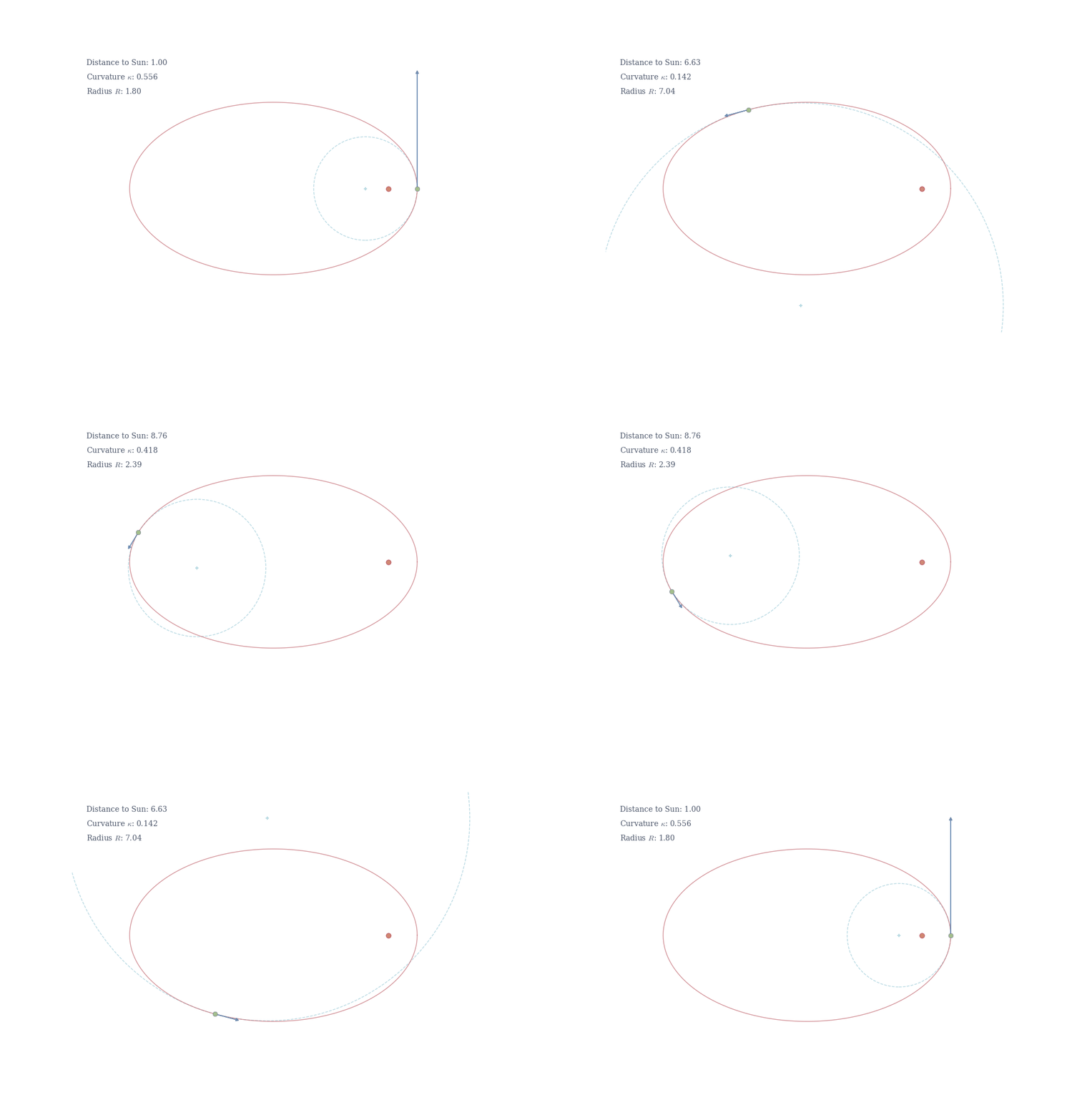
The ellipse. To differentiate \(y' = -\frac{b^2x}{a^2y}\) again we use implicit differentiation a second time: \[ y'' = -\frac{b^2}{a^2}\cdot\frac{y - x y'}{y^2} = -\frac{b^2}{a^2y^3}\Big(y^2 + \frac{b^2x^2}{a^2}\Big) = -\frac{b^4}{a^2y^3}, \] using \(\frac{x^2}{a^2} + \frac{y^2}{b^2} = 1\) to replace the bracket by \(b^2\). At the top \((0, b)\) we have \(y' = 0\) and \(y'' = -\frac{b}{a^2}\), so \(\kappa = \frac{b}{a^2}\). Near \((a, 0)\) the ellipse is the graph of \(x\) as a function of \(y\), and the same computation with the roles of \(x\) and \(y\) exchanged gives \(\kappa = \frac{a}{b^2}\). For \(a > b\) the curvature is larger at the ends of the long axis than at the top, which matches the picture.
12.6 Where This Leads
The next part of the book uses derivatives to answer questions. L’Hôpital’s rule evaluates limits that the algebra of limits cannot. Optimization finds maxima and minima, and the second derivative of this chapter decides which critical points are which. Related rates are implicit differentiation with time as the variable: two quantities tied by an equation have rates of change tied by the differentiated equation.
TipKey Ideas
- The derivative of an inverse is the reciprocal: \((f^{-1})'(f(a)) = 1/f'(a)\), because reflecting a graph in the diagonal exchanges rise and run. The proof needs \(f\) continuous and strictly monotone and \(f'(a) \ne 0\). A derivative that is nonzero at one point does not give an inverse.
- Inverse trigonometric derivatives follow at once: \((\arcsin y)' = \frac{1}{\sqrt{1-y^2}}\), \((\arctan y)' = \frac{1}{1+y^2}\), \((\arccos y)' = -\frac{1}{\sqrt{1-y^2}}\).
- Implicit differentiation applies the chain rule to an equation \(F(x, y(x)) = 0\) and solves for \(y'\). It assumes a differentiable branch \(y(x)\) exists, and it fails where the coefficient of \(y'\) vanishes.
- \(f'/f\) is the relative rate of change, and \(\ln|f|\) turns products into sums, so logarithmic differentiation is the product rule organized for long products and variable exponents.
- \(C^k\) records how many continuous derivatives a function has. Differentiable does not imply \(C^1\), and smooth functions can have all derivatives vanish at a point without being zero nearby.
- \(f'' > 0\) on an interval means the graph lies above its tangent lines. Curvature divides the turning of the tangent by the length traveled, and gives \(1/r\) for a circle of radius \(r\).
WarningProblem Set
Implicit differentiation.
For the folium \(x^3 + y^3 = 6xy\), show that \(y' = \dfrac{2y - x^2}{y^2 - 2x}\).
Find the points where the tangent is horizontal.
Find the tangent line at \((3,3)\).
Show that the tangent line to the ellipse \(\frac{x^2}{a^2} + \frac{y^2}{b^2} = 1\) at \((x_0, y_0)\) with \(y_0 \ne 0\) is \[ \frac{x\,x_0}{a^2} + \frac{y\,y_0}{b^2} = 1. \]
Logarithmic differentiation.
Let \(f(x) = (\sin x)^x\) for \(x \in (0,\pi)\). Show that \(f'(x) = (\sin x)^x\,\big[\ln(\sin x) + x\cot x\big]\).
Show that \(x = \frac\pi2\) is a critical point of \(f\), and that \(f\) has another critical point in \((0.3, 0.5)\).
Show that \(\dfrac{(fgk)'}{fgk} = \dfrac{f'}{f} + \dfrac{g'}{g} + \dfrac{k'}{k}\) wherever \(fgk \ne 0\).
Inverse functions.
Let \(f\) be invertible with \(f(2) = 3\) and \(f'(2) = 5\). Find \((f^{-1})'(3)\).
If also \(f''(2) = 7\), find \((f^{-1})''(3)\) by differentiating \((f^{-1})'(f(x))\,f'(x) = 1\).
Show that \(\arcsin y + \arccos y = \frac\pi2\) on \([-1,1]\). (Differentiate, and evaluate at one point.)
Show that \(f(x) = x^3\) is strictly increasing and continuous, but \(f^{-1}\) is not differentiable at \(0\). Which hypothesis of Theorem 12.1 fails?
Smoothness and concavity.
Let \(f(x) = x^3\sin(1/x)\) for \(x \ne 0\) and \(f(0) = 0\). Show that \(f \in C^1(\mathbb{R})\) but \(f''(0)\) does not exist.
Show that \((fg)'' = f''g + 2f'g' + fg''\).
Use Proposition 12.1 to show \(e^x > 1 + x\) for \(x \ne 0\) and \(\ln x < x - 1\) for \(x > 0\), \(x \ne 1\).
Find the inflection points of \(f(x) = xe^{-x^2}\).
Curvature (optional).
Find the curvature of \(y = x^2\) at \(x = 0\) and at \(x = 1\).
Find the radius of curvature of \(y = x^2\) at \(x = 0\).
WarningSolutions
Differentiating, \(3x^2 + 3y^2y' = 6y + 6xy'\), so \(y'(3y^2 - 6x) = 6y - 3x^2\) and \(y' = \frac{2y - x^2}{y^2 - 2x}\).
The tangent is horizontal where \(2y = x^2\) and \(y^2 \ne 2x\). Substituting \(y = \frac{x^2}{2}\) into the curve gives \(x^3 + \frac{x^6}{8} = 3x^3\), so \(x^6 = 16x^3\) and \(x = 0\) or \(x^3 = 16\). At \(x = 0\) the point is the origin, where \(y^2 - 2x = 0\) as well, so the formula gives \(\frac00\) and we exclude it. For \(x^3 = 16\) we get \(x = 2\sqrt[3]2\) and \(y = \frac{x^2}{2} = 2\sqrt[3]{4}\), and \(y^2 - 2x = 8\sqrt[3]2 - 4\sqrt[3]2 = 4\sqrt[3]2 \ne 0\). Check: \(x^3 + y^3 = 16 + 32 = 48 = 6xy = 3x^3\).
The point lies on the curve: \(27 + 27 = 54 = 6\cdot 9\). The slope is \(\frac{6 - 9}{9 - 6} = -1\), so the tangent line is \(y - 3 = -(x - 3)\), i.e. \(x + y = 6\).
By Example 5, the slope at \((x_0,y_0)\) is \(-\frac{b^2x_0}{a^2y_0}\), so the tangent is \(y - y_0 = -\frac{b^2x_0}{a^2y_0}(x - x_0)\). Multiply by \(\frac{y_0}{b^2}\): \(\frac{y y_0}{b^2} - \frac{y_0^2}{b^2} = -\frac{x_0(x - x_0)}{a^2}\). Rearranging gives \(\frac{xx_0}{a^2} + \frac{yy_0}{b^2} = \frac{x_0^2}{a^2} + \frac{y_0^2}{b^2} = 1\).
\(\ln f = x\ln\sin x\), so \(\frac{f'}{f} = \ln(\sin x) + x\frac{\cos x}{\sin x}\).
Since \((\sin x)^x > 0\), critical points are the zeros of \(\psi(x) = \ln(\sin x) + x\cot x\). At \(x = \frac\pi2\), \(\sin = 1\) and \(\cot = 0\), so \(\psi = 0\). At \(x = 0.3\): \(\ln(0.2955) = -1.219\) and \(0.3\cot(0.3) = 0.970\), so \(\psi \approx -0.25 < 0\). At \(x = 0.5\): \(\ln(0.4794) = -0.735\) and \(0.5\cot(0.5) = 0.915\), so \(\psi \approx 0.18 > 0\). By the Intermediate Value Theorem \(\psi\) vanishes somewhere in \((0.3, 0.5)\) (near \(0.40\)).
Apply the product rule to \((fg)\cdot k\), as in Problem 4(a) of the previous chapter, and divide by \(fgk\): \(\frac{(fgk)'}{fgk} = \frac{f'gk + fg'k + fgk'}{fgk}\).
\((f^{-1})'(3) = \frac{1}{f'(2)} = \frac15\).
Let \(g = f^{-1}\). Differentiating \(g'(f(x))f'(x) = 1\) gives \(g''(f(x))f'(x)^2 + g'(f(x))f''(x) = 0\). At \(x = 2\): \(25\,g''(3) + \frac15\cdot 7 = 0\), so \(g''(3) = -\frac{7}{125}\).
On \((-1,1)\) the derivative of \(\arcsin y + \arccos y\) is \(0\) (the derivatives cancel when \(\arccos y = \frac\pi2 - \arcsin y\) is replaced… so to avoid circularity, we compute \((\arccos y)'\) independently: \(\cos\) is strictly decreasing on \([0,\pi]\) with \(\cos' = -\sin < 0\) on \((0,\pi)\), so by Theorem 12.1, for \(y = \cos x\), \((\arccos y)' = -\frac{1}{\sin x} = -\frac{1}{\sqrt{1 - y^2}}\), since \(\sin x > 0\)). Hence the sum has derivative \(0\) on \((-1,1)\) and is constant by Corollary 9.1; at \(y = 0\) it equals \(0 + \frac\pi2\). At \(y = \pm1\) the identity holds by continuity.
\(x^3\) is continuous and strictly increasing, with inverse \(\sqrt[3]y\). At \(b = 0\) the quotient is \(\frac{\sqrt[3]{k}}{k} = k^{-2/3} \to \infty\), so the inverse is not differentiable at \(0\). The hypothesis \(f'(a) \ne 0\) fails at \(a = 0\), since \(f'(0) = 0\).
\(f'(0) = \lim h^2\sin(1/h) = 0\) because \(|h^2\sin(1/h)| \le h^2\). For \(x \ne 0\), \(f'(x) = 3x^2\sin(1/x) - x\cos(1/x) \to 0\) as \(x \to 0\), so \(f'\) is continuous at \(0\) and \(f \in C^1\). But \(\frac{f'(h) - f'(0)}{h} = 3h\sin(1/h) - \cos(1/h)\): the first term tends to \(0\), and \(\cos(1/h)\) has no limit (it equals \(1\) at \(h = \frac{1}{2n\pi}\) and \(-1\) at \(h = \frac{1}{(2n+1)\pi}\)). So \(f''(0)\) does not exist.
\((fg)' = f'g + fg'\), and differentiating again, \((fg)'' = f''g + f'g' + f'g' + fg'' = f''g + 2f'g' + fg''\).
For \(e^x\): \(f'' = e^x > 0\), and the tangent at \(a = 0\) is \(1 + x\), so \(e^x > 1 + x\) for \(x \ne 0\). For \(\ln\): \(-\ln\) has second derivative \(\frac{1}{x^2} > 0\) on \((0,\infty)\), and its tangent at \(1\) is \(-(x-1)\), so \(-\ln x > -(x - 1)\), i.e. \(\ln x < x - 1\) for \(x \ne 1\).
\(f' = (1 - 2x^2)e^{-x^2}\) and \(f'' = (-4x)e^{-x^2} + (1 - 2x^2)(-2x)e^{-x^2} = (4x^3 - 6x)e^{-x^2} = 2x(2x^2 - 3)e^{-x^2}\). This changes sign at \(x = 0\) and \(x = \pm\sqrt{3/2}\), which are the inflection points.
\(f' = 2x\) and \(f'' = 2\). At \(x = 0\): \(\kappa = \frac{2}{1} = 2\). At \(x = 1\): \(\kappa = \frac{2}{5^{3/2}} = \frac{2}{5\sqrt5} \approx 0.179\).
The radius of curvature is \(\frac1\kappa = \frac12\) at \(x = 0\).