
2 Sequences of Real Numbers
2.1 What Is a Sequence?
Suppose you measure something at regular intervals: a patient’s blood pressure each week, a savings balance each month, a pendulum’s position each second. You obtain a list of numbers \(a_1, a_2, a_3, \dots\) that never has to end. The interesting questions are almost never about one entry. They are about the pattern: does the list settle down, run off to infinity, or bounce around forever?
A finite record like this can only suggest a pattern. A sequence is the idealization in which the list never ends, and “what happens in the long run” becomes a question with a definite answer. Calculus is largely the art of answering that question precisely: limits, derivatives, integrals and series will all turn out to be statements about how some list of numbers behaves eventually. So we begin here, in the simplest setting where “eventually” has a meaning.
Definition 2.1 (Sequence) A sequence of real numbers is a function \[ a : \{n_0, n_0+1, n_0+2, \dots\} \to \mathbb{R}, \qquad n \mapsto a_n, \] where \(n_0\) is an integer, usually \(0\) or \(1\). The number \(a_n\) is the \(n\)-th term. We write the whole sequence as \((a_n)_{n \ge n_0}\), or simply \((a_n)\).
Two remarks are worth absorbing early, because they prevent a surprising number of mistakes later.
A sequence is the whole list, not one entry. \((a_n)\) is the entire infinite object; \(a_n\) is a single number. The difference is that between a film and one frame of it.
Parentheses, not braces. As a set, \(\{(-1)^n : n \ge 1\} = \{-1, 1\}\), which records which values occur and nothing else. The sequence \(\big((-1)^n\big) = (-1, 1, -1, 1, \dots)\) also remembers order and repetition. Long-run behavior lives in exactly that extra information, so we always write sequences with parentheses.
Indexing. Unless stated otherwise we start at \(n = 1\). Recursively defined sequences naturally start at \(n = 0\), where the “initial value” \(a_0\) lives. Each example below states its starting index.
2.1.1 Examples
- \(a_n = 1/n\) for \(n \ge 1\), i.e. \(\left(1, \tfrac12, \tfrac13, \tfrac14, \dots\right)\). The terms shrink toward \(0\) but never reach it.

- \(a_n = (-1)^n \dfrac{n}{n+1}\) for \(n \ge 1\), i.e. \(\left(-\tfrac12, \tfrac23, -\tfrac34, \tfrac45, -\tfrac56, \dots\right)\). Even-indexed terms creep up toward \(+1\), odd-indexed terms down toward \(-1\). There is no single number the sequence is approaching.
- \(a_n = n^2\) for \(n \ge 1\): \((1, 4, 9, 16, \dots)\). This one simply runs off.
A finite list never determines a sequence. The list \(1, 2, 4, 8, 16\) begs to be continued with \(32\), the pattern \(2^{n-1}\). But the number of regions cut out of a disk by chords joining \(n\) points on its boundary begins \(1, 2, 4, 8, 16\) and then continues with \(31\). Spotting a pattern in the first few terms produces a conjecture. To define a sequence you must give a rule that determines \(a_n\) for every \(n\).
2.2 Describing Long-Run Behavior
Given a sequence, there are three questions worth asking. Does it stay in a bounded region? Does it move consistently in one direction? Does it settle down? The first two have easy definitions.
Definition 2.2 (Bounded) A sequence \((a_n)\) is bounded if there is a number \(M \ge 0\) such that \(|a_n| \le M\) for all \(n\).
Definition 2.3 (Monotone) A sequence \((a_n)\) is nondecreasing if \(a_{n+1} \ge a_n\) for all \(n\), and nonincreasing if \(a_{n+1} \le a_n\) for all \(n\). It is monotone if it is one or the other. (Replace \(\ge, \le\) by \(>, <\) for strictly increasing or decreasing.)
| Sequence | Bounded? | Monotone? |
|---|---|---|
| \(1/n\) | yes (\(0 < a_n \le 1\)) | yes (decreasing) |
| \((-1)^n \frac{n}{n+1}\) | yes (\(\lvert a_n\rvert < 1\)) | no |
| \(n^2\) | no | yes (increasing) |
| \((-1)^n\) | yes | no |
| \((-1)^n n\) | no | no |
Notice what the table says: neither property alone tells you whether the sequence settles down. The sequence \((-1)^n\) is bounded and never settles; \(n^2\) is monotone and escapes. Yet the two properties together are much more powerful: a sequence that is both bounded and monotone cannot help but settle down. We will prove this later, and it is the first place in the course where the completeness of \(\mathbb{R}\) does real work.
Definition 2.4 (Eventually) A property of the terms holds eventually if there is an \(N\) such that it holds for all \(n \ge N\).
The word “eventually” carries most of the philosophy of this chapter. Changing the first million terms of a sequence, or the first billion, changes nothing about its long-run behavior. Any statement about where a sequence “goes” is a statement about its tail, and no finite amount of data can decide it.
2.3 A First Look at Convergence
What should it mean to say that \(a_n = 1/n\) “approaches \(0\)”, when no term ever equals \(0\)? Here is the idea, which the next chapter makes precise. Think of a challenge-and-response game. You name a tolerance, say \(0.001\). I must answer with a starting point after which every term is within that tolerance of \(0\). Since \(1/n < 0.001\) exactly when \(n > 1000\), I can answer with \(N = 1000\). If you name \(10^{-6}\), I answer \(N = 10^6\). However small a tolerance you choose, I can respond, and that is what “approaches \(0\)” means.
Written out, the statement \(a_n \to L\) says: \[ \text{for every } \varepsilon > 0 \text{ there is an } N \text{ such that } |a_n - L| < \varepsilon \text{ for all } n \ge N. \] (Proofs and the full theory come in the next chapter.)
Notice how much work “for every tolerance” does. It is also how you show a sequence does not settle: exhibit a single tolerance that no \(N\) can satisfy. For \(a_n = (-1)^n \frac{n}{n+1}\), consecutive terms have opposite signs, so \[ |a_{n+1} - a_n| = \frac{n+1}{n+2} + \frac{n}{n+1} = 2 - \frac{1}{n+2} - \frac{1}{n+1} > 1 \qquad (n \ge 1). \] If the terms did settle near some \(L\), then eventually every term would lie within \(\tfrac12\) of \(L\), so consecutive terms would be within \(1\) of each other. They never are. The tolerance \(\tfrac12\) defeats every candidate \(L\).
2.4 Two Ways to Define a Sequence
An explicit definition gives a formula for \(a_n\) in terms of \(n\), as in \(a_n = 1/n\). A recursive definition tells you how to get each term from the ones before it. Populations, bank balances and algorithms are naturally described this way: we know the rule of evolution before we know any closed formula.
Definition 2.5 (Recurrence Relation) A sequence \((a_n)_{n\ge 0}\) satisfies a recurrence of order \(k\) if there are a function \(f : \mathbb{R}^k \to \mathbb{R}\) and initial values \(a_0, \dots, a_{k-1}\) such that \[ a_{n+k} = f(a_{n+k-1}, \dots, a_{n}) \qquad \text{for all } n \ge 0. \]
Order \(1\) means \(a_{n+1} = f(a_n)\): each term depends only on the previous one, and a single initial value \(a_0\) starts the process.
2.4.1 Geometric and Arithmetic Sequences
The recurrence \(a_{n+1} = r\,a_n\) multiplies by a fixed ratio \(r\) at each step; the recurrence \(a_{n+1} = a_n + d\) adds a fixed difference \(d\). Their closed forms are \[ a_n = a_0\, r^n \qquad\text{and}\qquad a_n = a_0 + n\,d . \] These are theorems about the recursions, and a one-line induction proves each. For the geometric case: \(a_0 = a_0 r^0\), and if \(a_n = a_0 r^n\) then \(a_{n+1} = r\,a_n = a_0 r^{n+1}\).
2.4.2 Heron’s Method
Define \(a_0 = 1\) and \[ a_{n+1} = \frac12\left(a_n + \frac{2}{a_n}\right). \] The terms are \(1,\ 1.5,\ 1.41667,\ 1.414216,\ 1.41421356, \dots\). This is Newton’s method applied to \(x^2 - 2 = 0\), and it homes in on \(\sqrt2 = 1.41421356\ldots\) with startling speed: the number of correct digits roughly doubles at each step.
Observe the logic of what we can and cannot say yet. All terms are positive, and if they approach a limit \(L\), then passing to the limit in the recursion gives \(L = \tfrac12\left(L + \tfrac{2}{L}\right)\), which rearranges to \(L^2 = 2\), so \(L = \sqrt2\). This does not prove that the sequence converges. It only shows what the limit would have to be. Existence is a separate question, and we will answer it later using the monotone bounded theorem.
2.4.3 Simple Oscillation
\(a_0 = 1\), \(a_{n+1} = -a_n\) gives \(1, -1, 1, -1, \dots\). It is bounded, but it never settles down.
2.4.4 Affine Recurrences
The recurrence \(a_{n+1} = c\,a_n + d\) is the first one whose behavior is not obvious at a glance, yet it can be solved completely. The trick is to measure everything from the equilibrium.
Proposition 2.1 (Affine recurrences) Let \(c \ne 1\) and \(d\) be real numbers, and set \(L = \dfrac{d}{1-c}\). If \(a_{n+1} = c\,a_n + d\), then \[ a_n = c^{\,n}\,(a_0 - L) + L \qquad \text{for all } n \ge 0. \]
Proof. The number \(L\) satisfies \(L = cL + d\). Subtracting this from \(a_{n+1} = c\,a_n + d\) gives \(a_{n+1} - L = c\,(a_n - L)\). So the distance \(e_n = a_n - L\) from equilibrium obeys the geometric recursion \(e_{n+1} = c\,e_n\), hence \(e_n = c^n e_0\). \(\square\)
The proposition explains the behavior at a glance. Each step multiplies the distance from \(L\) by \(c\). If \(|c| < 1\) that distance shrinks geometrically, and if \(c < 0\) the sequence alternates sides of \(L\) as it does so. If \(|c| > 1\) it escapes, and if \(c = -1\) it oscillates forever. (For \(c = 1\) the recursion is the arithmetic one above.)
Example. Take \(a_{n+1} = -\tfrac12 a_n + \tfrac14\) with \(a_0 = 1\). Here \(L = \dfrac{1/4}{1 + 1/2} = \dfrac16\), so \[ a_n = \left(-\tfrac12\right)^n \cdot \tfrac56 + \tfrac16 . \] As a check, \(a_1 = -\tfrac12 + \tfrac14 = -\tfrac14\), and the formula gives \(-\tfrac{5}{12} + \tfrac{2}{12} = -\tfrac14\). The sequence spirals in on \(\tfrac16\), a damped oscillation like a pendulum with friction.
2.4.5 Explicit or Recursive?
A recursive description mirrors how the process unfolds, and for many sequences it is the only description we have. An explicit formula lets you jump straight to \(a_{10^9}\), and makes long-run behavior visible. Turning one into the other is what “solving a recurrence” means. This is possible for the families above, but for most nonlinear recurrences no simple closed form is known.
2.4.6 Reading a Pattern
A vibrating particle is measured at integer times, giving \(\left(-\tfrac58, \tfrac{17}{32}, -\tfrac{65}{128}, \tfrac{257}{512}, \dots\right)\). To find a rule, look at the numerators and denominators separately: \[ 5 = 4^1+1,\ \ 17 = 4^2+1,\ \ 65 = 4^3+1,\ \ 257 = 4^4+1; \qquad 8 = 2\cdot 4^1,\ \ 32 = 2\cdot 4^2,\ \ 128 = 2\cdot4^3,\ \ 512 = 2\cdot 4^4 . \] With alternating signs and \(n \ge 1\), \[ a_n = (-1)^n\,\frac{4^n+1}{2\cdot 4^n} = (-1)^n\left(\frac12 + \frac{1}{2\cdot 4^n}\right). \] The second form reveals the behavior: a sign flip times a quantity approaching \(\tfrac12\). Even terms approach \(+\tfrac12\) and odd terms \(-\tfrac12\), so, as in Example 2, this sequence does not settle. (And by the remark above, the formula is a conjecture that fits four data points; to be sure, it would have to come with a rule that holds for all \(n\).)
NoteGoing Further: Fibonacci and the Logistic Map
This section is optional. It shows what happens when recurrences leave the comfortable linear world.
Fibonacci. The sequence \(F_0 = 0\), \(F_1 = 1\), \(F_{n+2} = F_{n+1} + F_n\) is a recurrence of order \(2\), so it needs two initial values. Try a solution of the form \(F_n = \rho^n\): this works exactly when \(\rho^2 = \rho + 1\), i.e. \(\rho = \varphi = \frac{1+\sqrt5}{2}\) or \(\hat\varphi = \frac{1-\sqrt5}{2}\). Matching \(F_0 = 0\) and \(F_1 = 1\) gives \[ F_n = \frac{\varphi^n - \hat\varphi^{\,n}}{\sqrt5}. \]
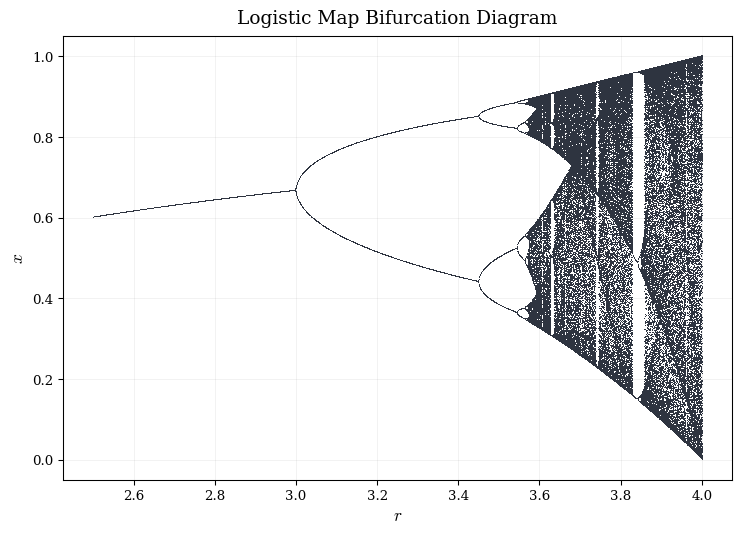
The logistic map. Let \(P_n\) be a population in generation \(n\), \(K\) a scale (the “carrying capacity”) and \(r\) a parameter, and suppose \[ P_{n+1} = r\,P_n\left(1 - \frac{P_n}{K}\right). \] Setting \(x_n = P_n/K\) gives the dimensionless recurrence \[ x_{n+1} = r\,x_n(1 - x_n), \qquad 0 < r \le 4,\ \ x_0 \in [0, 1], \] which keeps every \(x_n\) in \([0,1]\). The fixed points, the values with \(x = r\,x(1-x)\), are \(0\) and \(1 - \tfrac1r\). So the nonzero equilibrium population is \(K\left(1 - \tfrac1r\right)\), which is below \(K\): here \(K\) sets a scale but is not the equilibrium.
What happens as \(r\) grows? For \(1 < r < 3\) the sequence settles at \(1 - \tfrac1r\). At \(r = 3\) that equilibrium loses stability and the sequence starts alternating between two values, then four, then eight, and so on, with the doublings accumulating at \(r \approx 3.57\). Beyond that the behavior is mostly chaotic, interrupted by windows of order (for instance a stable period 3 near \(r \approx 3.83\)). The map was popularized by R. M. May in 1976, and the universality of the period-doubling cascade was found by Feigenbaum in the 1970s.

The hallmark of chaos is sensitive dependence on initial conditions. At \(r = 3.9\), two trajectories starting \(10^{-6}\) apart follow each other for a while and then have nothing to do with each other, even though nothing random is involved.
Code
rv = 3.9
x, y = [0.5], [0.5 + 1e-6]
for _ in range(60):
    x.append(rv * x[-1] * (1 - x[-1]))
    y.append(rv * y[-1] * (1 - y[-1]))

fig, ax = plt.subplots(figsize=(9, 2.8))
ax.plot(x, "-o", color=BLUE, ms=3, lw=1, label="$x_0 = 0.5$")
ax.plot(y, "-o", color=RED, ms=3, lw=1, alpha=0.7, label="$x_0 = 0.500001$")
ax.set_xlabel("$n$"); ax.legend(frameon=False, loc="upper right")
plt.show()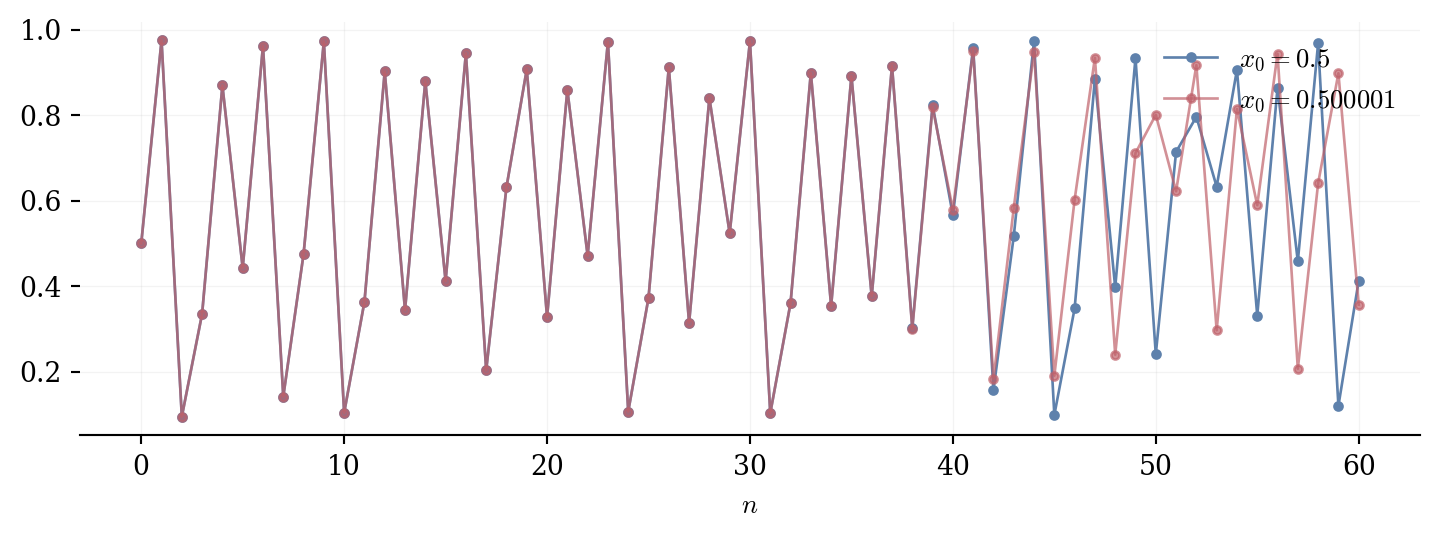
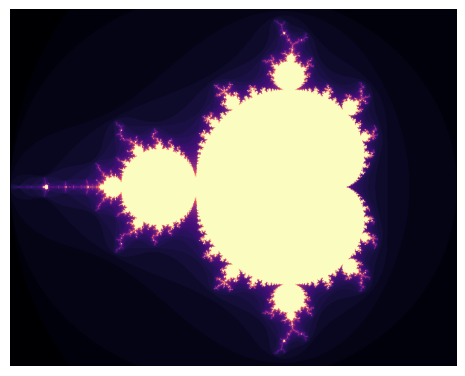
The quadratic iteration \(z_{n+1} = z_n^2 + c\) is the same family in disguise: for real \(c\) it is the logistic map after a change of variable, and for complex \(c\) the set of parameters whose orbit from \(z_0 = 0\) stays bounded is the Mandelbrot set.
TipKey Ideas
- A sequence is a function on the integers. \((a_n)\) is the whole list and \(a_n\) is one term, and we use parentheses because order and repetition matter.
- Long-run behavior is a property of the tail: it is unchanged by altering finitely many terms, and no finite list determines a sequence.
- Bounded and monotone are easy to define and neither alone implies that a sequence settles; together they do (proved later).
- \(a_n \to L\) means: for every tolerance there is a point after which all terms are within it. To refute convergence, exhibit a tolerance that no point satisfies.
- Recursions can often be solved by measuring distance from an equilibrium, as in the affine case.
- When a limit is assumed to exist, the recursion tells you what it must be. Proving it exists is a separate step.
WarningProblem Set
Let \(a_n = \dfrac{3n-1}{n+2}\) for \(n \ge 1\).
Compute \(a_1, a_2, a_3\) and write the first four terms as a list.
Show that \(a_n = 3 - \dfrac{7}{n+2}\).
Using (b), show that \(a_{n+1} - a_n = \dfrac{7}{(n+2)(n+3)}\) and explain why the change between consecutive terms shrinks as \(n\) grows.
Show that \((a_n)\) is increasing and bounded, with \(0 < a_n < 3\).
Let \(b_0 = 1\) and \(b_{n+1} = 2b_n + 1\) for \(n \ge 0\).
Compute \(b_1, b_2, b_3\).
Guess a closed form for \(b_n\), and prove it by induction.
Recover the same closed form from the proposition on affine recurrences.
State one advantage and one disadvantage of a recursive definition compared with an explicit one.
Let \(c_n = (-1)^n \dfrac{n+1}{n+2}\) for \(n \ge 1\).
Write out the first six terms.
Give formulas for the even-indexed terms \(c_{2k}\) (\(k\ge1\)) and odd-indexed terms \(c_{2k+1}\) (\(k \ge 0\)).
Describe how \(|c_n|\) behaves as \(n\) increases.
Show that \(|c_{n+1} - c_n| > 1\) for all \(n \ge 1\), and use the argument from the chapter to explain why \((c_n)\) does not settle down.
For each sequence, decide whether it is bounded and whether it is monotone, then say which you expect to settle down.
- \(n^2\) (ii) \(1/n^2\) (iii) \(\dfrac{n}{n+1}\) (iv) \((-1)^n n\) (v) \(\dfrac{(-1)^n}{n}\)
A first look at convergence.
Find \(N\) such that \(\dfrac1n < 10^{-3}\) for all \(n \ge N\).
For \(a_n = \dfrac{3n-1}{n+2}\), find \(N\) such that \(|a_n - 3| < 0.01\) for all \(n \ge N\).
Given any \(\varepsilon > 0\), find an \(N\) (in terms of \(\varepsilon\)) such that \(|a_n - 3| < \varepsilon\) for all \(n \ge N\).
WarningSolutions
\(a_1 = \frac{2}{3}\), \(a_2 = \frac{5}{4}\), \(a_3 = \frac{8}{5}\), and \(a_4 = \frac{11}{6}\), so the list is \(\frac23, \frac54, \frac85, \frac{11}{6}, \dots\)
\(\dfrac{3n-1}{n+2} = \dfrac{3(n+2) - 7}{n+2} = 3 - \dfrac{7}{n+2}\).
\(a_{n+1} - a_n = \dfrac{7}{n+2} - \dfrac{7}{n+3} = \dfrac{7}{(n+2)(n+3)}\). The denominator grows like \(n^2\), so consecutive terms get closer and closer together.
By (c), \(a_{n+1} - a_n > 0\), so the sequence is increasing. By (b), \(a_n < 3\) for every \(n\), and \(a_n \ge a_1 = \frac23 > 0\). So \(0 < a_n < 3\): bounded.
\(b_1 = 3\), \(b_2 = 7\), \(b_3 = 15\).
The values \(1, 3, 7, 15\) are each one less than a power of \(2\), suggesting \(b_n = 2^{n+1} - 1\). Base case: \(2^1 - 1 = 1 = b_0\). Inductive step: if \(b_n = 2^{n+1} - 1\), then \(b_{n+1} = 2(2^{n+1}-1) + 1 = 2^{n+2} - 1\). \(\square\)
Here \(c = 2\), \(d = 1\), so \(L = \frac{1}{1-2} = -1\). Then \(b_n = 2^n(b_0 - L) + L = 2^n \cdot 2 - 1 = 2^{n+1} - 1\).
Advantage: a recursion describes how the process evolves and is often the natural model. Disadvantage: computing \(b_n\) from the recursion alone requires computing all earlier terms, and long-run behavior is not visible from the rule.
\(-\frac23,\ \frac34,\ -\frac45,\ \frac56,\ -\frac67,\ \frac78\).
\(c_{2k} = \dfrac{2k+1}{2k+2}\) (positive) and \(c_{2k+1} = -\dfrac{2k+2}{2k+3}\) (negative).
\(|c_n| = \frac{n+1}{n+2} = 1 - \frac{1}{n+2}\) increases toward \(1\) but always stays below it.
Consecutive terms have opposite signs, so \[ |c_{n+1} - c_n| = \frac{n+2}{n+3} + \frac{n+1}{n+2} = 2 - \frac{1}{n+3} - \frac{1}{n+2} \ge 2 - \frac14 - \frac13 = \frac{17}{12} > 1 . \] If the sequence settled near some \(L\), eventually every term would be within \(\frac12\) of \(L\), forcing consecutive terms to be within \(1\) of each other. That never happens, so \((c_n)\) does not settle down.
Unbounded; increasing. Does not settle.
Bounded (\(0 < a_n \le 1\)); decreasing. Settles, at \(0\).
\(\frac{n}{n+1} = 1 - \frac{1}{n+1}\): bounded (\(0 < a_n < 1\)); increasing. Settles, at \(1\).
Unbounded; not monotone (the sign alternates). Does not settle.
Bounded (\(|a_n| \le 1\)); not monotone (the sign alternates). It still settles, at \(0\), because \(|a_n| = 1/n \to 0\). Monotonicity is not necessary for settling.
\(\frac1n < 10^{-3} \iff n > 1000\), so \(N = 1001\) works.
\(|a_n - 3| = \frac{7}{n+2} < 0.01 \iff n + 2 > 700 \iff n \ge 699\). So \(N = 699\).
\(|a_n - 3| = \frac{7}{n+2} < \varepsilon \iff n + 2 > \frac{7}{\varepsilon}\). Choose any integer \(N > \frac{7}{\varepsilon}\); then for all \(n \ge N\) we have \(n + 2 > \frac{7}{\varepsilon}\), so \(|a_n - 3| < \varepsilon\).
You can download the problem set here: