6 Construction of the Real Numbers
We have treated \(\mathbb{R}\) as given throughout Part II. At least once, you should see where it comes from.
The problem with \(\mathbb{Q}\) is that it has holes. The canonical example:
\[ A = \{q \in \mathbb{Q}_{>0} : q^2 < 2\} \]
is bounded above in \(\mathbb{Q}\) — by \(2\), for instance — but has no supremum there. The set is reaching for \(\sqrt{2}\), and \(\sqrt{2}\) is not there. More generally, there exist Cauchy sequences in \(\mathbb{Q}\) with no limit in \(\mathbb{Q}\): the partial sums \[ \sum_{k=0}^n \frac{(-1)^k}{2k+1} \] converge to \(\pi/4\), which is irrational.
The fix is direct: formally adjoin the missing limits. A Cauchy sequence in \(\mathbb{Q}\) that does not converge to a rational number is reaching for something; declare that something to exist. Call it the limit.
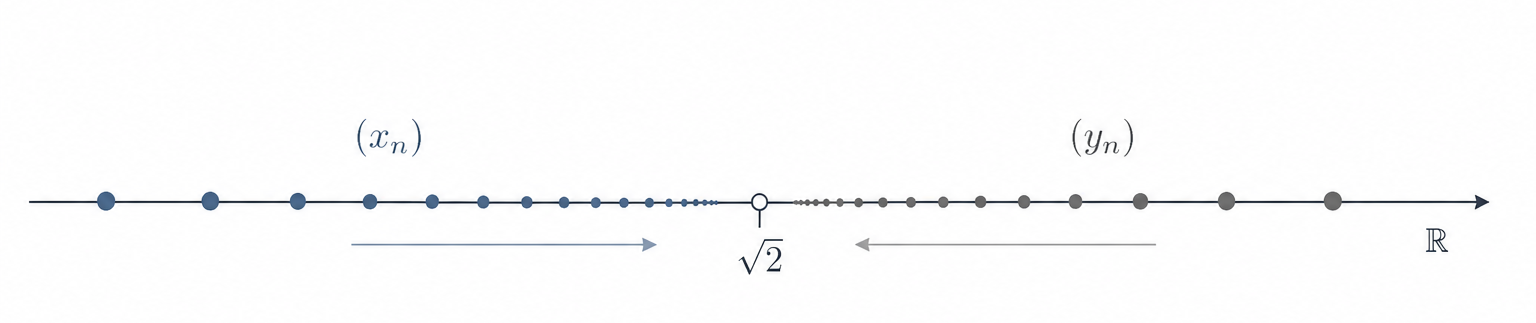
Both sequences are in \(\mathbb{Q}\). Both are Cauchy. Neither converges to a rational number. The equivalence class that contains them both is \(\sqrt{2}\) — once we build \(\mathbb{R}\).
6.1 Cauchy sequences of rationals
Definition 6.1 (Cauchy sequence in \(\mathbb{Q}\)) A sequence \((x_n) \subset \mathbb{Q}\) is Cauchy if \[ \forall\, \varepsilon > 0,\; \exists N \in \mathbb{N} : m,n \geq N \Rightarrow |x_m - x_n| < \varepsilon. \]
Write \(\mathcal{Q}_C\) for the set of all Cauchy sequences in \(\mathbb{Q}\). Note the apparent circularity: \(\varepsilon > 0\) and \(|\cdot|\) are invoked before \(\mathbb{R}\) is defined. There is no circularity — the condition references only \(\mathbb{Q}\), where arithmetic and absolute value are already defined.
Two Cauchy sequences are equivalent if their difference converges to zero: \[ (x_n) \sim (y_n) \quad \iff \quad |x_n - y_n| \to 0. \]
Lemma 6.1 (\(\sim\) is an equivalence relation)
Proof. Reflexivity and symmetry are immediate.
For transitivity, suppose \[ |x_n-y_n| \to 0, \qquad |y_n-z_n| \to 0. \] Then by the triangle inequality, \[ |x_n-z_n| \leq |x_n-y_n| + |y_n-z_n| \to 0. \] Hence \((x_n)\sim(z_n)\).
Definition 6.2 (The real numbers) \[ \mathbb{R} := \mathcal{Q}_C/\!\sim. \]
A real number is an equivalence class \([(x_n)]\).
The picture is simple: every Cauchy sequence in \(\mathbb{Q}\) is reaching for a limit. Sequences reaching for the same limit are identified. The equivalence class becomes the limit itself — now an object in its own right, whether or not it previously existed inside \(\mathbb{Q}\).
NoteDedekind cuts
The other standard construction uses Dedekind cuts: a real number is defined as a subset \(\alpha \subset \mathbb{Q}\) that is nonempty, bounded above, closed downward, and contains no largest element. The cut represents \(\sup \alpha\).
This makes the order structure and the least upper bound property almost immediate: ordering becomes inclusion, and suprema are unions. Arithmetic, however, becomes technically cumbersome. The Cauchy sequence construction packages the algebra more cleanly and generalises naturally: any metric space can be completed by the same procedure.
6.2 Field structure
Define addition and multiplication termwise: \[ [(x_n)] + [(y_n)] := [(x_n+y_n)], \] \[ [(x_n)]\cdot[(y_n)] := [(x_ny_n)]. \]
These operations are well-defined on equivalence classes.
For addition, if \((x_n)\sim(x_n')\) and \((y_n)\sim(y_n')\), then \[ |(x_n+y_n)-(x_n'+y_n')| \leq |x_n-x_n'| + |y_n-y_n'| \to 0. \]
For multiplication, note first that every Cauchy sequence in \(\mathbb{Q}\) is bounded. If \(|x_n|\le M\), then \[ |x_ny_n - x_n'y_n'| \leq |x_n||y_n-y_n'| + |y_n'||x_n-x_n'|. \] Since \((y_n')\) is bounded and both differences converge to zero, the right-hand side converges to zero.
The additive and multiplicative identities are represented by the constant sequences \[ [(0,0,\dots)], \qquad [(1,1,\dots)]. \]
Associativity, commutativity, and distributivity follow immediately from the corresponding properties in \(\mathbb{Q}\).
For inverses: if \([(x_n)]\neq0\), then \((x_n)\) is not equivalent to the zero sequence. Hence there exist \(\varepsilon>0\) and \(N\) such that \[ |x_n|>\varepsilon \qquad (n\ge N). \] Thus \((1/x_n)\) is eventually defined and Cauchy, and we define \[ [(x_n)]^{-1}:=[(1/x_n)]. \]
Therefore \(\mathbb{R}\) is a field.
6.3 Order
Declare \([(x_n)]>0\) if there exist \(\varepsilon>0\) and \(N\) such that \[ x_n>\varepsilon \qquad (n\ge N). \]
Requiring a uniform positive lower bound is essential: the sequence \((1/n)\) is eventually positive but represents \(0\).
This definition is independent of representatives. Indeed, if \((x_n)\sim(y_n)\) and \(x_n>\varepsilon\) eventually, then eventually \[ |x_n-y_n|<\varepsilon/2, \] hence \[ y_n>x_n-\varepsilon/2>\varepsilon/2. \]
Define the full order relation by \[ [(x_n)] > [(y_n)] \iff [(x_n-y_n)]>0. \]
One checks that trichotomy holds: every real number is exactly one of positive, negative, or zero.
6.4 The embedding \(\mathbb{Q}\hookrightarrow\mathbb{R}\)
Define \[ q \mapsto [(q,q,q,\dots)]. \]
This is a field homomorphism. It is injective because two constant sequences are equivalent only when the constants agree.
Henceforth we identify \(\mathbb{Q}\) with its image inside \(\mathbb{R}\).
6.5 Completeness
Theorem 6.1 (\(\mathbb{R}\) is complete) Every Cauchy sequence in \(\mathbb{R}\) converges in \(\mathbb{R}\).
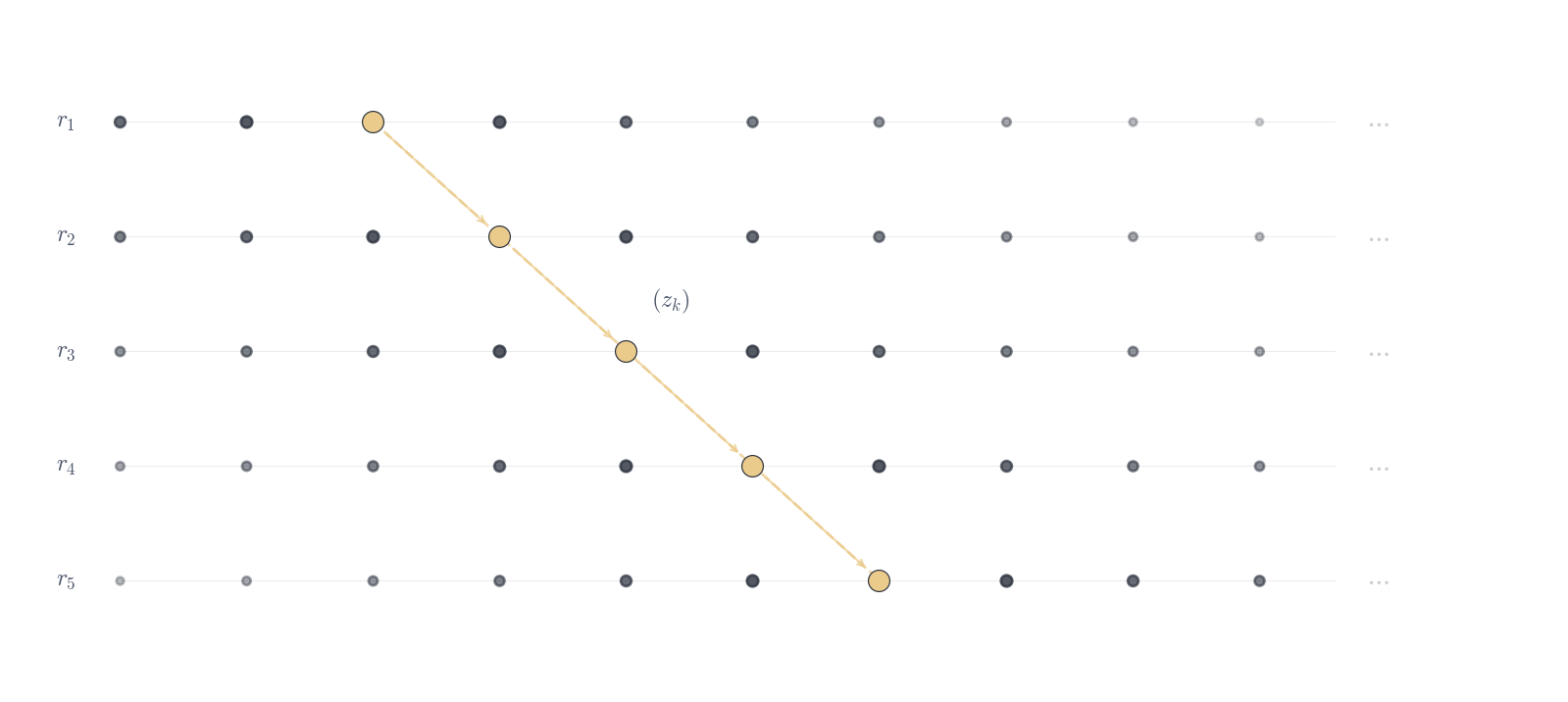
Proof. Let \((r_k)\) be a Cauchy sequence in \(\mathbb{R}\), where \[ r_k=[(x_n^{(k)})]. \]
For each fixed \(k\), the representative sequence \((x_n^{(k)})\) is Cauchy in \(\mathbb{Q}\). Hence there exists \(N_k\) such that \[ m,n\ge N_k \quad\Rightarrow\quad |x_m^{(k)}-x_n^{(k)}|<\frac1k. \]
Choose \[ z_k:=x_{N_k}^{(k)}\in\mathbb{Q}. \]
We claim that \((z_k)\) is Cauchy in \(\mathbb{Q}\).
Let \(\varepsilon>0\). Since \((r_k)\) is Cauchy in \(\mathbb{R}\), there exists \(K\) such that \[ j,\ell\ge K \quad\Rightarrow\quad |r_j-r_\ell|<\frac{\varepsilon}{3}. \]
Then for sufficiently large \(n\), \[ |x_n^{(j)}-x_n^{(\ell)}|<\frac{\varepsilon}{3}. \]
Now choose \(j,\ell\ge\max(K,3/\varepsilon)\). Taking \(n\) sufficiently large and using the triangle inequality, \[ \begin{aligned} |z_j-z_\ell| &\le |z_j-x_n^{(j)}| + |x_n^{(j)}-x_n^{(\ell)}| + |x_n^{(\ell)}-z_\ell| \\ &< \frac1j+\frac{\varepsilon}{3}+\frac1\ell \\ &< \varepsilon. \end{aligned} \]
Hence \((z_k)\) is Cauchy in \(\mathbb{Q}\).
Define \[ L := [(z_k)] \in \mathbb{R}. \]
One then checks directly that \[ r_k \to L. \]
Therefore every Cauchy sequence in \(\mathbb{R}\) converges.
Completeness is the central property. It is precisely what \(\mathbb{Q}\) lacks and what \(\mathbb{R}\) was built to possess.
6.6 Density and the Archimedean property
Proposition 6.1 (\(\mathbb{Q}\) is dense in \(\mathbb{R}\)) For every \(x\in\mathbb{R}\) and every \(\varepsilon>0\), there exists \(q\in\mathbb{Q}\) such that \[ |x-q|<\varepsilon. \]
Proof. Let \[ x=[(x_n)]. \]
Since \((x_n)\) is Cauchy, there exists \(N\) such that \[ m,n\ge N \quad\Rightarrow\quad |x_m-x_n|<\varepsilon. \]
Fix \(n\ge N\) and define \[ q:=x_n\in\mathbb{Q}. \]
Then the constant sequence \((q,q,\dots)\) differs from \((x_m)\) by less than \(\varepsilon\) eventually, so \[ |x-q|<\varepsilon. \]
This is worth pausing over. \(\mathbb{Q}\) is dense in \(\mathbb{R}\) — between any two reals lies a rational — yet \(\mathbb{Q}\) is countable and \(\mathbb{R}\) is not. Density is a topological statement, not a statement about size.
The Archimedean property now follows from completeness rather than being taken as an axiom: if \(\mathbb{N}\) were bounded above in \(\mathbb{R}\), the least upper bound property would produce \(s=\sup\mathbb{N}\). But then \(s-1\) would fail to be an upper bound, so some \(n\in\mathbb{N}\) would satisfy \[ n>s-1, \] hence \[ n+1>s, \] contradicting that \(s\) is an upper bound.
6.7 Uniqueness
Theorem 6.2 (Uniqueness of \(\mathbb{R}\)) Any complete ordered field is isomorphic to \(\mathbb{R}\).
Proof. Sketch.
Any complete ordered field contains an isomorphic copy of \(\mathbb{Q}\) as its prime subfield. The Archimedean property implies that every element is determined by the rationals below it, while completeness ensures that these cuts correspond uniquely between complete ordered fields.
One constructs the isomorphism by sending each element to the Dedekind cut it determines in \(\mathbb{Q}\).
We constructed \(\mathbb{R}\), not merely a complete ordered field. The properties of being ordered, complete, and Archimedean characterise it uniquely up to isomorphism.
Exercise. Show that \[ \mathbb{Q}[\sqrt2] = \{a+b\sqrt2 : a,b\in\mathbb{Q}\} \] is an ordered field that is not complete.
TipSolution
\(\mathbb{Q}[\sqrt2]\) is a field: it is closed under the four operations, and \[ (a+b\sqrt2)^{-1} = \frac{a-b\sqrt2}{a^2-2b^2} \] whenever \(a+b\sqrt2\neq0\).
The denominator is nonzero because \(\sqrt2\) is irrational.
The ordering is inherited from \(\mathbb{R}\).
It is not complete. The sequence \[ 1,\ 1.7,\ 1.73,\ 1.732,\dots \] of rational approximations to \(\sqrt3\) is Cauchy in \(\mathbb{Q}[\sqrt2]\) but does not converge there.
Indeed, suppose \[ \sqrt3=a+b\sqrt2 \qquad (a,b\in\mathbb Q). \] Squaring gives \[ 3=a^2+2b^2+2ab\sqrt2. \] Since the left-hand side is rational, we must have \(ab=0\).
If \(a=0\), then \(2b^2=3\), impossible over \(\mathbb{Q}\).
If \(b=0\), then \(a^2=3\), also impossible over \(\mathbb{Q}\).
Hence \(\sqrt3\notin\mathbb Q[\sqrt2]\), so the sequence has no limit there. \(\square\)
Exercise. Prove directly from the definition that \[ x_n=\left(1+\frac1n\right)^n \] is Cauchy in \(\mathbb{R}\), and identify its limit.
TipSolution
We show first that \((x_n)\) is monotone increasing and bounded above.
Monotonicity. One may verify directly that \[ x_n \le x_{n+1}. \] For instance, this follows from Bernoulli’s inequality applied to the ratio \(x_{n+1}/x_n\).
Boundedness. By the binomial theorem, \[ x_n = \sum_{k=0}^n \binom{n}{k}\frac1{n^k}. \] Since \[ \binom{n}{k}\frac1{n^k} = \frac{n(n-1)\cdots(n-k+1)}{k!\,n^k} \le \frac1{k!}, \] we obtain \[ x_n \le \sum_{k=0}^n \frac1{k!} < \sum_{k=0}^\infty \frac1{k!} = e. \]
Thus \((x_n)\) is monotone increasing and bounded above, hence convergent by the monotone convergence theorem. Every convergent sequence is Cauchy.
Its limit is \(e\). \(\square\)