5 Order, Bounds, and the Least Upper Bound Property
The construction of \(\mathbb{R}\) delivers a complete ordered field. The order structure carries a fundamental property — the least upper bound property — that distinguishes \(\mathbb{R}\) from \(\mathbb{Q}\) and underpins virtually every existence theorem in analysis. The goal of this chapter is to understand that property precisely, extract its immediate consequences, and introduce the tools — limsup and liminf — that make it usable in sequence arguments.
5.1 Upper and lower bounds
Definition 5.1 (Bounded above and below) Let \(\varnothing \neq S \subset \mathbb{R}\). A number \(M \in \mathbb{R}\) is an upper bound of \(S\) if \(x \leq M\) for all \(x \in S\); \(S\) is bounded above if such \(M\) exists. Similarly, \(m \in \mathbb{R}\) is a lower bound if \(m \leq x\) for all \(x \in S\); \(S\) is bounded if both bounds exist.
Upper bounds are not unique: if \(M\) is one, so is \(M + c\) for any \(c > 0\). The content of the LUB property is that among all upper bounds there is always a smallest one.
5.2 Supremum and infimum
Definition 5.2 (Supremum and infimum) Let \(\varnothing \neq S \subset \mathbb{R}\) be bounded above. The supremum \(\sup S\) is the unique \(s \in \mathbb{R}\) satisfying:
- \(x \leq s\) for all \(x \in S\);
- for every \(\varepsilon > 0\) there exists \(x \in S\) with \(x > s - \varepsilon\).
The infimum \(\inf S\) is defined symmetrically when \(S\) is bounded below.
Condition (ii) is the one that does work in proofs: it says \(s\) is approachable from below, that no strictly smaller number is still an upper bound. Equivalently, \(s = \sup S\) iff \(s\) is an upper bound and for every \(M < s\) there exists \(x \in S\) with \(x > M\).
NoteSupremum vs maximum
\(\sup S\) need not belong to \(S\). The maximum \(\max S\) is the supremum when it is attained, i.e., \(\sup S \in S\). A bounded set always has a supremum (by the LUB property below) but need not have a maximum: \[ \sup(0,1) = 1 \notin (0,1), \qquad \sup(0,1] = \max(0,1] = 1 \in (0,1]. \]
Exercise. Determine the supremum, infimum, maximum, and minimum (if they exist) of each of the following subsets of \(\mathbb{R}\):
- \(\{x \in \mathbb{Q} : 0 \leq x \leq \pi\}\),
- \(\{x \notin \mathbb{Q} : 0 \leq x \leq \pi\}\),
- \(\{x \in \mathbb{R} : 0 \leq x(x-2) \leq 1\}\),
- \(\{n(e^{1/n} - 1) : n \in \mathbb{Z}^+\}\).
TipSolution
\(\sup = \pi\), \(\inf = \min = 0\). No maximum, since \(\pi \notin \mathbb{Q}\).
\(\sup = \pi = \max\) (as \(\pi \notin \mathbb{Q}\)), \(\inf = 0\). No minimum, since \(0 \in \mathbb{Q}\).
\(x(x-2) \leq 1\) gives \(x^2 - 2x - 1 \leq 0\), i.e. \(x \in [1-\sqrt{2}, 1+\sqrt{2}]\); combined with \(x(x-2) \geq 0\), i.e. \(x \leq 0\) or \(x \geq 2\). The set is \([1-\sqrt{2}, 0] \cup [2, 1+\sqrt{2}]\). So \(\sup = \max = 1+\sqrt{2}\) and \(\inf = \min = 1 - \sqrt{2}\).
Let \(a_n = n(e^{1/n}-1)\). By the Taylor expansion \(e^t = 1 + t + t^2/2 + \cdots\), we have \(a_n = 1 + \frac{1}{2n} + O(n^{-2})\), so \(a_n \to 1\) from above. In particular \(a_n > 1\) for all \(n\) and the sequence is decreasing (one checks \(a_{n+1} < a_n\)). Thus \(\inf = 1\) (not attained) and \(\sup = \max = a_1 = e - 1\). \(\square\)
5.3 The least upper bound property
Theorem 5.1 (Least upper bound property) Every non-empty subset of \(\mathbb{R}\) that is bounded above has a supremum in \(\mathbb{R}\).
This is a theorem about \(\mathbb{R}\), not a definition of \(\sup\). It fails in \(\mathbb{Q}\): the set \(\{q \in \mathbb{Q} : q^2 < 2\}\) is bounded above in \(\mathbb{Q}\) (by \(2\), for instance) but has no supremum in \(\mathbb{Q}\), since any rational upper bound can be improved — the true least upper bound is \(\sqrt{2} \notin \mathbb{Q}\).
In the Cauchy sequence construction of \(\mathbb{R}\), the LUB property is proved by building a Cauchy sequence of rational upper bounds that converges to the supremum. The idea is clear; the execution is bookkeeping.
5.4 Consequences of the LUB property
The following are used repeatedly.
Proposition 5.1 (Archimedean property) For every \(x \in \mathbb{R}\) there exists \(n \in \mathbb{Z}^+\) with \(n > x\).
Proof. Suppose not. Then \(\mathbb{Z}^+\) is bounded above, so \(M = \sup \mathbb{Z}^+\) exists. Since \(M - 1\) is not an upper bound, some \(n \in \mathbb{Z}^+\) satisfies \(n > M - 1\), giving \(n + 1 > M\). But \(n + 1 \in \mathbb{Z}^+\), contradicting \(M = \sup \mathbb{Z}^+\). \(\square\)
Two consequences follow immediately: \(1/n \to 0\) as \(n \to \infty\) (for any \(\varepsilon > 0\) take \(n > 1/\varepsilon\)), and \(\mathbb{Q}\) is dense in \(\mathbb{R}\) (between any two reals sits a rational). The latter uses the Archimedean property to find \(n\) large enough that consecutive multiples of \(1/n\) have spacing smaller than \(y - x\).
Exercise. Let \(\alpha \in \mathbb{R}\), \(\alpha \geq 0\), and let \(\varnothing \neq A \subset \mathbb{R}\) be bounded above.
- Show that \(\sup(\alpha A) = \alpha \sup A\), where \(\alpha A = \{\alpha a : a \in A\}\).
- Show that \(\sup(\alpha + A) = \alpha + \sup A\), where \(\alpha + A = \{\alpha + a : a \in A\}\).
TipSolution
Let \(s = \sup A\). For any \(a \in A\) we have \(a \leq s\), so \(\alpha a \leq \alpha s\), making \(\alpha s\) an upper bound of \(\alpha A\). For any \(\varepsilon > 0\), there exists \(a \in A\) with \(a > s - \varepsilon/\alpha\) (if \(\alpha > 0\)), giving \(\alpha a > \alpha s - \varepsilon\). So \(\alpha s = \sup(\alpha A)\). The case \(\alpha = 0\) is trivial.
\(\alpha + a \leq \alpha + s\) for all \(a \in A\), so \(\alpha + s\) is an upper bound. For any \(\varepsilon > 0\) there exists \(a \in A\) with \(a > s - \varepsilon\), so \(\alpha + a > \alpha + s - \varepsilon\). Hence \(\sup(\alpha + A) = \alpha + s\). \(\square\)
Exercise. Let \(A\) and \(B\) be non-empty bounded subsets of \(\mathbb{R}\), and define \(A + B = \{a + b : a \in A,\, b \in B\}\). Show that \(\sup(A + B) = \sup A + \sup B\).
TipSolution
Let \(s = \sup A\) and \(t = \sup B\). For any \(a \in A\) and \(b \in B\), \(a + b \leq s + t\), so \(s + t\) is an upper bound of \(A + B\). For any \(\varepsilon > 0\), choose \(a \in A\) with \(a > s - \varepsilon/2\) and \(b \in B\) with \(b > t - \varepsilon/2\); then \(a + b > s + t - \varepsilon\). So \(\sup(A + B) = s + t\). \(\square\)
This identity also holds in any ordered group where the LUB property holds — the proof is the same.
Exercise. Let \(A\) and \(B\) be non-empty subsets of \(\mathbb{R}\) with \(\sup A < \sup B\). Show that \(B\) contains at least one upper bound of \(A\).
TipSolution
Let \(s = \sup A\) and \(t = \sup B\) with \(s < t\). Since \(s\) is not an upper bound of \(B\) (as \(s < t = \sup B\)), there exists \(b \in B\) with \(b > s\). Any such \(b\) is an upper bound of \(A\), since \(x \leq s < b\) for all \(x \in A\). \(\square\)
One cannot guarantee that \(B\) contains an upper bound of \(A\) merely from \(\sup A \leq \sup B\) — consider \(A = B = (0,1)\).
5.5 Limsup and liminf
When a sequence does not converge, asking for its limit is the wrong question. The right substitute is to ask for the range of its eventual behaviour. This is made precise by the limsup and liminf.
Definition 5.3 (Limsup and liminf) Let \((a_n)\) be a bounded sequence in \(\mathbb{R}\). Define \[ \limsup_{n \to \infty} a_n := \lim_{n \to \infty} \sup_{k \geq n} a_k, \qquad \liminf_{n \to \infty} a_n := \lim_{n \to \infty} \inf_{k \geq n} a_k. \]
The sequences \(s_n = \sup_{k \geq n} a_k\) and \(i_n = \inf_{k \geq n} a_k\) are monotone — \(s_n\) is decreasing, \(i_n\) is increasing — and bounded. A monotone bounded sequence always converges: its supremum (resp. infimum) is its limit, by the LUB property. So both limits exist. Thus \(\limsup\) and \(\liminf\) always exist for bounded sequences, even when the sequence itself diverges.
Two equivalent characterisations are worth having: \[ \limsup_{n\to\infty} a_n = \inf_{n \geq 0}\, \sup_{k \geq n} a_k, \qquad \liminf_{n\to\infty} a_n = \sup_{n \geq 0}\, \inf_{k \geq n} a_k, \] and always \(\liminf a_n \leq \limsup a_n\).
Exercise. Compute \(\limsup\) and \(\liminf\) for each of the following sequences:
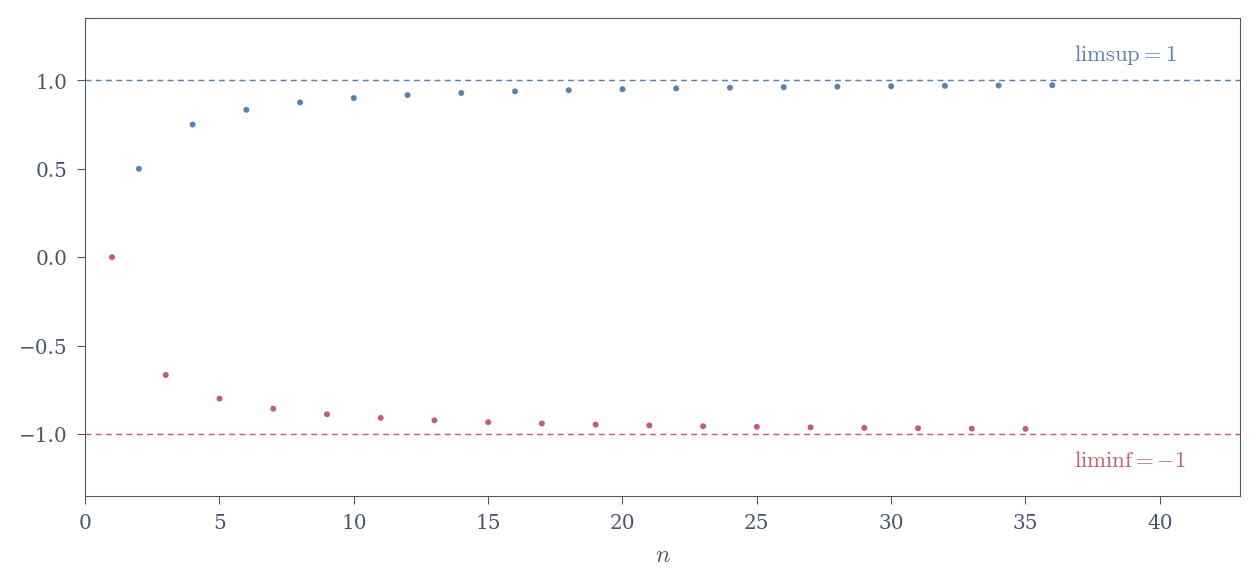
- \(a_n = (-1)^n\),
- \(a_n = (-1)^n + 1/n\),
- \(a_n = (-1)^n/n\),
- \(a_n = \sin n\).
TipSolution
\(\limsup = 1\), \(\liminf = -1\). The sequence alternates; tails always contain both \(+1\) and \(-1\).
\(\limsup = 1\), \(\liminf = -1\). The perturbation \(1/n \to 0\) does not shift the eventual oscillation range.
\(\limsup = 0\), \(\liminf = 0\). Indeed \(|a_n| = 1/n \to 0\), so \(a_n \to 0\), and limsup \(=\) liminf \(= 0\).
\(\limsup = 1\), \(\liminf = -1\). The sequence \((\sin n)\) is dense in \([-1,1]\) (a consequence of the irrationality of \(\pi\)), so every tail comes arbitrarily close to both \(1\) and \(-1\). \(\square\)
Proposition 5.2 (Subadditivity of limsup) For bounded sequences \((a_n)\) and \((b_n)\), \[ \limsup_{n\to\infty}(a_n + b_n) \leq \limsup_{n\to\infty} a_n + \limsup_{n\to\infty} b_n. \]
Proof. For all \(k \geq n\), \(a_k + b_k \leq \sup_{k \geq n} a_k + \sup_{k \geq n} b_k\). Taking the supremum over \(k \geq n\) on the left and then the limit gives the result. \(\square\)
Exercise. Give an example showing that strict inequality can hold.
TipSolution
Take \(a_n = (-1)^n\) and \(b_n = (-1)^{n+1} = -a_n\). Then \(a_n + b_n = 0\) for all \(n\), so \(\limsup(a_n + b_n) = 0\). But \(\limsup a_n = 1\) and \(\limsup b_n = 1\), so \(\limsup a_n + \limsup b_n = 2\). \(\square\)
The key theorem connecting limsup and liminf to ordinary convergence:
Proposition 5.3 (Convergence criterion) A bounded sequence \((a_n)\) converges if and only if \(\limsup_{n\to\infty} a_n = \liminf_{n\to\infty} a_n\), in which case \(\lim_{n\to\infty} a_n\) equals the common value.
Proof. If \(a_n \to L\), then for any \(\varepsilon > 0\), eventually \(|a_k - L| < \varepsilon\) for all \(k \geq N\), so \(\sup_{k \geq N} a_k \leq L + \varepsilon\) and \(\inf_{k \geq N} a_k \geq L - \varepsilon\). Taking \(n \to \infty\) gives \(\limsup a_n \leq L + \varepsilon\) and \(\liminf a_n \geq L - \varepsilon\). Since \(\varepsilon\) was arbitrary and \(\liminf \leq \limsup\), both equal \(L\).
Conversely, if \(\limsup a_n = \liminf a_n = L\), then for any \(\varepsilon > 0\), eventually \(\sup_{k \geq n} a_k < L + \varepsilon\) and \(\inf_{k \geq n} a_k > L - \varepsilon\), which means \(|a_n - L| < \varepsilon\) for all large \(n\). \(\square\)
The value of this criterion is that limsup and liminf always exist, so one can perform computations and comparisons with them without first knowing whether the limit exists. If the two agree, convergence follows for free.