14 Pointwise and Uniform Convergence
The previous chapters developed continuity for a single function. Analysis requires working with sequences of functions — approximating an unknown function by computable ones, passing to limits in differential equations, building functions with prescribed properties. The right notion of convergence for functions is the central question.
14.1 Two notions of convergence
Let \(X\) be a set and \((Y, d)\) a metric space. A sequence of functions \(f_n : X \to Y\) can converge in two qualitatively different ways.
Definition 14.1 (Pointwise convergence) \((f_n)\) converges pointwise to \(f : X \to Y\) if for every \(x \in X\), \[ d(f_n(x), f(x)) \to 0 \quad \text{as } n \to \infty. \]
Definition 14.2 (Uniform convergence) \((f_n)\) converges uniformly to \(f : X \to Y\) if \[ \sup_{x \in X} d(f_n(x), f(x)) \to 0 \quad \text{as } n \to \infty. \]
The quantifier order is what separates them. Pointwise: \(\forall x\; \forall \varepsilon\; \exists N\) (depending on both \(x\) and \(\varepsilon\)). Uniform: \(\forall \varepsilon\; \exists N\) (depending only on \(\varepsilon\), working simultaneously at every \(x\)).
Uniform convergence implies pointwise convergence. The converse fails and the failure matters.
14.2 The sup-norm connection
For \(Y = \mathbb{R}\) (or any normed space), define the bounded functions on \(X\): \[ B(X, Y) := \{f : X \to Y : \sup_{x \in X} \|f(x)\| < \infty\}. \] The sup-norm (or uniform norm) is \[ \|f\|_\infty := \sup_{x \in X} \|f(x)\|. \]
Proposition 14.1 (Uniform convergence is convergence in the sup-norm) \((f_n)\) converges uniformly to \(f\) if and only if \(\|f_n - f\|_\infty \to 0\).
Proof. Immediate from the definitions: \(\sup_{x \in X} d(f_n(x), f(x)) = \|f_n - f\|_\infty\), and the statement \(\|f_n - f\|_\infty \to 0\) is exactly uniform convergence. \(\square\)
This is not merely notational. It says that uniform convergence is metric convergence in a function space. All the theory of convergence in metric spaces — uniqueness of limits, the Cauchy criterion, completeness — applies directly to sequences of functions under the sup-norm. This repackaging is what makes analysis of function spaces tractable.
In particular, the Cauchy criterion for uniform convergence:
Proposition 14.2 (Cauchy criterion for uniform convergence) A sequence \((f_n)\) in \(B(X, Y)\) converges uniformly if and only if it is Cauchy in \(\|\cdot\|_\infty\): for every \(\varepsilon > 0\) there exists \(N\) such that \[ \|f_m - f_n\|_\infty < \varepsilon \quad \text{for all } m, n \geq N. \]
Proof. \(B(X, Y)\) with the sup-norm is a metric space. A sequence in a metric space converges iff it is Cauchy iff the space is complete. Completeness of \(B(X, Y)\) when \(Y\) is complete: if \((f_n)\) is Cauchy in sup-norm, then for each \(x\), \((f_n(x))\) is Cauchy in \(Y\) (since \(d(f_m(x), f_n(x)) \leq \|f_m - f_n\|_\infty\)), hence converges to some \(f(x)\). The convergence is uniform: given \(\varepsilon > 0\), for \(n \geq N\) and all \(x\), \[ d(f_n(x), f(x)) = \lim_{m \to \infty} d(f_n(x), f_m(x)) \leq \limsup_{m \to \infty} \|f_n - f_m\|_\infty \leq \varepsilon. \] So \(f \in B(X,Y)\) and \(f_n \to f\) uniformly. \(\square\)
14.3 Uniform convergence preserves continuity
The key theorem, proved in the continuous maps chapter:
Theorem 14.1 (Uniform limit of continuous functions is continuous) Let \(f_n : X \to Y\) be continuous for each \(n\), and suppose \(f_n \to f\) uniformly. Then \(f\) is continuous.
The proof is the \(\varepsilon/3\) argument. The point here is to understand it as a statement about the function space: \(C(X, Y)\), the continuous functions from \(X\) to \(Y\), is a closed subset of \(B(X, Y)\) under the sup-norm. Limits of continuous functions under uniform convergence stay continuous.
Corollary 14.1 (\(C(K)\) is complete) Let \(K\) be a compact metric space. Then \(C(K) := C(K, \mathbb{R})\) with the sup-norm is a Banach space.
Proof. \(C(K)\) is a normed space under \(\|f\|_\infty = \sup_{x \in K} |f(x)|\). To show completeness: let \((f_n)\) be Cauchy in \(C(K)\). Then \((f_n)\) is Cauchy in \(B(K, \mathbb{R})\), which is complete, so \(f_n \to f\) uniformly for some \(f \in B(K, \mathbb{R})\). By the preceding theorem, \(f\) is continuous, so \(f \in C(K)\). \(\square\)
This is the most important function space in analysis. The norm \(\|f - g\|_\infty\) measures the maximum discrepancy between two functions — the geometry of \(C(K)\) is the geometry of uniform approximation.
14.4 Pointwise convergence can fail badly
The failure of pointwise convergence to preserve continuity is not a technicality. It is a genuine obstruction that appears everywhere.
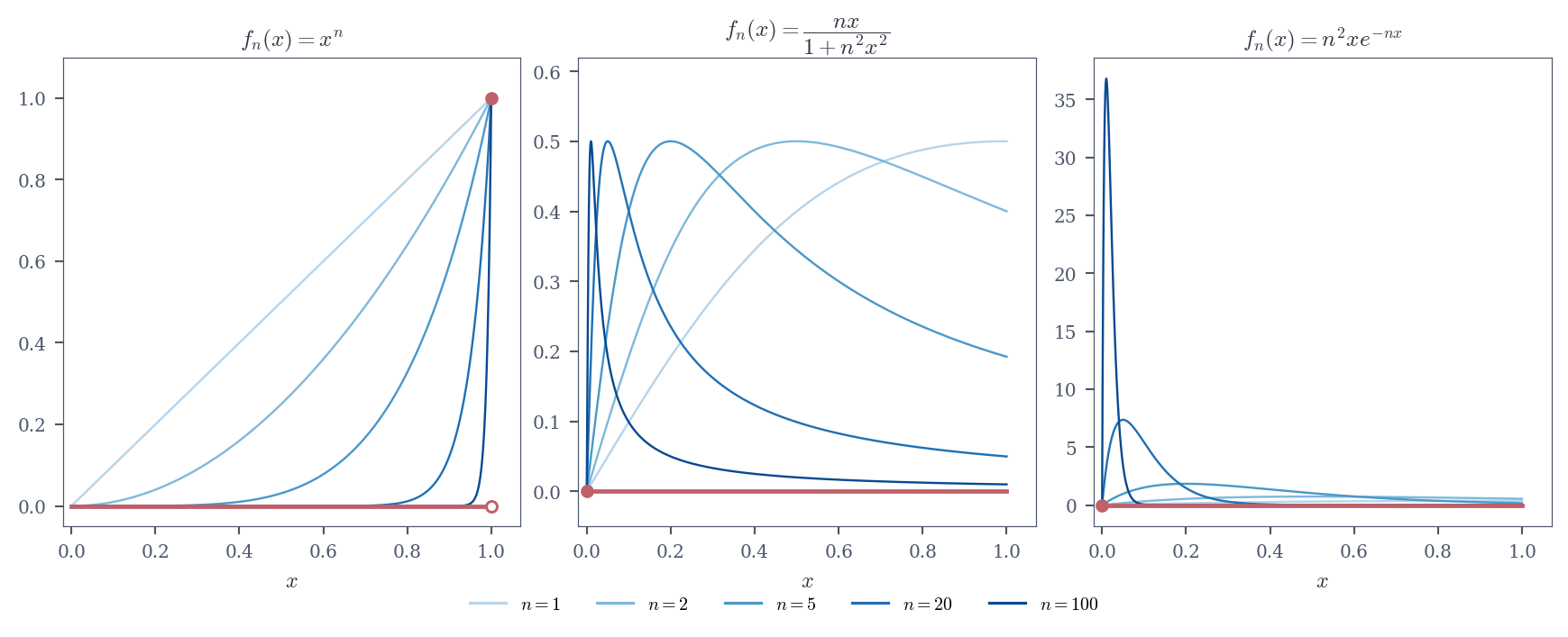
The three panels exhibit qualitatively different behaviours, all sharing the feature that the convergence is not uniform:
- \(x^n\): the limit is discontinuous (the jump at \(x=1\));
- \(nx/(1+n^2x^2)\): the limit is zero, but \(\|f_n\|_\infty = 1/2\) for all \(n\), so the convergence cannot be uniform;
- \(n^2 x e^{-nx}\): the limit is again zero, but \(\int_0^1 f_n(x)\,dx = n^2 \int_0^1 x e^{-nx}\,dx \to \infty\), so the limit and the integral cannot be interchanged.
14.5 Failure of interchange with limits
The central pathologies of pointwise convergence are failures to interchange limits with other operations: differentiation, integration, and the sup itself.
Proposition 14.3 (What can fail under pointwise convergence) Let \(f_n \to f\) pointwise. Each of the following can fail:
- \(f\) need not be continuous even if each \(f_n\) is.
- \(\int f_n \to \int f\) need not hold even if each \(f_n\) is integrable.
- \(f_n' \to f'\) need not hold even if each \(f_n\) is differentiable.
Examples:
(a) \(f_n(x) = x^n\) on \([0,1]\).
(b) The sequence \(f_n(x) = n \cdot \mathbf{1}_{[0,1/n]}(x)\) satisfies \(f_n \to 0\) pointwise (for each \(x > 0\), eventually \(x > 1/n\)) but \(\int_0^1 f_n = 1\) for all \(n\).
(c) Let \(f_n(x) = \sin(nx)/\sqrt{n}\). Then \(f_n \to 0\) uniformly (since \(|f_n(x)| \leq 1/\sqrt{n}\)), but \(f_n'(x) = \sqrt{n}\cos(nx)\), which does not converge to \(0\).
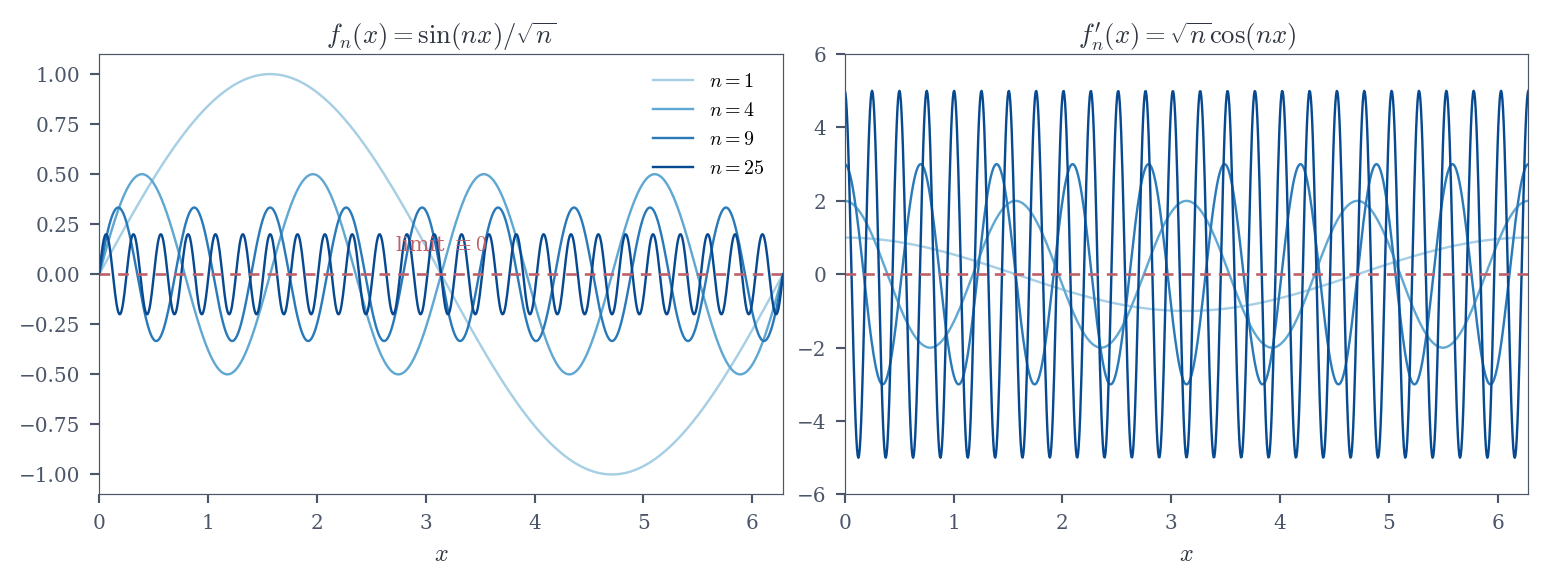
This is the key message: uniform convergence is needed to exchange limits with integration and differentiation. The theorems making this precise are proved in the next chapters.
14.6 When pointwise convergence implies uniform
Pointwise convergence is not always weaker. Two important situations where they coincide:
Theorem 14.2 (Dini’s theorem) Let \(K\) be a compact topological space and \((f_n)\) a sequence of continuous functions \(f_n : K \to \mathbb{R}\). If \(f_n \to f\) pointwise where \(f\) is continuous, and the convergence is monotone (either \(f_n(x) \nearrow f(x)\) or \(f_n(x) \searrow f(x)\) for every \(x\)), then \(f_n \to f\) uniformly.
Proof. Assume \(f_n \searrow f\) (the other case is similar). Given \(\varepsilon > 0\), define \[ U_n := \{x \in K : f_n(x) - f(x) < \varepsilon\}. \] Each \(U_n\) is open (since \(f_n - f\) is continuous). Since \(f_n(x) \searrow f(x)\) for each \(x\), every \(x\) eventually enters \(U_n\), so \(K = \bigcup_n U_n\). The \(U_n\) are increasing (if \(x \in U_n\) then \(x \in U_{n+1}\) since \(f_{n+1}(x) \leq f_n(x)\)), so this is an open cover of the compact \(K\) by an increasing sequence. Compactness gives a finite subcover; since the sequence is increasing, \(K = U_N\) for some \(N\). Then \(0 \leq f_n(x) - f(x) < \varepsilon\) for all \(x \in K\) and all \(n \geq N\). \(\square\)
Dini’s theorem has a clean conceptual structure: monotone pointwise convergence to a continuous limit on a compact set is automatically uniform. All three hypotheses are necessary.
- Compactness: \(f_n(x) = x^n\) on \([0,1)\) is monotone with continuous limit \(0\) but the convergence is not uniform.
- Monotone: the examples in the figure above are non-monotone.
- Continuous limit: \(f_n(x) = x^n\) on \([0,1]\) is monotone but the limit is discontinuous, and the convergence is not uniform.
Exercise. Verify that each of the three hypotheses of Dini’s theorem is necessary by exhibiting a sequence that satisfies the other two but whose convergence is not uniform.
TipSolution
Compactness fails: \(f_n(x) = x^n\) on \([0,1)\). Monotone decreasing, limit \(f \equiv 0\) is continuous, but \(\sup_{x \in [0,1)} |f_n(x)| = \sup_{x \in [0,1)} x^n = 1\) for all \(n\), so convergence is not uniform.
Monotone fails: \(f_n(x) = \sin(nx)/n\) on \([0, 2\pi]\). Continuous limit \(f \equiv 0\), compact domain, but not monotone. Convergence is actually uniform here (\(\|f_n\|_\infty = 1/n \to 0\)), so this doesn’t give a counterexample. Better: \(f_n(x) = \sin(nx)\) on \([0, 2\pi]\) converges pointwise to \(0\) (by Riemann–Lebesgue, a nontrivial fact) but not uniformly. It is not monotone, illustrating that without monotone the theorem can fail.
Continuous limit fails: \(f_n(x) = x^n\) on \([0,1]\). Compact, monotone, but the limit \(f(x) = \mathbf{1}_{\{1\}}(x)\) is discontinuous. Convergence is not uniform (\(\sup_x |x^n - f(x)| = 1\) for all \(n\)). \(\square\)
14.7 Uniform convergence on compact subsets
A weaker but often sufficient notion:
Definition 14.3 (Locally uniform convergence) A sequence \((f_n)\) converges uniformly on compact subsets (or locally uniformly) to \(f\) if for every compact \(K \subset X\), \(f_n|_K \to f|_K\) uniformly.
This is strictly weaker than uniform convergence on all of \(X\). For example, \(f_n(x) = x/n\) on \(\mathbb{R}\) converges to \(0\) uniformly on every bounded interval but not uniformly on \(\mathbb{R}\) (since \(\sup_{x \in \mathbb{R}} |x/n| = \infty\)). Locally uniform convergence still preserves continuity, by the same \(\varepsilon/3\) argument applied locally.
Exercise. Show that if \(f_n \to f\) pointwise and each \(f_n\) is monotone increasing, then \(f\) is monotone increasing. Is \(f\) necessarily continuous?
TipSolution
Monotone: For any \(x \leq y\), \(f_n(x) \leq f_n(y)\) for all \(n\). Taking \(n \to \infty\): \(f(x) \leq f(y)\). So \(f\) is monotone increasing.
Continuity: Not necessarily. The sequence \(f_n \equiv \mathbf{1}_{[0,\infty)}\) is constant (already the limit) and discontinuous at \(0\). More interestingly, consider \(f_n(x) = \lfloor nx \rfloor / n\) on \([0,1]\): each \(f_n\) is monotone increasing (a staircase), \(f_n \to x\) pointwise, and the limit is continuous. But the sequence \(f_n(x) = \mathbf{1}_{[1/2, \infty)}(x)\) is a constant pointwise limit that is monotone and discontinuous. So no: a pointwise limit of monotone functions can be discontinuous. \(\square\)
Monotone functions on \(\mathbb{R}\) can only have jump discontinuities, and the set of jump discontinuities is at most countable. This is a classical fact used in the theory of the Riemann–Stieltjes integral.
14.8 The sup-norm topology on \(C(K)\)
We close by putting the earlier discussion into context. The space \(C(K)\) with the sup-norm is a Banach space — a complete normed space. The norm \(\|f\|_\infty\) measures the “size” of a function as the height of its graph.
Convergence in this norm is exactly uniform convergence, which is exactly what is needed to preserve:
continuity (shown above),
integrability and the value of integrals (next chapter),
differentiability, under an additional condition on the derivatives (the chapter after).
The supremum norm is the natural topology for \(C(K)\) in the same way that the Euclidean norm is the natural topology for \(\mathbb{R}^n\). Functions in \(C(K)\) that are close in \(\|\cdot\|_\infty\) are close in every quantitative sense that analysis cares about.
Exercise. Let \(K\) be compact and \(f_n, f \in C(K)\) with \(f_n \to f\) in \(\|\cdot\|_\infty\). Show that \(\|f_n\|_\infty \to \|f\|_\infty\), i.e. the norm is a continuous function on \(C(K)\).
TipSolution
By the reverse triangle inequality for the sup-norm, \[ |\|f_n\|_\infty - \|f\|_\infty| \leq \|f_n - f\|_\infty \to 0. \qquad \square \] This is immediate from the fact that \(x \mapsto \|x\|\) is always continuous on a normed space, since \(|\|x\| - \|y\|| \leq \|x - y\|\) for any norm.