8 Metric Spaces
The topological spaces of the previous chapter were defined by declaring which sets are open, with no mechanism for measuring distance. The most important source of topological spaces in analysis is richer: a metric makes distance precise, and the topology it induces is concrete enough to work with directly.
This chapter develops metric spaces, the topology they carry, and the analytic content — convergence, completeness — that the abstract framework of open sets alone cannot see.
8.1 Metrics
Definition 8.1 (Metric) A metric on a set \(X\) is a function \(d : X \times X \to [0,\infty)\) satisfying:
- \(d(x,y) = 0 \iff x = y\),
- \(d(x,y) = d(y,x)\),
- \(d(x,z) \leq d(x,y) + d(y,z)\) (triangle inequality).
The pair \((X,d)\) is a metric space.
Conditions (i) and (ii) are immediate in all examples. The triangle inequality is the one requiring verification. An immediate consequence is the reverse triangle inequality: \[ |d(x,z) - d(y,z)| \leq d(x,y), \] obtained by applying (iii) to both orderings of \(x, y, z\). It says that distance to a fixed point is a Lipschitz function of the varying argument — a fact used repeatedly.
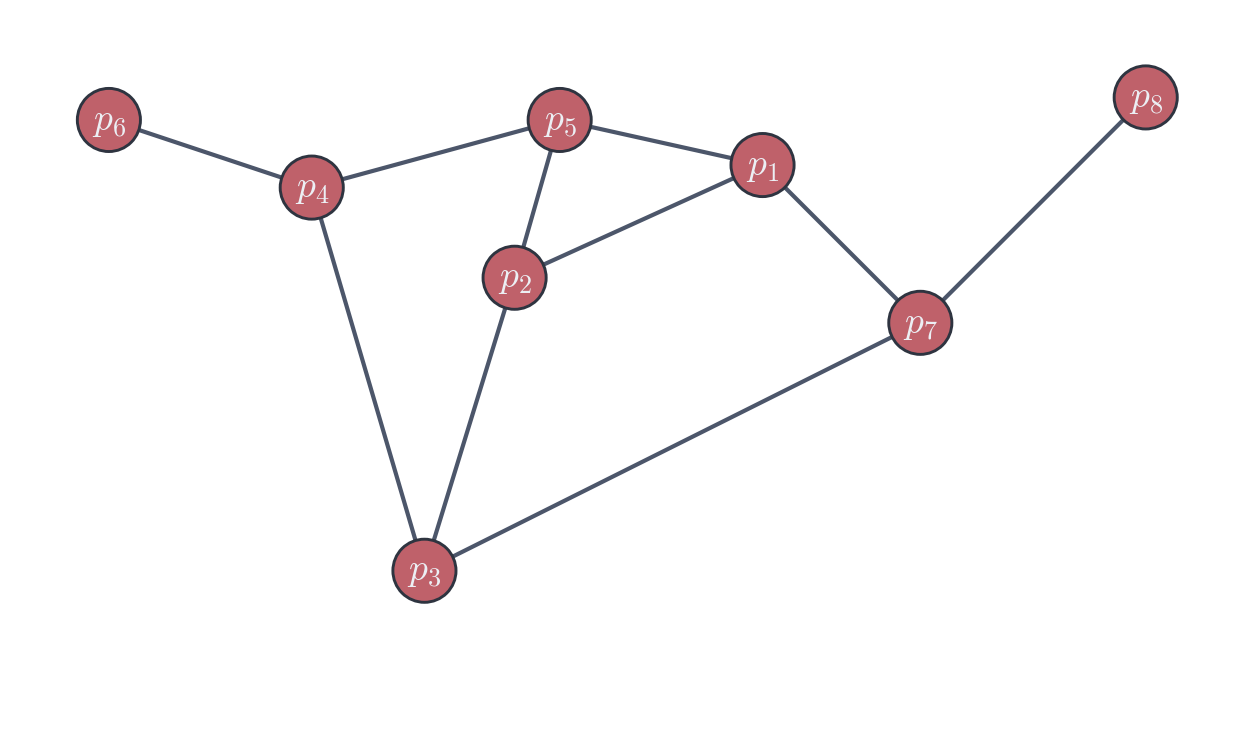
Exercise. Let \((V,E)\) be a simple undirected connected graph. Define \(d(p,q)\) on \(V\) as the minimum number of edges in a path from \(p\) to \(q\).
Verify that \(d\) satisfies all metric axioms.
Compute \(d(p_i, p_j)\) for several pairs in the graph below.
TipSolution
Non-negativity is clear. Since the graph is simple, \(d(p,q) = 0\) iff no edges need to be traversed iff \(p = q\). Symmetry holds because each edge may be traversed in either direction. For the triangle inequality: if \(\gamma_{pr}\) is a shortest path from \(p\) to \(r\) and \(\gamma_{rq}\) a shortest path from \(r\) to \(q\), their concatenation is a (not necessarily shortest) path from \(p\) to \(q\), so \[ d(p,q) \leq |\gamma_{pr}| + |\gamma_{rq}| = d(p,r) + d(r,q). \]
Reading off shortest paths from the graph: \[ d(p_6, p_8) = 4, \quad d(p_6, p_7) = 3, \quad d(p_1, p_3) = 2, \quad d(p_6, p_1) = 3. \] For example, a shortest path from \(p_6\) to \(p_8\) is \(p_6 \to p_4 \to p_3 \to p_7 \to p_8\). \(\square\)
Example 8.1 (Metrics)
\(\mathbb{R}^n\) with \(d(x,y) = \|x-y\|_2\), the Euclidean metric. More generally, any norm \(\|\cdot\|\) on a vector space induces a metric \(d(u,v) = \|u-v\|\); this is developed below.
\(C([a,b])\), the continuous functions on \([a,b]\), with the supremum metric \(d(f,g) = \sup_{x \in [a,b]} |f(x)-g(x)|\). Convergence in this metric is uniform convergence — the topology it generates is the right one for analysis of functions.
The discrete metric on any set \(X\): \(d(x,y) = \mathbf{1}_{x \neq y}\). Every subset is open; the metric topology is the discrete topology. Unremarkable analytically, but a useful test case.
8.2 Normed spaces
The most structured metrics in analysis come from norms.
Definition 8.2 (Normed space) A norm on a real vector space \(\mathcal{V}\) is a function \(\|\cdot\| : \mathcal{V} \to [0,\infty)\) satisfying:
- \(\|v\| = 0 \iff v = 0\),
- \(\|\lambda v\| = |\lambda|\,\|v\|\),
- \(\|u+v\| \leq \|u\| + \|v\|\).
Setting \(d(u,v) := \|u-v\|\) makes \((\mathcal{V}, d)\) a metric space. A complete normed space is a Banach space.
Exercise. Show that \(d(u,v) = \|u-v\|\) defines a metric on \(\mathcal{V}\).
TipSolution
Non-negativity and the identity axiom follow from the first two norm axioms. Symmetry holds since \(\|u-v\| = \|{-1}(v-u)\| = |-1|\,\|v-u\| = \|v-u\|\). The triangle inequality follows from \[ \|u-v\| = \|(u-w)+(w-v)\| \leq \|u-w\| + \|w-v\|. \qquad\square \]
Exercise. Suppose \(d\) is a metric on a real vector space \(\mathcal{V}\) that is translation-invariant, that is
\[d(u,v) = d(u+w, v+w) \quad \forall u,v,w \in \mathcal{V},\]
and absolutely homogeneous
\[ d(\alpha u, \alpha v) = |\alpha|\,d(u,v) \quad \forall u,v \in \mathcal{V}, \, \forall \alpha \in \mathbb{R}. \]
Show that \(\|u\| := d(u,0)\) defines a norm on \(\mathcal{V}\) with \(d(u,v) = \|u-v\|\). Show also that both conditions are necessary, and give examples of metrics satisfying each condition but not the other.
TipSolution
\(\|\cdot\|\) is a norm and \(d(u,v) = \|u-v\|\). Non-negativity and the identity axiom are immediate from the metric axioms. Homogeneity: \(\|\alpha u\| = d(\alpha u, 0) = d(\alpha u, \alpha \cdot 0) = |\alpha|\,d(u,0) = |\alpha|\,\|u\|\). Triangle inequality: by translation-invariance, \[ \|u+v\| = d(u+v,0) = d(u,-v) \leq d(u,0)+d(0,-v) = \|u\|+\|v\|. \] Finally, setting \(w = -v\) in translation-invariance gives \(d(u,v) = d(u-v,0) = \|u-v\|\).
Both conditions are necessary. If \(d(u,v) = \|u-v\|\) for some norm, both properties follow directly from the norm axioms, so neither can be dropped.
Examples. Translation-invariant but not absolutely homogeneous: take \(\mathcal{V} = \mathbb{R}\) with \(d(x,y) = \min\{|x-y|,1\}\). This depends only on \(x-y\), so it is translation-invariant, but \(d(2,0) = 1 \neq 2 = 2\,d(1,0)\). Absolutely homogeneous but not translation-invariant: take \(\mathcal{V} = \mathbb{R}^2\) with the post-office metric \[ d(u,v) = \begin{cases} 0 & u = v, \\ \|u\|_2 + \|v\|_2 & u \neq v. \end{cases} \] Then \(d(\alpha u, \alpha v) = |\alpha|(\|u\|_2 + \|v\|_2) = |\alpha|\,d(u,v)\), but translation-invariance fails: \(d(e_1, 2e_1) = 1+2 = 3\) while \(d(0, e_1) = 1\). \(\square\)
Exercise. Show that \(\|f\|_\infty = \sup_{x \in [0,1]} |f(x)|\) defines a norm on \(C([0,1])\). Interpret \(d(f,g) = \|f - g\|_\infty\) geometrically.
TipSolution
Non-negativity is clear; \(\|f\|_\infty = 0\) iff \(f \equiv 0\) since \(f\) is continuous. For homogeneity on has
\[ \|\lambda f\|_\infty = \sup_x |\lambda f(x)| = |\lambda| \sup_x |f(x)| = |\lambda|\,\|f\|_\infty. \]
Finally, the triangle inequality, \(\sup_x |f(x)+g(x)| \leq \sup_x |f(x)| + \sup_x |g(x)|\).
Geometrically, \(d(f,g)\) is the maximum vertical distance between the graphs of \(f\) and \(g\). The ball \(B_r(f)\) consists of all continuous functions whose graphs lie inside the vertical tube of half-width \(r\) around the graph of \(f\):
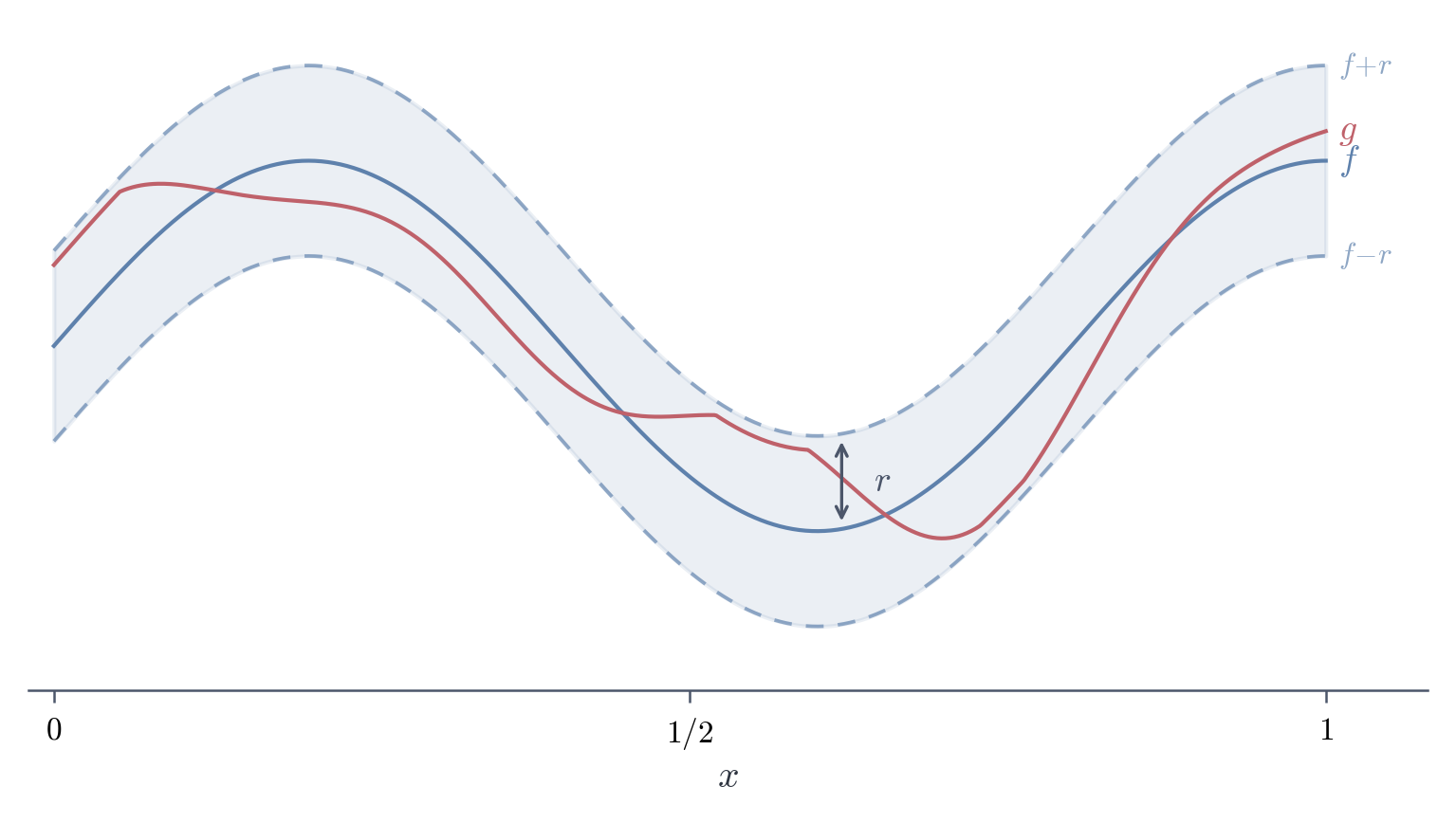
In fact, convergence \(f_n \to f\) in this metric is exactly uniform convergence on \([0,1]\), as we will see later. \(\square\)
Exercise. Show that \[ \|f\|_{W^{1,\infty}} := \|f\|_\infty + \|f'\|_\infty \] defines a norm on \(C^1([0,1])\), where \(\|\cdot\|_\infty\) is the supremum norm from above.
NoteRemark (Sobolev norms)
This is beyond the scope of this text, but it is a special case of the Sobolev norm. In general, the Sobolev space \(W^{k,p}(\Omega):= \{f \in L^p(\Omega) : D^\alpha f \in L^p(\Omega) \text{ for all } |\alpha| \le k\}\) carries the norm \[ \|f\|_{W^{k,p}} = \left(\sum_{|\alpha| \le k} \|D^\alpha f\|_p^p\right)^{1/p}, \qquad \|D^\alpha f\|_p = \left(\int_\Omega |D^\alpha f|^p\,dx\right)^{1/p}. \]
Where \(D^\alpha f=\partial^{\alpha_1}_1 \cdots \partial^{\alpha_n}_n f\) denotes the weak derivative of \(f\) of order \(\alpha\), and the sum is over all multi-indices \(\alpha\) with total order \(|\alpha| \le k\) and when we say weak derivative we mean in the sense of distributions; that is \[ \int_\Omega f \, D^\alpha \varphi \, dx = (-1)^{|\alpha|} \int_\Omega D^\alpha f \, \varphi \, dx \quad \forall \varphi \in C_c^\infty(\Omega). \]
The case \(k=0\) recovers the usual \(L^p\) norm.
For \(p = \infty\) the integral norm is replaced by \(\|D^\alpha f\|_\infty = \sup_{x \in \Omega} |D^\alpha f(x)|\) and the sum by a supremum over \(|\alpha| \le k\). The present norm \(\|\cdot\|_{W^{1,\infty}}\) corresponds to \(W^{1,\infty}([0,1])\), i.e. \(k=1\) and \(p=\infty\).
TipSolution
Non-negativity and homogeneity follow immediately from the corresponding properties of \(\|\cdot\|_\infty\). Definiteness is clear since \(\|f\|_{W^{1,\infty}}=0\) implies \(\|f\|_\infty=0\), hence \(f\equiv 0\). The triangle inequality follows from the triangle inequality for \(\|\cdot\|_\infty\) \[\begin{align*} \|f+g\|_{W^{1,\infty}} &= \|f+g\|_\infty + \|f'+g'\|_\infty\\ &\le \|f\|_\infty + \|g\|_\infty + \|f'\|_\infty + \|g'\|_\infty\\ &= \|f\|_{W^{1,\infty}} + \|g\|_{W^{1,\infty}}. \end{align*}\]
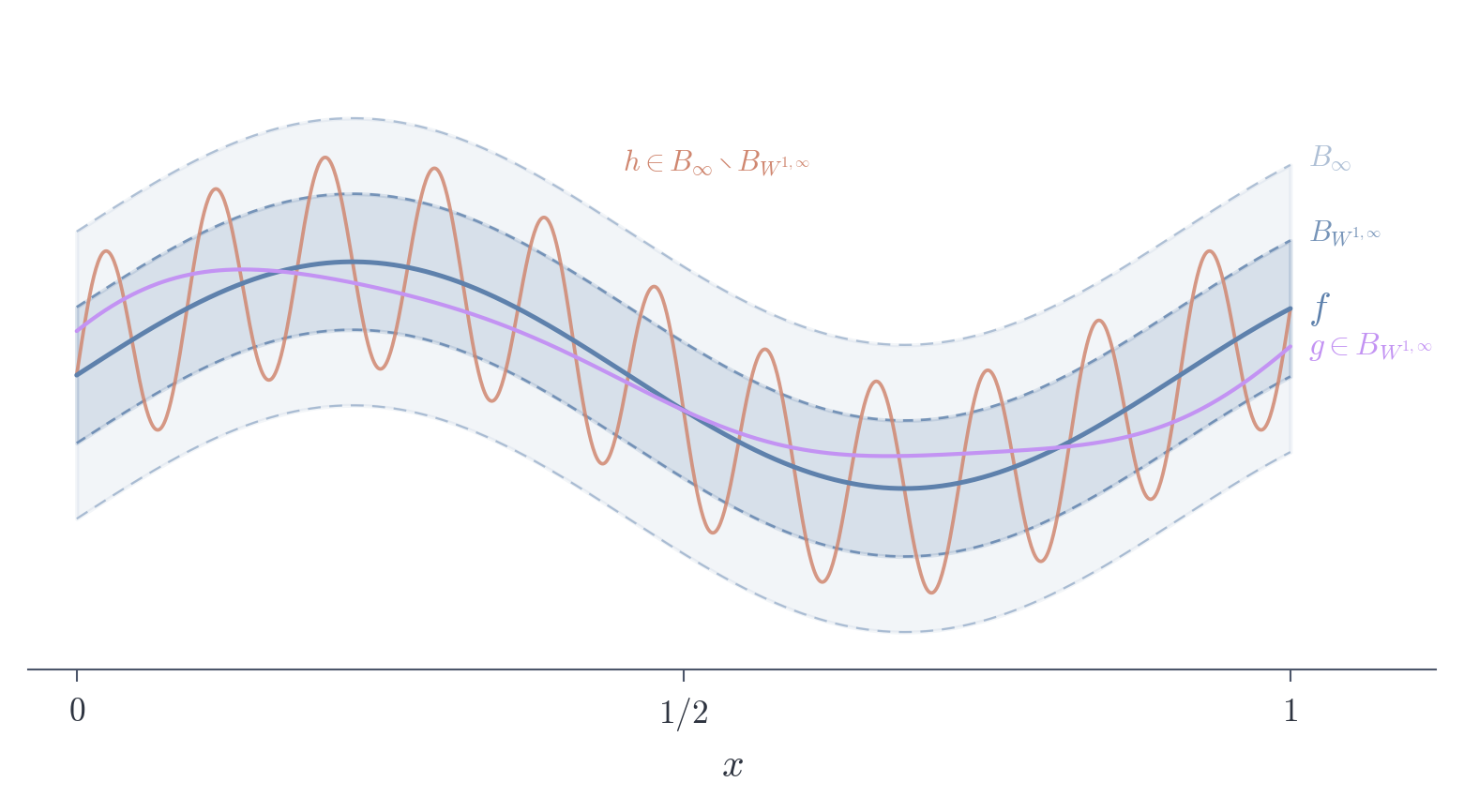
Geometrically, the ball \(B_{W^{1,\infty}}(f,r)\) consists of functions \(g\) that are close to \(f\) both in value and in “slope” simultaneously. It is strictly smaller than the \(\|\cdot\|_\infty\)-ball of the same radius: a rapidly oscillating function \(h\) can lie in \(B_\infty(f,r)\) yet have large derivative, placing it outside \(B_{W^{1,\infty}}(f,r)\).
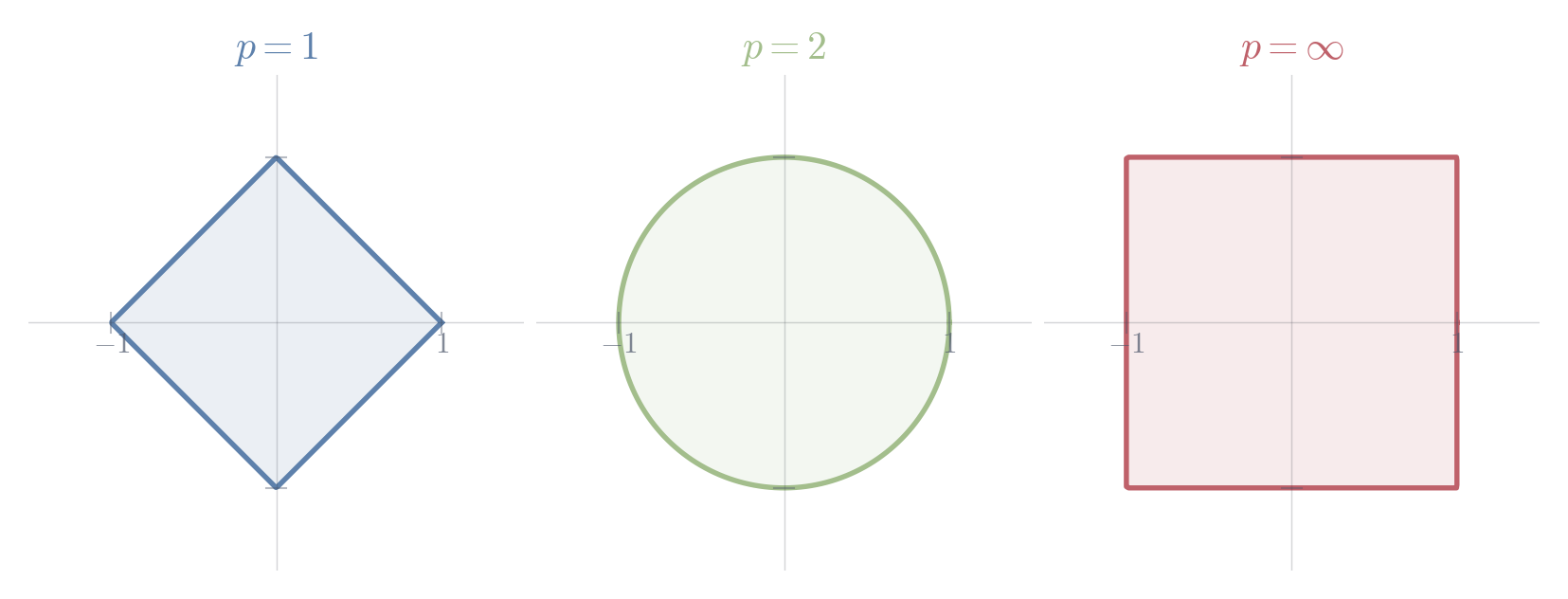
Example 8.2 (The \(p\)-norms on \(\mathbb{R}^n\)) For \(p \in [1,\infty]\): \[ \|x\|_p := \left(\sum_{i=1}^n |x_i|^p\right)^{1/p} \quad(p < \infty), \qquad \|x\|_\infty := \max_i |x_i|. \] The triangle inequality for \(p < \infty\) is Minkowski’s inequality. All \(p\)-norms on \(\mathbb{R}^n\) are equivalent — they generate the same topology.
Example 8.3 (Sequence spaces \(\ell^p\)) For \(1 \le p < \infty\), define \[ \ell^p = \left\{ x = (x_n)_{n=1}^\infty \subset \mathbb{R} : \sum_{n=1}^\infty |x_n|^p < \infty \right\}\quad \text{and}\quad\ell^\infty = \left\{ x=(x_n)_{n=1}^\infty : \sup_n |x_n| < \infty \right\} \] equipped with the norms \[ \|x\|_p = \left( \sum_{n=1}^\infty |x_n|^p \right)^{1/p} \quad \text{and}\quad\|x\|_\infty = \sup_n |x_n|. \]
Each \(\ell^p\) is a Banach space.
It is often convenient to denote the \(n\)-th coordinate of a sequence \(x\) by \(x_n\), and for a family of sequences \((x^{(k)})_{k=1}^\infty\), the notation \[ x^{(k)} = \bigl(x_n^{(k)}\bigr)_{n=1}^\infty \] means that \(x_n^{(k)}\) is the \(n\)-th entry of the \(k\)-th sequence. Thus convergence \(x^{(k)} \to x\in\ell^p\) means \[ \|x^{(k)} - x\|_p \to 0. \]
The inclusions \(\ell^1 \subsetneq \ell^2 \subsetneq \cdots \subsetneq \ell^\infty\) are strict. For example, the sequence \(x_n = 1/n\) belongs to \(\ell^p\) for every \(p>1\), since \[ \sum_{n=1}^\infty \frac1{n^p} \] converges exactly when \(p>1\), but \(x \notin \ell^1\).
A standard counterexample showing that the \(\ell^p\)-norms are not equivalent (see Definition 8.6) in infinite dimensions is obtained from the sequences \[ x^{(k)} = (\underbrace{1,\dots,1}_{k\text{ times}},0,0,\dots). \] Then \[ \|x^{(k)}\|_p = k^{1/p}, \qquad \|x^{(k)}\|_q = k^{1/q}. \] Hence \[ \frac{\|x^{(k)}\|_p}{\|x^{(k)}\|_q} = k^{1/p-1/q}, \] which is unbounded when \(p<q\). Therefore no constants \(C,c>0\) can satisfy \[ c\|x\|_q \le \|x\|_p \le C\|x\|_q \] for all \(x\in \ell^p \cap \ell^q\).
This contrasts sharply with finite-dimensional spaces such as \(\mathbb{R}^n\), where all norms are equivalent and therefore induce the same topology. In infinite-dimensional analysis, the choice of norm fundamentally affects convergence, continuity, compactness, and completeness.
8.3 The metric topology
Definition 8.3 (Open ball and metric topology) The open ball of radius \(r > 0\) at \(x\) is \(B_r(x) := \{y \in X : d(x,y) < r\}\). The collection \(\mathscr{B} = \{B_r(x) : x \in X,\, r > 0\}\) is a basis for a topology on \(X\), called the metric topology \(\mathscr{T}_d\).
Proof. Every \(x\) lies in \(B_1(x)\). For condition (ii): if \(z \in B_r(x) \cap B_s(y)\), set \[ \varepsilon = \min\bigl(r - d(x,z),\; s - d(y,z)\bigr) > 0. \] For any \(w \in B_\varepsilon(z)\), the triangle inequality gives \(d(x,w) \leq d(x,z) + d(z,w) < r\), and similarly \(d(y,w) < s\). So \(B_\varepsilon(z) \subset B_r(x) \cap B_s(y)\). \(\square\)
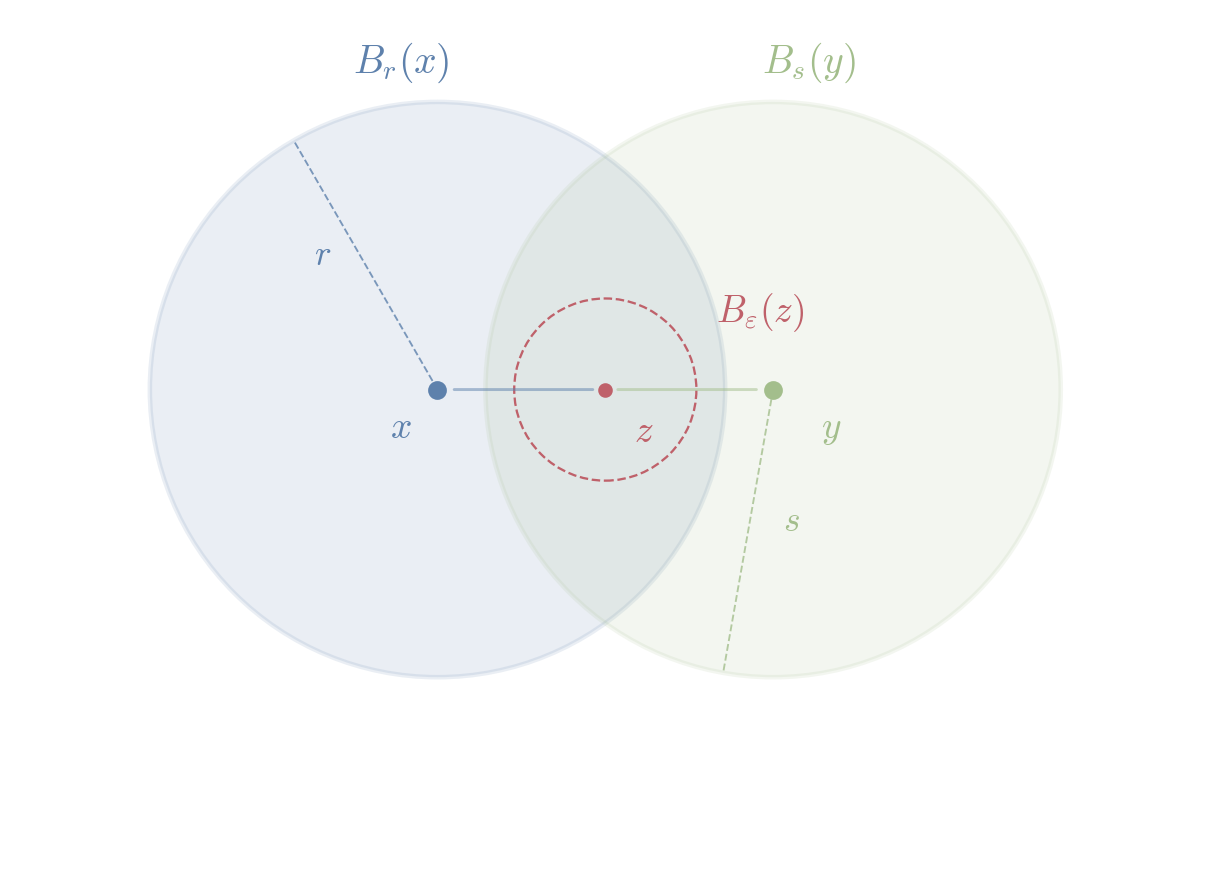
A set \(U\) is open in \(\mathscr{T}_d\) iff for every \(x \in U\) there exists \(r > 0\) with \(B_r(x) \subset U\). This is the \(\varepsilon\)-definition of open sets from single-variable analysis, now in any metric space.
8.4 Closure and limit points
The metric makes the abstract notions of the previous chapter concrete.
Proposition 8.1 (Closure and limit points in metric spaces) Let \(A \subset (X,d)\). Then:
- \(x \in \overline{A}\) iff \(\inf_{a \in A}\, d(x,a) = 0\),
- \(x \in A'\) iff \(\inf_{a \in A \setminus \{x\}}\, d(x,a) = 0\).
Proof.
- \(x \in \overline{A}\) iff every open set containing \(x\) meets \(A\) (by the exercise from the previous chapter), iff every ball \(B_r(x)\) meets \(A\), iff for every \(r > 0\) there exists \(a \in A\) with \(d(x,a) < r\), iff \(\inf_{a \in A} d(x,a) = 0\). Part (b) replaces \(A\) with \(A \setminus \{x\}\). \(\square\)
This is the reason the closure computation \(\overline{(a,b)} = [a,b]\) is immediate in \(\mathbb{R}\): the infimum of \(|x - a|\) over \((a,b)\) is zero iff \(x \geq a\), and similarly for \(b\).
In metric spaces, topology is also determined by sequences — a special feature that fails in general topological spaces.
Proposition 8.2 (Sequential characterisation) In a metric space:
- \(x \in \overline{A}\) iff there exists a sequence \((a_n) \subset A\) with \(a_n \to x\).
- \(U\) is open iff every sequence converging to a point of \(U\) is eventually in \(U\).
Proof.
- If \(\inf_{a \in A} d(x,a) = 0\), pick \(a_n \in A\) with \(d(x,a_n) < 1/n\); then \(a_n \to x\). Conversely, any such sequence witnesses the infimum is zero. Part (b) follows immediately. \(\square\)
8.5 Convergence and completeness
Definition 8.4 (Convergence) A sequence \((x_n)\) in \((X,d)\) converges to \(x\) if \(d(x_n, x) \to 0\), i.e. for every \(\varepsilon > 0\) there exists \(N\) such that \(d(x_n, x) < \varepsilon\) for all \(n \geq N\).
Definition 8.5 (Cauchy sequence and completeness) A sequence \((x_n)\) in \((X,d)\) is Cauchy if for every \(\varepsilon > 0\) there exists \(N\) such that \(d(x_m, x_n) < \varepsilon\) for all \(m, n \geq N\). The space \((X,d)\) is complete if every Cauchy sequence converges.
Every convergent sequence is Cauchy: if \(x_n \to x\), then \(d(x_m, x_n) \leq d(x_m, x) + d(x, x_n) \to 0\). Completeness is the converse, and it is the analytic heart of the metric structure. This is precisely what distinguishes \(\mathbb{R}\) from \(\mathbb{Q}\): the rational approximations to \(\sqrt{2}\) are Cauchy in \(\mathbb{Q}\) but have no limit there. The construction of \(\mathbb{R}\) in Chapter 3 was, in this language, exactly the completion of \(\mathbb{Q}\).
Proposition 8.3 (Completeness of the classical spaces)
- \(\mathbb{R}\) and \(\mathbb{R}^n\) are complete.
- \(C([a,b])\) with \(d(f,g) = \sup_{x}|f(x)-g(x)|\) is complete.
- \(\ell^p\) is complete for all \(1 \leq p \leq \infty\).
Proof.
\(\mathbb{R}\) is complete by construction (Chapter 3). For \(\mathbb{R}^n\): a Cauchy sequence in \(\mathbb{R}^n\) is Cauchy in each coordinate, each coordinate converges by completeness of \(\mathbb{R}\), and coordinatewise convergence coincides with convergence in \(\|\cdot\|_2\).
Let \((f_n)\) be Cauchy in \(C([a,b])\). For each \(x\), the bound \(|f_n(x) - f_m(x)| \leq \|f_n - f_m\|_\infty\) shows \((f_n(x))\) is Cauchy in \(\mathbb{R}\), so define \(f(x) := \lim_n f_n(x)\). The convergence is uniform: for \(m,n \geq N\), \(|f_n(x) - f_m(x)| < \varepsilon\) for all \(x\), and letting \(m \to \infty\) gives \(|f_n(x) - f(x)| \leq \varepsilon\) uniformly. A uniform limit of continuous functions is continuous — proved in the Sequences and Series of Functions chapter — so \(f \in C([a,b])\).
Analogous: a Cauchy sequence in \(\ell^p\) converges coordinatewise, and one verifies the limit lies in \(\ell^p\) with \(\|x^{(n)} - x\|_p \to 0\). \(\square\)
8.6 Equivalent metrics and equivalent norms
Definition 8.6 (Equivalent metrics) Metrics \(d\) and \(d'\) on \(X\) are equivalent if they generate the same topology: \(\mathscr{T}_d = \mathscr{T}_{d'}\). They are strongly equivalent if there exist constants \(c, C > 0\) with \[ c\,d(x,y) \leq d'(x,y) \leq C\,d(x,y) \] for all \(x, y \in X\). Strong equivalence implies equivalence.
The distinction matters: equivalent metrics give the same open sets, hence the same continuous functions and the same convergent sequences. But they may assign different distances, and in particular one may be complete while the other is not.
Proposition 8.4 (All norms on \(\mathbb{R}^n\) are equivalent) If \(\|\cdot\|\) and \(\|\cdot\|'\) are norms on \(\mathbb{R}^n\), then there exist \(c, C > 0\) such that \[ c\,\|v\| \leq \|v\|' \leq C\,\|v\| \] for all \(v \in \mathbb{R}^n\).
Proof. It suffices to show every norm \(\|\cdot\|\) is equivalent to \(\|\cdot\|_1\). Fix a basis \(e_1,\ldots,e_n\).
Upper bound. For \(v = \sum x_i e_i\), \[ \|v\| \leq \sum_i |x_i|\,\|e_i\| \leq \bigl(\max_i \|e_i\|\bigr)\|v\|_1 =: C\|v\|_1. \]
Lower bound. The upper bound shows \(\|\cdot\|\) is continuous with respect to \(\|\cdot\|_1\). The unit sphere \(S = \{\|v\|_1 = 1\}\) is compact in \((\mathbb{R}^n, \|\cdot\|_1)\) — closed and bounded. A continuous function on a compact set attains its infimum, and \(\inf_S \|v\| > 0\) since \(\|\cdot\|\) is positive on \(S\). Call this infimum \(c\). For any \(v \neq 0\), applying this to \(v/\|v\|_1 \in S\) gives \(\|v\| \geq c\|v\|_1\). \(\square\)
The key step — compactness of the unit sphere — is specific to finite dimensions. On \(\ell^2\) the unit sphere is not compact, and no two distinct \(\ell^p\) norms are equivalent.
8.7 Completions
Every metric space has a canonical completion.
Theorem 8.1 (Completion) For any metric space \((X,d)\), there exists a complete metric space \((\hat{X}, \hat{d})\) and an isometric embedding \(\iota : X \hookrightarrow \hat{X}\) with dense image. The space \(\hat{X}\) is unique up to isometry.
Proof. Define \(\hat{X}\) to be the set of equivalence classes of Cauchy sequences in \(X\), where \((x_n) \sim (y_n)\) iff \(d(x_n, y_n) \to 0\). Set \(\hat{d}([(x_n)], [(y_n)]) = \lim_n d(x_n, y_n)\); this limit exists because \((d(x_n, y_n))\) is a Cauchy sequence in \(\mathbb{R}\), and it is well-defined on equivalence classes. The triangle inequality, completeness of \(\hat{X}\), and density of the image of \(\iota(x) = [(x, x, x, \ldots)]\) each follow by direct verification. Uniqueness up to isometry is a standard exercise. \(\square\)
The same Cauchy-sequence construction that produced \(\mathbb{R}\) from \(\mathbb{Q}\) works verbatim for any metric space. A complete normed space is called a Banach space — \(\mathbb{R}^n\) and the \(\ell^p\) spaces above are standard examples.
NoteMetrizability
Clearly not every topological space arises from a metric. A topological space \((X, \mathscr{T})\) is metrizable if there exists a metric \(d\) on \(X\) with \(\mathscr{T} = \mathscr{T}_d\). Necessary conditions are easy to identify — every metrizable space is Hausdorff, normal (\(T_4\)), and first-countable (see next chapter), placing it at the top of every separation and covering hierarchy. But necessity is not sufficiency.
The characterisation of metrizability is a central result of general topology:
- Urysohn Metrization Theorem. Every regular (\(T_3\)) second-countable space is metrizable. This covers the classical cases: \(\mathbb{R}^n\), manifolds, separable function spaces.
This theorem belongs to a general topology course. For this text, every space of interest is a metric space or a normed space, and metrizability is not in question. The point worth carrying forward: for metric spaces, the separation hierarchy collapses entirely — metrizable implies normal, regular, and Hausdorff, all simultaneously. This is why metric spaces are so well-suited to analysis.
Exercise. Prove that any subspace of a metric space is a metric space under the restricted metric, and that the subspace topology coincides with the metric topology on the subspace.
TipSolution
Let \((X,d)\) be a metric space and \(A \subset X\). The restriction \(d|_{A \times A}\) satisfies all metric axioms by inheritance. The metric topology \(\mathscr{T}_{d|_A}\) has as basis the balls \(B_r^A(a) = \{x \in A : d(a,x) < r\}\). But \(B_r^A(a) = B_r(a) \cap A\), and the sets \(\{B_r(a) \cap A : a \in A, r > 0\}\) are exactly the basis for the subspace topology on \(A\) inherited from \(\mathscr{T}_d\). So the two topologies coincide. \(\square\)
Exercise. Show that \(d'(x,y) = d(x,y)/(1 + d(x,y))\) defines a metric on \(X\) equivalent to \(d\), with \(d' < 1\). Conclude that every metric space is homeomorphic to a bounded one. Show further that \(d\) and \(d'\) are simultaneously complete or not — so bounding the metric does not alter completeness.
TipSolution
Metric axioms. Symmetry and the identity axiom are inherited. For the triangle inequality, use that \(t \mapsto t/(1+t)\) is increasing: \[ \frac{d(x,z)}{1+d(x,z)} \leq \frac{d(x,y)+d(y,z)}{1+d(x,y)+d(y,z)} \leq \frac{d(x,y)}{1+d(x,y)} + \frac{d(y,z)}{1+d(y,z)}. \]
Equivalence. \(d'(x,y) < \varepsilon\) iff \(d(x,y) < \varepsilon/(1-\varepsilon)\) (for \(\varepsilon < 1\)), so \(d\)-balls and \(d'\)-balls are mutually cofinal and \(\mathscr{T}_d = \mathscr{T}_{d'}\). The bound \(d' < 1\) is immediate.
Completeness. We claim \(d\) and \(d'\) are simultaneously complete or not, so no counterexample exists. Since \(t \mapsto t/(1+t)\) is strictly increasing with inverse \(t \mapsto t/(1-t)\), we have \[ d(x,y) = \frac{d'(x,y)}{1 - d'(x,y)}. \] In particular \(d'(x_m, x_n) \to 0\) if and only if \(d(x_m, x_n) \to 0\): a sequence is Cauchy in \(d'\) if and only if it is Cauchy in \(d\), and since the topologies coincide, limits are the same. Hence \((X,d)\) is complete if and only if \((X,d')\) is complete.
The exercise teaches that completeness is not a topological property — it depends on the metric, not just the topology. The spaces \((0,1)\) and \(\mathbb{R}\) are homeomorphic (via \(x \mapsto \tan(\pi(x - \tfrac{1}{2}))\)) but \((0,1)\) is not complete under its standard metric while \(\mathbb{R}\) is. Bounding the metric by composing with \(t/(1+t)\) does not change this — to pass between complete and incomplete metrics one must genuinely change the Cauchy structure, not merely rescale it. \(\square\)