3 Finite-Dimensional Vector Spaces
A vector space is determined by which linear combinations it permits. When finitely many vectors generate the entire space, structure becomes rigid: size is measurable, decomposition is unique under mild conditions, and algebraic properties are tractable.
We work over \(\mathbb{R}\) unless stated otherwise.
3.1 Linear Combinations and Generation
The axioms of a vector space permit only addition and scalar multiplication. Any vector constructed from given ones arises from these operations.
Definition 3.1 (Linear combination) Let \(\mathcal{V}\) be a vector space. A linear combination of vectors \(v_1,\dots,v_n \in \mathcal{V}\) is a vector of the form \[ \sum_{i=1}^{n} a_i v_i, \] where \(a_1,\dots,a_n \in \mathbb{R}\).
In \(\mathbb{R}^2\), the vector \(\begin{pmatrix} 3 \\ 2 \end{pmatrix}\) is the linear combination \[ 3 \begin{pmatrix} 1 \\ 0 \end{pmatrix} + 2 \begin{pmatrix} 0 \\ 1 \end{pmatrix}. \] In the space \(\mathcal{P}_2\) of polynomials of degree at most 2, the polynomial \(p(x) = 2 + 3x - x^2\) is \[ 2 \cdot 1 + 3 \cdot x + (-1) \cdot x^2. \]
Definition 3.2 (Span) Let \(S \subset \mathcal{V}\). The span of \(S\), denoted \(\operatorname{span}(S)\), is the set of all finite linear combinations of elements of \(S\).
Theorem 3.1 (Algebraic closure) A vector \(v \in \mathcal{V}\) lies in \(\operatorname{span}(S)\) if and only if it can be obtained from elements of \(S\) using finitely many additions and scalar multiplications.
Proof. This is immediate from the definition: a linear combination is precisely the result of finitely many additions and scalar multiplications. \(\square\)
The span formalizes algebraic generation.
Theorem 3.2 For any \(S \subset \mathcal{V}\), \(\operatorname{span}(S)\) is a subspace of \(\mathcal{V}\).
Proof. The zero vector is obtained as the trivial sum. If \[ u = \sum_{i=1}^{n} a_i u_i, \quad v = \sum_{j=1}^{m} b_j v_j \] with \(u_i, v_j \in S\), then \[ u + v = \sum_{i=1}^{n} a_i u_i + \sum_{j=1}^{m} b_j v_j \] is another finite linear combination. For \(c \in \mathbb{R}\), \[ cu = \sum_{i=1}^{n} (ca_i) u_i \] is also in \(\operatorname{span}(S)\). \(\square\)
The span is not just a subspace containing \(S\); it is the smallest such subspace.
Theorem 3.3 \[ \operatorname{span}(S) = \bigcap \{ \mathcal{W} \subset \mathcal{V} : \mathcal{W} \text{ is a subspace and } S \subset \mathcal{W} \}. \]
Proof. Any subspace containing \(S\) contains all finite linear combinations of elements of \(S\), hence contains \(\operatorname{span}(S)\). Conversely, \(\operatorname{span}(S)\) itself is such a subspace. \(\square\)
The span of \(\left\{ \begin{pmatrix} 1 \\ 0 \end{pmatrix}, \begin{pmatrix} 0 \\ 1 \end{pmatrix} \right\}\) in \(\mathbb{R}^2\) is all of \(\mathbb{R}^2\). The span of \(\{1, x, x^2\}\) in \(\mathcal{P}\) is \(\mathcal{P}_2\). The span of a single nonzero vector \(v\) is \(\{cv : c \in \mathbb{R}\}\), the line through the origin in direction \(v\).
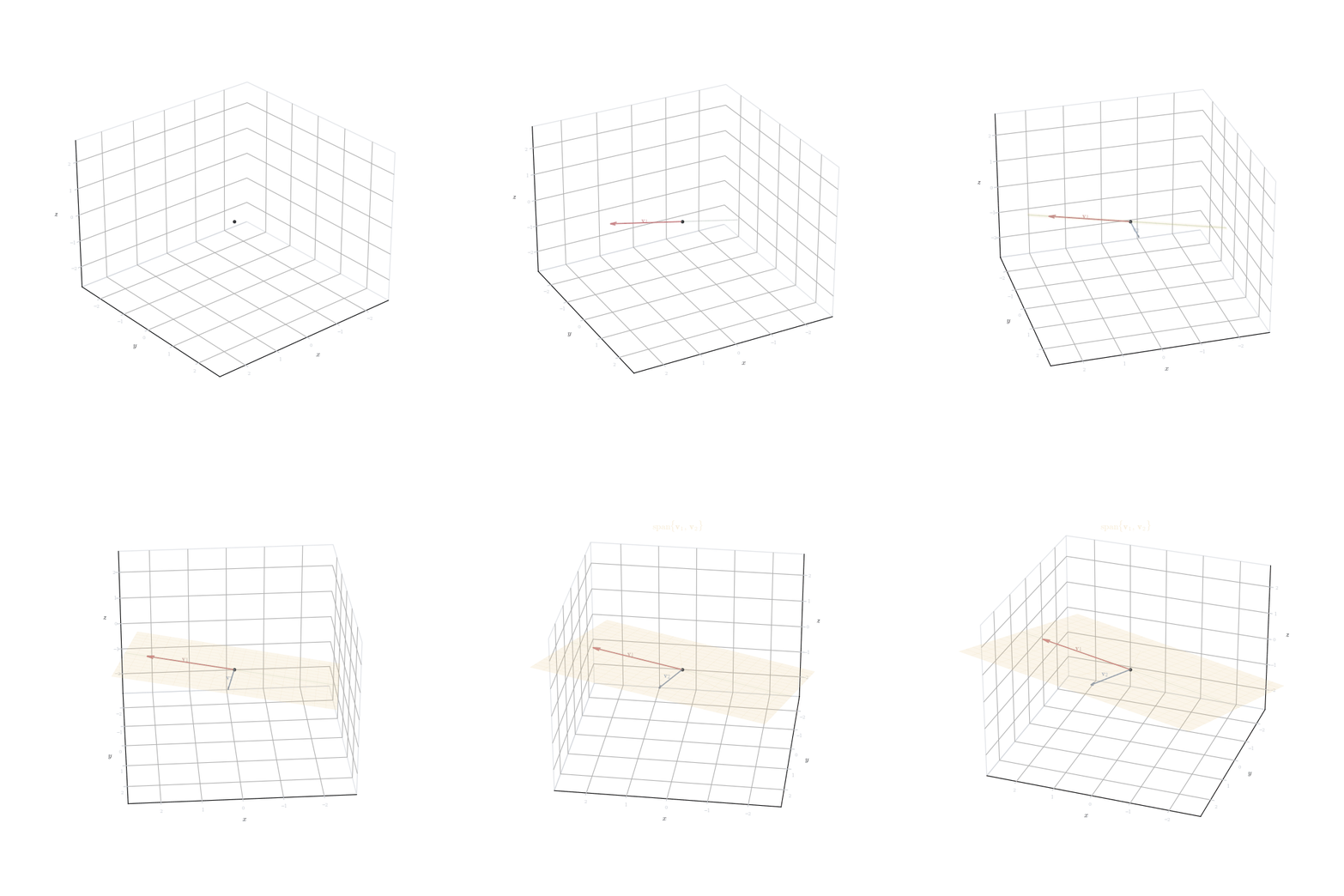
Definition 3.3 (Finite generation) A vector space \(\mathcal{V}\) is finitely generated if \(\mathcal{V} = \operatorname{span}(S)\) for some finite set \(S \subset \mathcal{V}\).
Finite generation is the hypothesis under which dimension becomes meaningful. Infinite-dimensional spaces require different techniques.
3.2 Linear Independence and Redundancy
A generating set may contain unnecessary vectors. In \(\mathbb{R}^2\), the set \[ \left\{ \begin{pmatrix} 1 \\ 0 \end{pmatrix}, \begin{pmatrix} 0 \\ 1 \end{pmatrix}, \begin{pmatrix} 1 \\ 1 \end{pmatrix} \right\} \] spans the space, but the third vector is redundant: \[ \begin{pmatrix} 1 \\ 1 \end{pmatrix} = 1 \cdot \begin{pmatrix} 1 \\ 0 \end{pmatrix} + 1 \cdot \begin{pmatrix} 0 \\ 1 \end{pmatrix}. \]
Definition 3.4 (Linear independence) A finite set \(\{v_1,\dots,v_n\} \subset \mathcal{V}\) is linearly independent if \[ \sum_{i=1}^{n} a_i v_i = 0 \quad \Longrightarrow \quad a_1 = \cdots = a_n = 0. \] Otherwise, the set is linearly dependent.
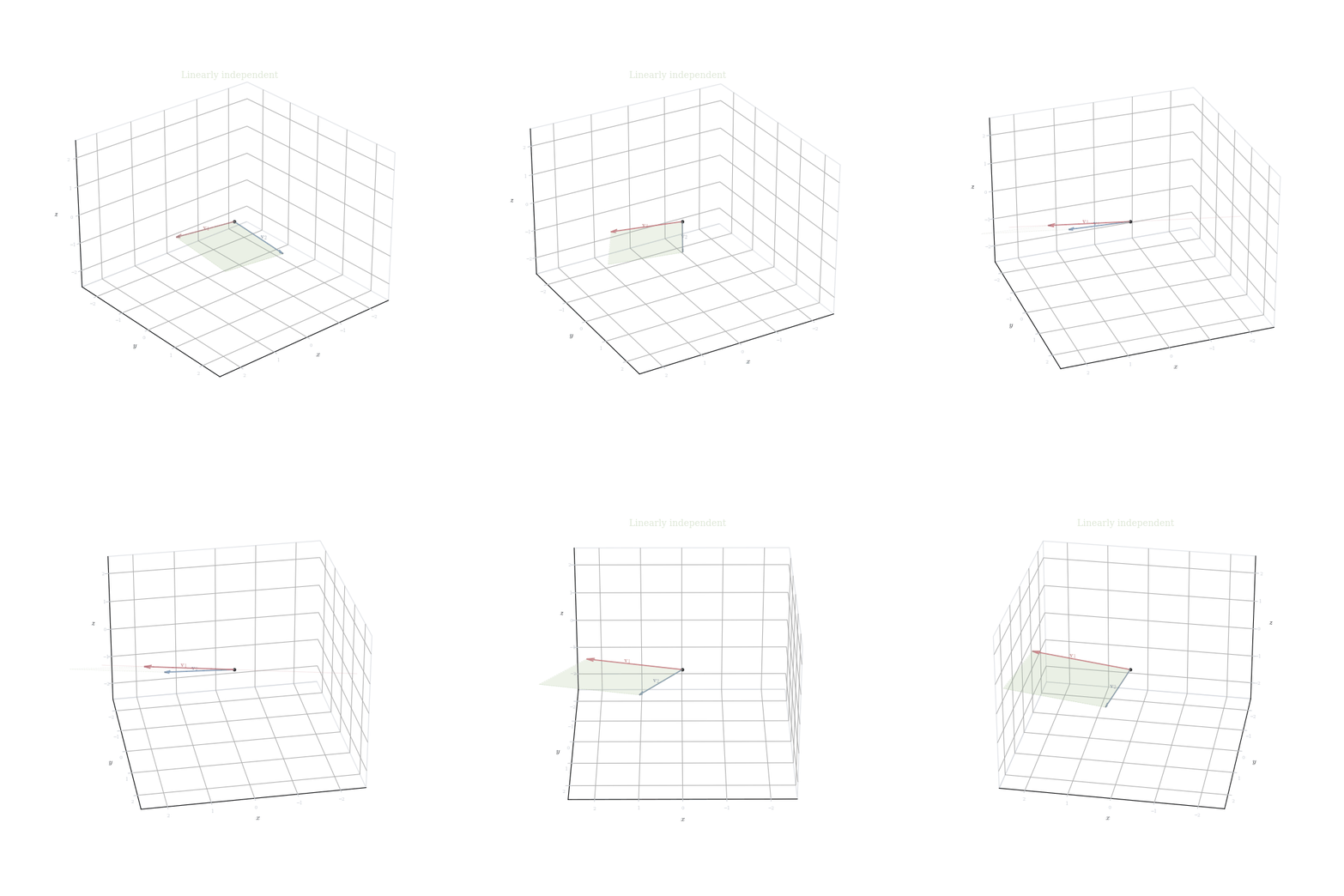
Theorem 3.4 A finite set \(\{v_1,\dots,v_n\} \subset \mathcal{V}\) is linearly dependent if and only if one of the vectors lies in the span of the others.
Proof. Suppose the set is linearly dependent. Then there exist scalars \(a_1,\dots,a_n\), not all zero, such that \[ \sum_{i=1}^{n} a_i v_i = 0. \] Choose \(k\) with \(a_k \neq 0\). Solving for \(v_k\) gives \[ v_k = -\frac{1}{a_k} \sum_{i \neq k} a_i v_i, \] so \(v_k\) is a linear combination of the others.
Conversely, if \(v_k = \sum_{i \neq k} b_i v_i\), then \[ \sum_{i \neq k} b_i v_i - v_k = 0, \] a nontrivial relation. \(\square\)
Corollary 3.1 If a spanning set is linearly dependent, it can be reduced without changing its span.
Proof. If \(S\) spans \(\mathcal{V}\) and is linearly dependent, then by Theorem 3.4 some \(v \in S\) lies in \(\operatorname{span}(S \setminus \{v\})\). Since every element of \(\operatorname{span}(S)\) is a linear combination of elements of \(S\), replacing \(v\) by its expression in terms of the remaining vectors shows \(\operatorname{span}(S \setminus \{v\}) = \operatorname{span}(S) = \mathcal{V}\). \(\square\)
Theorem 3.5 If \(\{v_1,\dots,v_n\}\) is linearly independent, then every vector in \(\operatorname{span}(v_1,\dots,v_n)\) admits a unique representation as a linear combination of the \(v_i\).
Proof. Suppose \[ v = \sum_{i=1}^{n} a_i v_i = \sum_{i=1}^{n} b_i v_i. \] Subtracting yields \[ \sum_{i=1}^{n} (a_i - b_i) v_i = 0. \] By independence, \(a_i - b_i = 0\) for all \(i\). \(\square\)
3.3 Bases
Linear independence eliminates redundancy but does not guarantee generation. A basis satisfies both properties.
Definition 3.5 (Basis) A basis of a vector space \(\mathcal{V}\) is a linearly independent set that spans \(\mathcal{V}\).
Theorem 3.6 A finite set \(\mathcal{B} \subset \mathcal{V}\) is a basis if and only if it is a minimal spanning set, or equivalently a maximal linearly independent set.
Proof. Suppose \(\mathcal{B}\) is a basis. For minimality: if some \(v \in \mathcal{B}\) could be removed without changing the span, then \(v \in \operatorname{span}(\mathcal{B} \setminus \{v\})\), which by Theorem 3.4 would make \(\mathcal{B}\) linearly dependent—contradicting the assumption that \(\mathcal{B}\) is a basis. So no vector can be removed, and \(\mathcal{B}\) is minimal. For maximality: if any \(v \in \mathcal{V}\) is added to \(\mathcal{B}\), then since \(\mathcal{B}\) spans we have \(v \in \operatorname{span}(\mathcal{B})\), so \(\mathcal{B} \cup \{v\}\) is linearly dependent by Theorem 3.4. So \(\mathcal{B}\) is maximal.
Conversely, if \(\mathcal{B}\) is a minimal spanning set and were linearly dependent, then by Theorem 3.4 some \(v \in \operatorname{span}(\mathcal{B} \setminus \{v\})\), meaning \(\mathcal{B} \setminus \{v\}\) still spans—contradicting minimality. So \(\mathcal{B}\) is independent, hence a basis. If \(\mathcal{B}\) is a maximal independent set but did not span, there would exist \(v \notin \operatorname{span}(\mathcal{B})\); then \(\mathcal{B} \cup \{v\}\) would be independent (any relation \(\sum a_i b_i + cv = 0\) with \(c \neq 0\) would give \(v \in \operatorname{span}(\mathcal{B})\), a contradiction), contradicting maximality. So \(\mathcal{B}\) spans, hence is a basis. \(\square\)
The set \(\left\{ \begin{pmatrix} 1 \\ 0 \end{pmatrix}, \begin{pmatrix} 0 \\ 1 \end{pmatrix} \right\}\) is a basis of \(\mathbb{R}^2\). The set \(\{1, x, x^2, \dots, x^n\}\) is a basis of \(\mathcal{P}_n\).
Theorem 3.7 Every finitely generated vector space admits a basis.
Proof. Let \(S\) be a finite spanning set. If \(S\) is independent, it is a basis. Otherwise, by Theorem 3.4, one vector in \(S\) lies in the span of the others. Remove it. The span remains unchanged by Corollary 3.1. Repeat. Since \(S\) is finite, the algorithm terminates with an independent spanning set. \(\square\)
Bases are not unique. In \(\mathbb{R}^2\), both \[ \left\{ \begin{pmatrix} 1 \\ 0 \end{pmatrix}, \begin{pmatrix} 0 \\ 1 \end{pmatrix} \right\} \quad \text{and} \quad \left\{ \begin{pmatrix} 1 \\ 1 \end{pmatrix}, \begin{pmatrix} 1 \\ -1 \end{pmatrix} \right\} \] are bases. But all bases of a given space have the same cardinality.
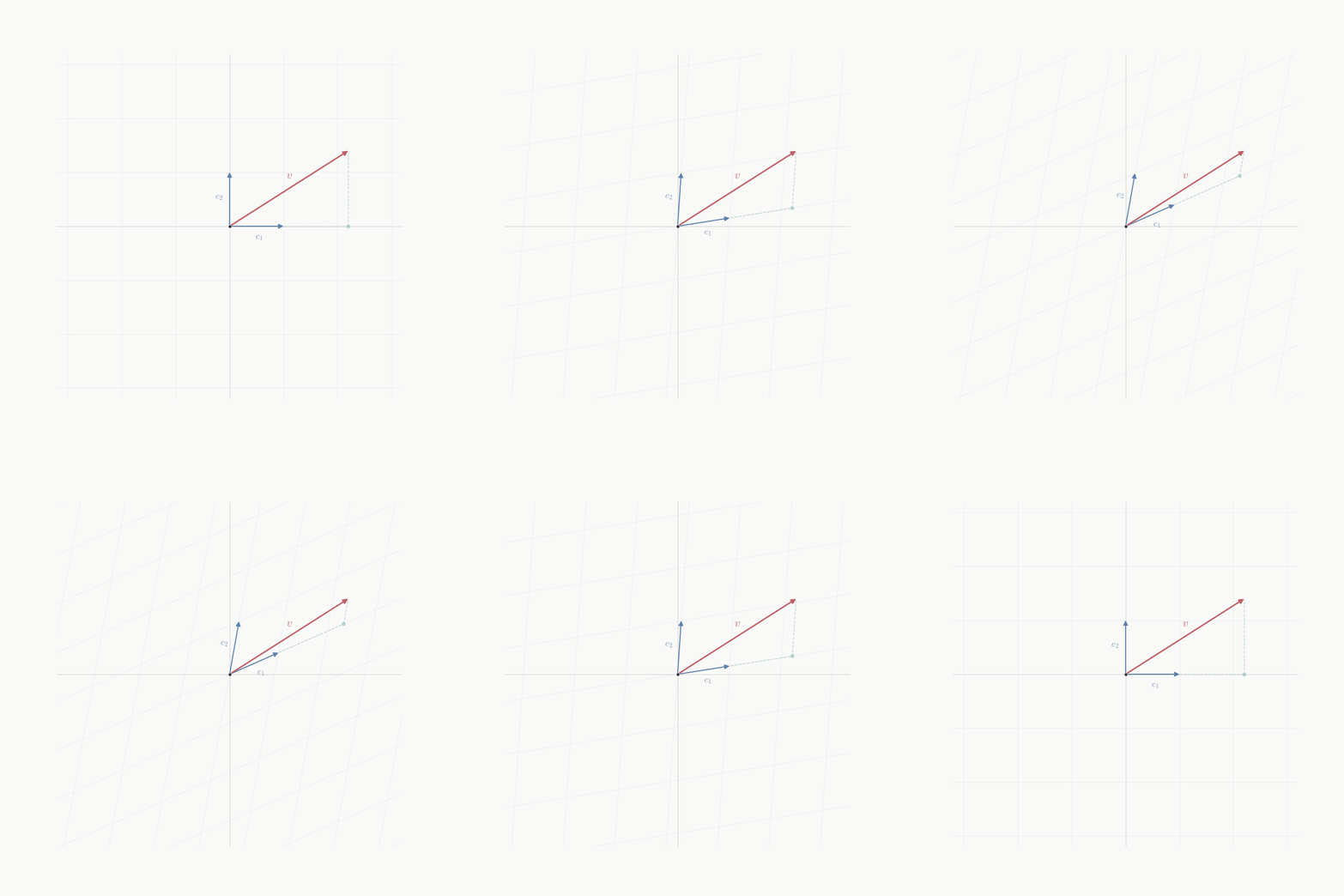
Theorem 3.8 (Extension to a basis) Every linearly independent set in a finite-dimensional vector space can be extended to a basis.
Proof. Let \(\mathcal{V}\) be finite-dimensional with \(\dim \mathcal{V} = n\), and let \(\{v_1,\ldots,v_k\}\) be linearly independent. By Theorem 3.7, \(\mathcal{V}\) has a basis \(\{w_1,\ldots,w_n\}\).
Consider the combined set \(\{v_1,\ldots,v_k,w_1,\ldots,w_n\}\). This spans \(\mathcal{V}\). If it is independent it is already a basis containing \(\{v_1,\ldots,v_k\}\) and we are done. Otherwise apply the reduction of Theorem 3.7, but at each step we choose to remove a \(w_i\), never a \(v_j\). This is always possible: if the current set \(\{v_1,\ldots,v_k, w_{i_1},\ldots,w_{i_p}\}\) is dependent, there is a nontrivial relation \[ \sum_{j=1}^{k} a_j v_j + \sum_{m=1}^{p} c_m w_{i_m} = 0. \] The \(w\)-coefficients cannot all be zero, for that would give \(\sum a_j v_j = 0\), contradicting independence of \(\{v_1,\ldots,v_k\}\). Hence some \(c_m \neq 0\), and we may remove that \(w_{i_m}\) from the set without shrinking the span. Repeating, the process terminates with an independent spanning set that still contains \(\{v_1,\ldots,v_k\}\), i.e., a basis extending the original independent set. \(\square\)
This theorem justifies the technique: “Let \(\{u_1, \ldots, u_k\}\) be a basis of \(\ker(T)\) and extend it to a basis of \(\mathcal{V}\).” We now know such an extension always exists.
3.4 Dimension
To prove that all bases have the same size, we need a principle controlling the cardinality of independent sets relative to spanning sets.
Theorem 3.9 (Exchange lemma) Let \(\{v_1,\dots,v_n\}\) be linearly independent and suppose \[ \mathcal{V} = \operatorname{span}(w_1,\dots,w_m). \] Then \(n \le m\).
Proof. We show by induction on \(k = 0, 1, \ldots, n\) that, after suitably reindexing the \(w_j\), \[ \mathcal{V} = \operatorname{span}(v_1, \ldots, v_k, w_{k+1}, \ldots, w_m). \]
For \(k = 0\) this is the hypothesis. Suppose the claim holds for some \(k < n\). Since \(v_{k+1} \in \mathcal{V}\), write \[ v_{k+1} = \sum_{i=1}^{k} a_i v_i + \sum_{j=k+1}^{m} b_j w_j. \] Since \(\{v_1, \ldots, v_{k+1}\}\) is linearly independent, \(v_{k+1} \notin \operatorname{span}(v_1, \ldots, v_k)\), so at least one \(b_j \neq 0\). Reindex so that \(b_{k+1} \neq 0\). Solving for \(w_{k+1}\) gives \[ w_{k+1} = \frac{1}{b_{k+1}}\left(v_{k+1} - \sum_{i=1}^{k} a_i v_i - \sum_{j=k+2}^{m} b_j w_j\right), \] so \(w_{k+1} \in \operatorname{span}(v_1,\ldots,v_{k+1}, w_{k+2},\ldots,w_m)\). By Theorem 3.3, \[ \mathcal{V} = \operatorname{span}(v_1, \ldots, v_{k+1}, w_{k+2}, \ldots, w_m). \] This completes the induction step.
After \(n\) steps we have \(\mathcal{V} = \operatorname{span}(v_1,\ldots,v_n, w_{n+1},\ldots,w_m)\), which requires \(n \leq m\): if \(n > m\), then at the step \(k = m\) we would have \(\mathcal{V} = \operatorname{span}(v_1,\ldots,v_m)\), forcing \(v_{m+1} \in \operatorname{span}(v_1,\ldots,v_m)\) and contradicting independence of \(\{v_1,\ldots,v_n\}\). Hence \(n \le m\). \(\square\)
Historical note. This result is often called the Steinitz exchange lemma, after Ernst Steinitz (1913), who proved it in the context of field extensions. The argument above—iteratively exchanging spanning vectors for independent ones—is essentially Steinitz’s original method.
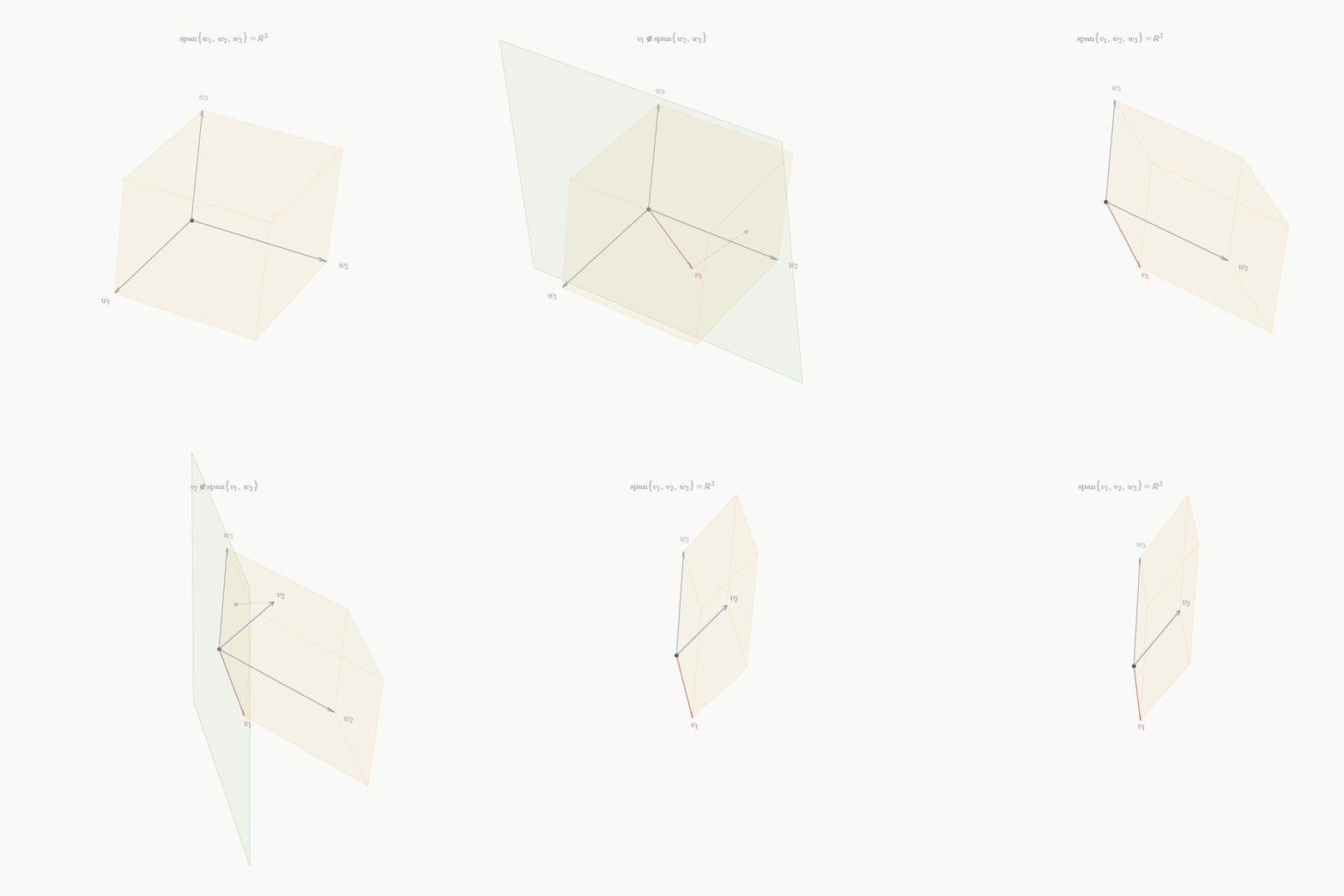
Theorem 3.10 Any two bases of a finitely generated vector space have the same cardinality.
Proof. Let \(\mathcal{B}_1, \mathcal{B}_2\) be bases. Since \(\mathcal{B}_1\) is independent and \(\mathcal{B}_2\) spans, Theorem 3.9 gives \(|\mathcal{B}_1| \le |\mathcal{B}_2|\). Reversing the roles gives \(|\mathcal{B}_2| \le |\mathcal{B}_1|\). \(\square\)
Definition 3.6 (Dimension) The dimension of a finite-dimensional vector space \(\mathcal{V}\), denoted \(\dim \mathcal{V}\), is the number of elements in any basis of \(\mathcal{V}\).
We have \(\dim \mathbb{R}^n = n\), \(\dim \mathcal{P}_n = n+1\).
3.5 Sums of Subspaces
Definition 3.7 (Sum of subspaces) Let \(\mathcal{W}_1, \mathcal{W}_2 \subset \mathcal{V}\) be subspaces. Their sum is \[ \mathcal{W}_1 + \mathcal{W}_2 = \left\{ w_1 + w_2 : w_1 \in \mathcal{W}_1, w_2 \in \mathcal{W}_2 \right\}. \]
Theorem 3.11 \(\mathcal{W}_1 + \mathcal{W}_2\) is a subspace of \(\mathcal{V}\).
Proof. The zero vector is \(0 + 0\). If \(u = u_1 + u_2\) and \(v = v_1 + v_2\), then \[ u + v = (u_1 + v_1) + (u_2 + v_2) \in \mathcal{W}_1 + \mathcal{W}_2. \] Scalar multiples behave similarly. \(\square\)
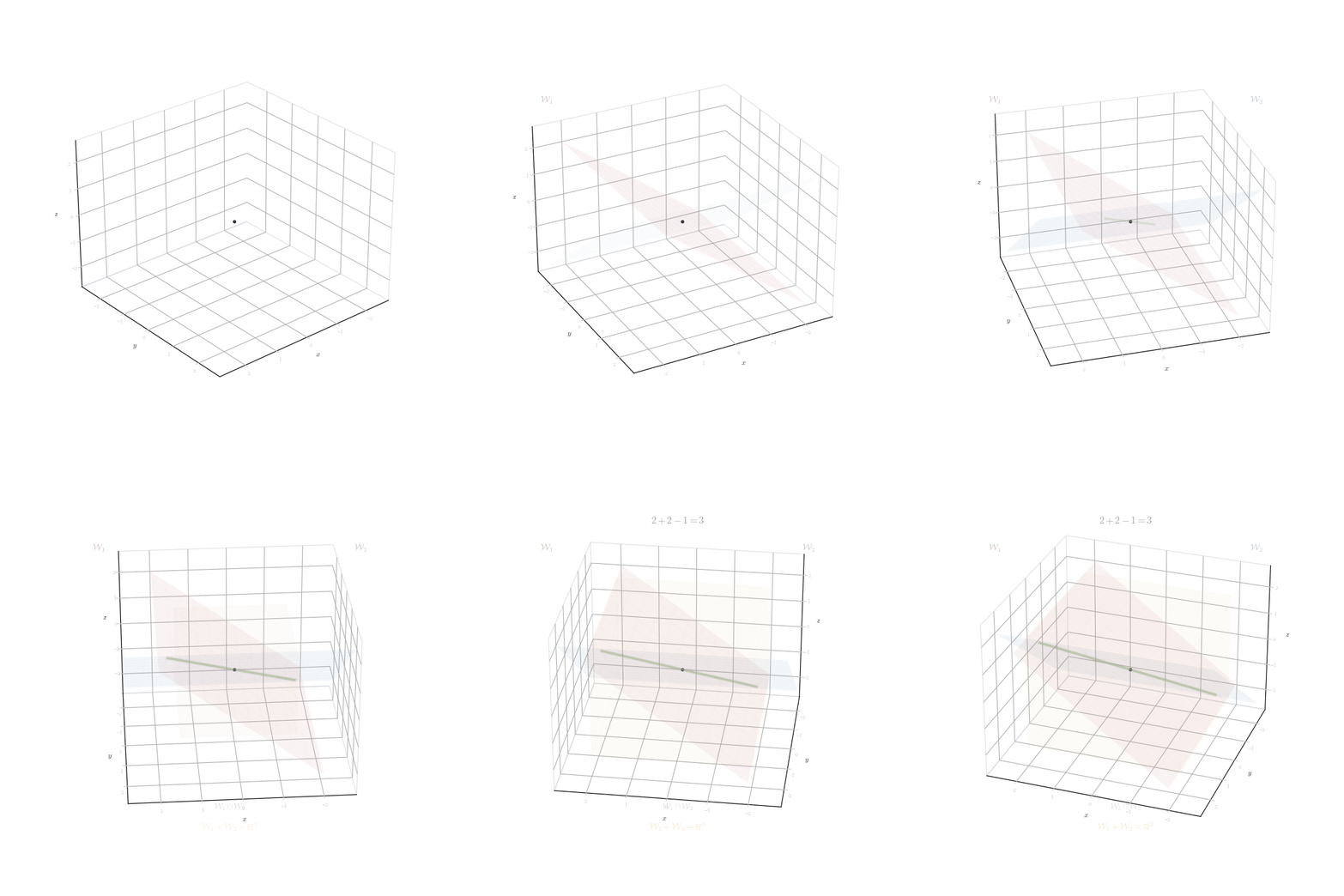
Theorem 3.12 (Dimension formula) If \(\mathcal{W}_1, \mathcal{W}_2\) are finite-dimensional subspaces of \(\mathcal{V}\), then \[ \dim(\mathcal{W}_1 + \mathcal{W}_2) = \dim \mathcal{W}_1 + \dim \mathcal{W}_2 - \dim(\mathcal{W}_1 \cap \mathcal{W}_2). \]
Proof. Let \(\{u_1,\dots,u_k\}\) be a basis of \(\mathcal{W}_1 \cap \mathcal{W}_2\). By Theorem 3.8, extend it to bases \[ \{u_1,\dots,u_k, v_1,\dots,v_r\} \quad \text{of } \mathcal{W}_1, \] \[ \{u_1,\dots,u_k, w_1,\dots,w_s\} \quad \text{of } \mathcal{W}_2. \]
We claim \(\{u_1,\dots,u_k, v_1,\dots,v_r, w_1,\dots,w_s\}\) is a basis of \(\mathcal{W}_1 + \mathcal{W}_2\).
Any \(x \in \mathcal{W}_1 + \mathcal{W}_2\) has the form \(x = x_1 + x_2\) with \(x_i \in \mathcal{W}_i\). Then \[ x_1 = \sum_{i=1}^{k} a_i u_i + \sum_{j=1}^{r} b_j v_j, \quad x_2 = \sum_{i=1}^{k} c_i u_i + \sum_{\ell=1}^{s} d_\ell w_\ell, \] so \[ x = \sum_{i=1}^{k} (a_i + c_i) u_i + \sum_{j=1}^{r} b_j v_j + \sum_{\ell=1}^{s} d_\ell w_\ell. \] The set spans.
For independence, suppose \[ \sum_{i=1}^{k} \alpha_i u_i + \sum_{j=1}^{r} \beta_j v_j + \sum_{\ell=1}^{s} \gamma_\ell w_\ell = 0. \] Rearranging, \[ \sum_{j=1}^{r} \beta_j v_j = - \sum_{i=1}^{k} \alpha_i u_i - \sum_{\ell=1}^{s} \gamma_\ell w_\ell. \] The left side lies in \(\mathcal{W}_1\); the right side lies in \(\mathcal{W}_2\). Hence both lie in \(\mathcal{W}_1 \cap \mathcal{W}_2\), so \[ \sum_{j=1}^{r} \beta_j v_j = \sum_{i=1}^{k} \delta_i u_i \] for some scalars \(\delta_i\). Since \(\{u_1,\dots,u_k, v_1,\dots,v_r\}\) is a basis of \(\mathcal{W}_1\), all coefficients are zero: \(\beta_j = 0\) for all \(j\) and \(\delta_i = 0\) for all \(i\). Substituting back, \[ \sum_{i=1}^{k} \alpha_i u_i + \sum_{\ell=1}^{s} \gamma_\ell w_\ell = 0, \] and independence of \(\{u_1,\dots,u_k, w_1,\dots,w_s\}\) forces \(\alpha_i = 0\) and \(\gamma_\ell = 0\).
Thus the combined set is a basis of \(\mathcal{W}_1 + \mathcal{W}_2\), which has \(k + r + s\) elements. Since \(\dim \mathcal{W}_1 = k + r\) and \(\dim \mathcal{W}_2 = k + s\) and \(\dim(\mathcal{W}_1 \cap \mathcal{W}_2) = k\), \[ \dim(\mathcal{W}_1 + \mathcal{W}_2) = k + r + s = (k+r) + (k+s) - k = \dim \mathcal{W}_1 + \dim \mathcal{W}_2 - \dim(\mathcal{W}_1 \cap \mathcal{W}_2). \quad \square \]
The subtracted term compensates for the vectors counted in both \(\mathcal{W}_1\) and \(\mathcal{W}_2\).
3.6 Direct Sums
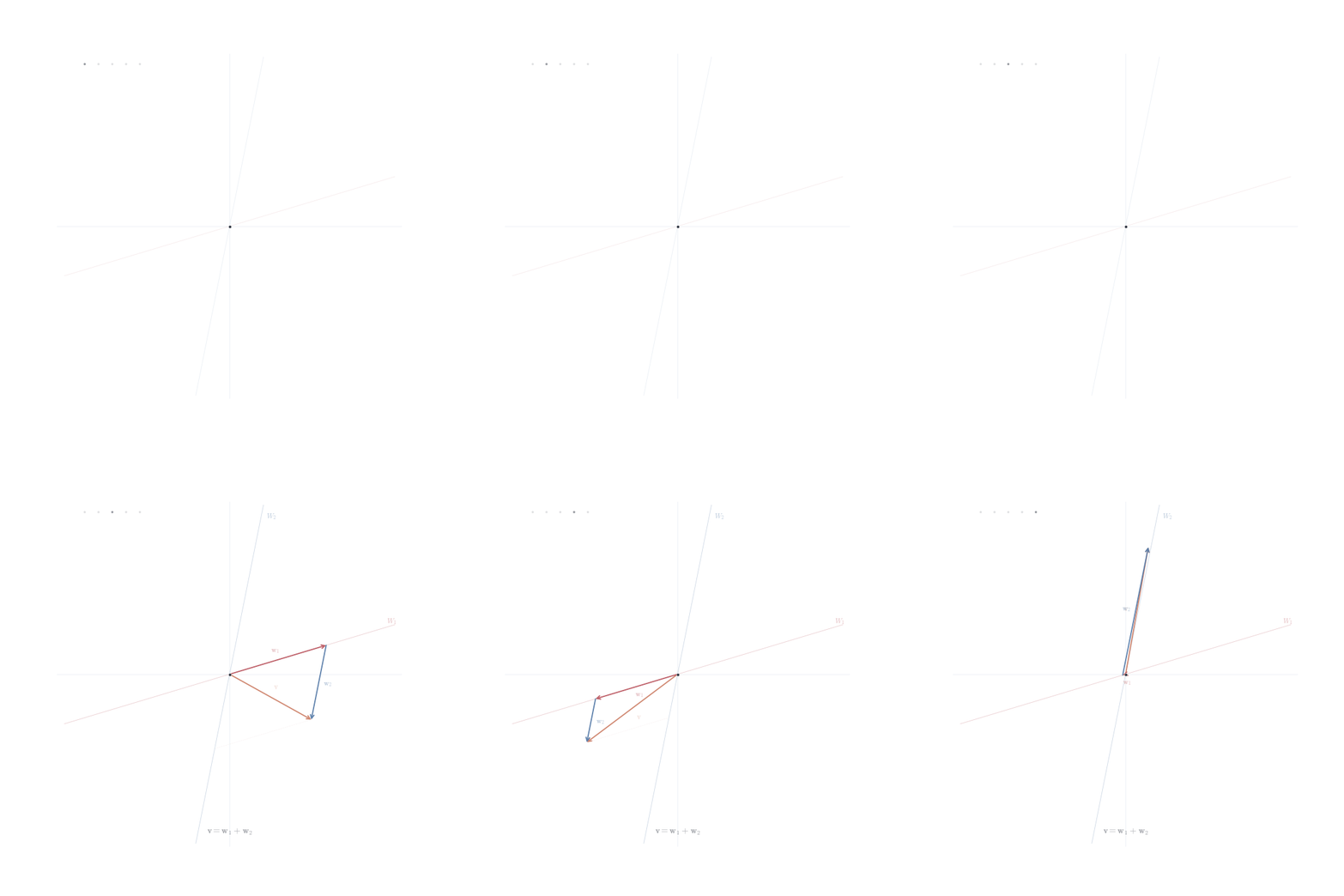
Definition 3.8 (Direct sum) We write \[ \mathcal{V} = \mathcal{W}_1 \oplus \mathcal{W}_2 \] if every \(v \in \mathcal{V}\) can be written uniquely as \(v = w_1 + w_2\) with \(w_i \in \mathcal{W}_i\).
Theorem 3.13 For subspaces \(\mathcal{W}_1, \mathcal{W}_2 \subset \mathcal{V}\), the following are equivalent:
- \(\mathcal{V} = \mathcal{W}_1 \oplus \mathcal{W}_2\)
- \(\mathcal{V} = \mathcal{W}_1 + \mathcal{W}_2\) and \(\mathcal{W}_1 \cap \mathcal{W}_2 = \{0\}\)
Proof. \((1)\Rightarrow (2)\): Suppose \(u \in \mathcal{W}_1 \cap \mathcal{W}_2\). Then \(u = u + 0 = 0 + u\) with \(u \in \mathcal{W}_1\) and \(u \in \mathcal{W}_2\). Uniqueness forces \(u = 0\).
\((2)\Rightarrow (1)\): If \(v = w_1 + w_2 = w_1' + w_2'\), then \[ w_1 - w_1' = w_2' - w_2 \in \mathcal{W}_1 \cap \mathcal{W}_2 = \{0\}, \] so \(w_1 = w_1'\) and \(w_2 = w_2'\). \(\square\)
Corollary 3.2 If \(\mathcal{V} = \mathcal{W}_1 \oplus \mathcal{W}_2\), then \[ \dim \mathcal{V} = \dim \mathcal{W}_1 + \dim \mathcal{W}_2. \]
Proof. Apply Theorem 3.12 with \(\mathcal{W}_1 \cap \mathcal{W}_2 = \{0\}\). \(\square\)
3.7 Finite-Dimensional Subspaces
Theorem 3.14 Every subspace of a finite-dimensional vector space is finite-dimensional.
Proof. Let \(\mathcal{W} \subseteq \mathcal{V}\) with \(\dim \mathcal{V} = n\). Any linearly independent subset of \(\mathcal{W}\) is linearly independent in \(\mathcal{V}\), hence has size at most \(n\) by Theorem 3.9. \(\square\)
Theorem 3.15 If \(\mathcal{W} \subsetneq \mathcal{V}\), then \(\dim \mathcal{W} < \dim \mathcal{V}\).
Proof. Let \(\{w_1,\dots,w_k\}\) be a basis of \(\mathcal{W}\). Since \(\mathcal{W} \neq \mathcal{V}\), there exists \(v \in \mathcal{V} \setminus \mathcal{W}\). The set \(\{w_1,\dots,w_k, v\}\) is independent: any relation \[ \sum_{i=1}^{k} a_i w_i + bv = 0 \] with \(b \neq 0\) would give \(v \in \operatorname{span}(w_1,\dots,w_k) = \mathcal{W}\), a contradiction. So \(b = 0\), and then independence of \(\{w_1,\dots,w_k\}\) forces \(a_i = 0\) for all \(i\). Thus \(\dim \mathcal{V} \ge k+1 > k = \dim \mathcal{W}\). \(\square\)
3.8 Closing Remarks
Finite-dimensional vector spaces admit bases, and dimension provides a complete numerical invariant. Linear independence eliminates redundancy; bases provide unique coordinates; direct sums decompose spaces into independent components.
In the next chapter we study linear maps between vector spaces. Kernels and images produce new subspaces, and dimension governs their interaction through the rank–nullity theorem.