3 Curves, Surfaces, and Level Sets
The objects of multivariable calculus are not all open subsets of \mathbb{R}^n. A particle traces a curve through space. A temperature field has isothermal surfaces. A mechanical system moves along a constraint surface. Before we can do calculus on these objects — before we can even say what “tangent direction” means — we need to understand their geometry.
This chapter is concrete. Every definition comes with an example you can draw; every theorem has a computation you can check. The abstraction of the coming chapters is built entirely on what we develop here. The central thread is simple: a smooth function f near any point looks linear to first order, and that linear approximation completely controls the local geometry of the level sets of f.
3.1 Parametric Curves
Definition 3.1 (Parametric curve) A parametric curve in \mathbb{R}^n is a smooth map \gamma : (a,b) \to \mathbb{R}^n. We call \gamma(t) the position at time t, and the image \gamma\bigl((a,b)\bigr) \subset \mathbb{R}^n is the underlying geometric curve.
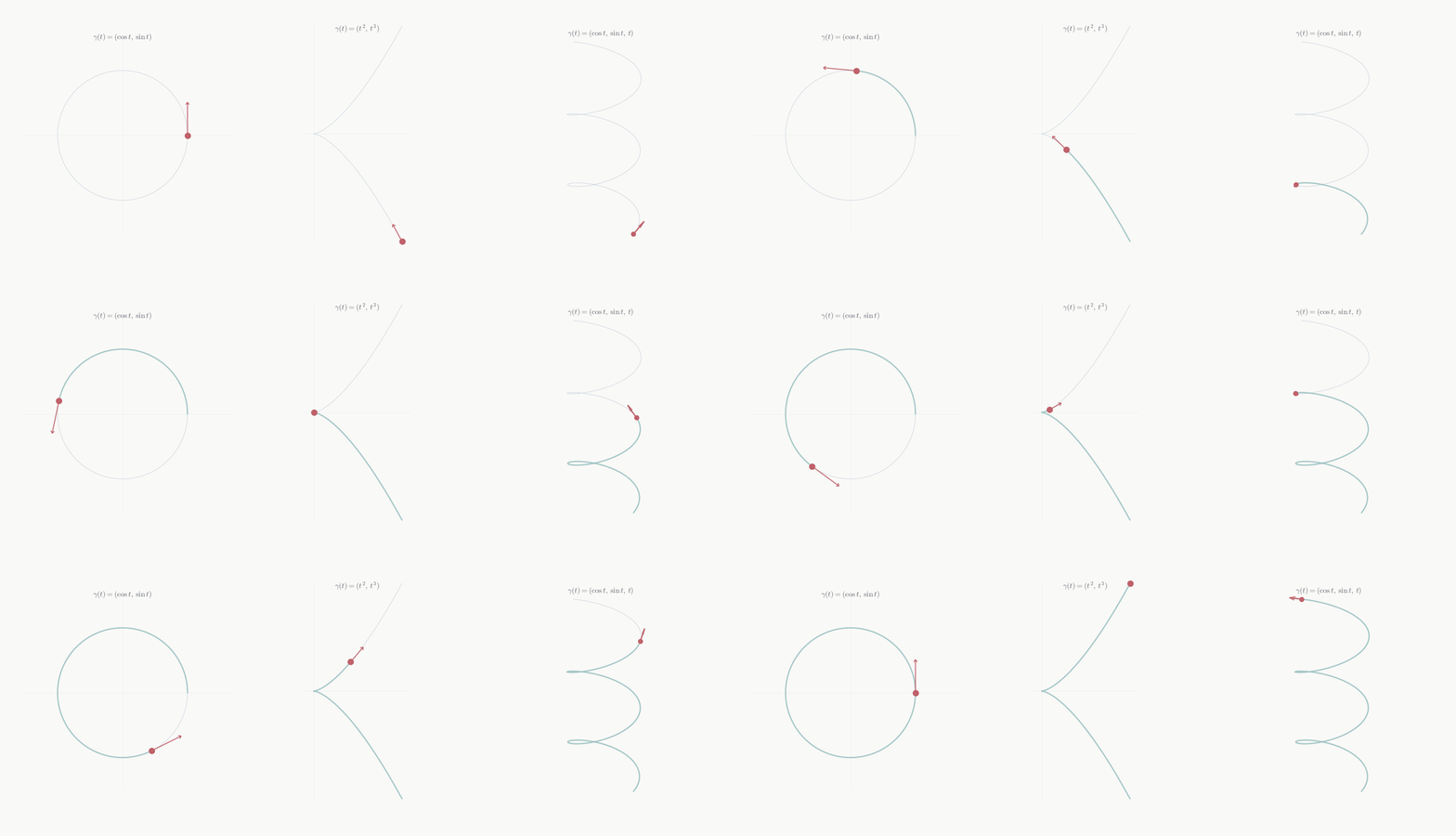
The map and its image are different things. The two parametrisations \gamma_1(t) = (\cos t,\, \sin t), \qquad \gamma_2(t) = (\cos 2t,\, \sin 2t) trace the same geometric circle at different speeds. This distinction — between the curve as a map and the curve as a set — will matter throughout.
Definition 3.2 (Velocity vector) The velocity vector of \gamma at t_0 is \gamma'(t_0) = \lim_{h \to 0} \frac{\gamma(t_0+h) - \gamma(t_0)}{h} = \bigl(\gamma_1'(t_0),\,\ldots,\,\gamma_n'(t_0)\bigr) \in \mathbb{R}^n.
Each component \gamma_i'(t_0) is an ordinary single-variable derivative, so smoothness of \gamma means smoothness of each component function \gamma_i : (a,b) \to \mathbb{R}. The velocity at (1,0) on the unit circle: \gamma_1'(0) = (0,1), \qquad \gamma_2'(0) = (0,2). Same point, same geometric curve, different velocities. The direction is intrinsic to the image; the speed is not.
Definition 3.3 (Regular curve) A smooth curve \gamma : (a,b) \to \mathbb{R}^n is regular if \gamma'(t) \neq 0 for all t.
Regularity is the condition that the particle never stops. It guarantees a well-defined tangent direction at every point. The curve \gamma(t) = (t^2, t^3) fails at t = 0: \gamma'(0) = (0,0), and the image has a cusp at the origin — it folds back on itself with no definite tangent direction. We will see the same phenomenon for level sets, controlled by the same condition in spirit.
Example. The helix \gamma(t) = (\cos t, \sin t, t) has \gamma'(t) = (-\sin t,\, \cos t,\, 1), \qquad \|\gamma'(t)\| = \sqrt{2}. It is regular everywhere. The velocity has constant magnitude — the particle climbs the cylinder at a steady rate, neither speeding up nor slowing down.
3.2 Arc Length
The length of a curve should depend only on its image, not on how fast we traverse it — walking and running the same path covers the same distance.
Definition 3.4 (Arc length) The arc length of a smooth curve \gamma : [a,b] \to \mathbb{R}^n is L(\gamma) = \int_a^b \|\gamma'(t)\|\, dt.
If we reparametrise by t = \phi(s) for a smooth strictly increasing \phi : [c,d] \to [a,b], the substitution rule gives \int_c^d \|\gamma'(\phi(s))\|\,\phi'(s)\, ds = \int_a^b \|\gamma'(t)\|\, dt, so the length is unchanged. The arc length function s(t) = \int_a^t \|\gamma'(u)\|\, du measures distance along the curve from \gamma(a). For a regular curve s'(t) = \|\gamma'(t)\| > 0, so s is strictly increasing and invertible. The reparametrisation \tilde\gamma = \gamma \circ s^{-1} satisfies \|\tilde\gamma'(s)\| = 1 everywhere — we say \tilde\gamma is unit speed, or parametrised by arc length.
Example. For the helix \|\gamma'(t)\| = \sqrt{2}, so s(t) = \sqrt{2}\,t and the unit-speed reparametrisation is \tilde\gamma(s) = \bigl(\cos(s/\sqrt{2}),\, \sin(s/\sqrt{2}),\, s/\sqrt{2}\bigr).
Arc length and unit-speed parametrisation play a supporting role in what follows: they will appear when we need results that depend on the curve as a geometric set rather than on the particular way it is traversed — for instance, when we study curvature, or integrate a scalar function along a curve. For the level-set geometry that is the main topic of this chapter, only the velocity direction matters, not its magnitude.
3.3 Scalar Functions and Level Sets
Definition 3.5 (Scalar function and level set) A scalar function on an open set U \subset \mathbb{R}^n is a smooth map f : U \to \mathbb{R}. For c \in \mathbb{R}, the level set at height c is f^{-1}(c) = \{x \in U : f(x) = c\}.
Level sets organise the domain into layers — the preimages of individual values. Every point of U belongs to exactly one level set, so the family \{f^{-1}(c)\}_{c \in \mathbb{R}} foliates U without overlap.
Examples.
- f(x,y) = x^2 + y^2: level sets are circles for c > 0, the origin for c = 0, empty for c < 0.
- f(x,y,z) = x^2 + y^2 + z^2: level sets are spheres for c > 0.
- f(x,y) = y - x^2: each level set is a parabola, shifting vertically as c varies.
- f(x,y) = xy: level sets are rectangular hyperbolas for c \neq 0. For c = 0, the two coordinate axes — crossing at the origin.
That last case signals trouble. The level set f^{-1}(0) is not a smooth curve near (0,0): two branches cross, and no neighbourhood of the origin in f^{-1}(0) looks like an interval. Something about f at (0,0) distinguishes it from the level sets at c \neq 0. Identifying that something is the work of the rest of this chapter.
3.4 Differentiability
From linear algebra, a linear functional on \mathbb{R}^n is a linear map \ell : \mathbb{R}^n \to \mathbb{R}. The reader knows that every such functional has the form \ell(v) = \langle u, v \rangle for a unique u \in \mathbb{R}^n (Riesz representation theorem): linearity determines \ell entirely from its values on a basis, and the representing vector is u = (\ell(e_1), \ldots, \ell(e_n)). The geometry is transparent: the level sets of \ell are the cosets of \ker \ell = u^\perp, a family of parallel hyperplanes of dimension n-1, uniformly spaced and covering all of \mathbb{R}^n.
Linear functionals are the simplest maps \mathbb{R}^n \to \mathbb{R} one can write down, and their level sets are the simplest possible geometry. A smooth function f is not linear, but near any point p it ought to look linear to first order — this is the multivariable version of the single-variable approximation f(a + h) \approx f(a) + f'(a)\,h. The only difference is that the domain is now \mathbb{R}^n, so the “slope” at p must be a linear functional rather than a number.
Definition 3.6 (Differentiable function) We say f : U \to \mathbb{R} is differentiable at p \in U if there exists a linear functional Df_p : \mathbb{R}^n \to \mathbb{R} such that f(p + v) = f(p) + Df_p(v) + o(\|v\|) \qquad \text{as } v \to 0.
That is, \displaystyle\lim_{v \to 0} \frac{f(p+v) - f(p) - Df_p(v)}{\|v\|} = 0. We call Df_p the derivative of f at p, and say f is smooth if it is differentiable at every p \in U and the map p \mapsto Df_p is itself smooth in the same sense.
The condition says that the error in the linear approximation is not merely small but small relative to the displacement v — it shrinks faster than \|v\| as v \to 0. This is stronger than just saying f is continuous.
Uniqueness. The functional Df_p is unique when it exists. If L and L' both satisfy the approximation, then for any fixed nonzero v, substituting tv for small t > 0 gives \frac{(L - L')(tv)}{\|tv\|} = \frac{t(L-L')(v)}{t\|v\|} = \frac{(L-L')(v)}{\|v\|} \to 0, so (L - L')(v) = 0 for every v, meaning L = L'.
Since Df_p is a linear functional, Riesz gives a unique vector \nabla f(p) \in \mathbb{R}^n with Df_p(v) = \nabla f(p) \cdot v. This vector is the gradient of f at p. Its coordinate expression — in terms of partial derivatives — is the content of the coming chapters; here we work with the functional Df_p directly and do not need coordinates.
Examples. We compute Df_p directly from the definition.
For f(x,y) = x^2 + y^2 at p = (a,b): f(p + v) = (a+v_1)^2 + (b+v_2)^2 = (a^2+b^2) + 2av_1 + 2bv_2 + (v_1^2+v_2^2). The quadratic remainder satisfies v_1^2 + v_2^2 = \|v\|^2 = o(\|v\|), so Df_p(v) = 2av_1 + 2bv_2 = 2p \cdot v.
For f(x,y) = xy at p = (a,b): f(p+v) = (a+v_1)(b+v_2) = ab + bv_1 + av_2 + v_1 v_2. Since |v_1 v_2| \leq \|v\|^2 = o(\|v\|), we get Df_p(v) = bv_1 + av_2.
For f(x,y) = x^2 - y^2 at p = (0,0): f(0 + v) = v_1^2 - v_2^2 = o(\|v\|), so Df_0(v) = 0 for all v — the zero functional. Geometrically this means f has no linear part at the origin: it is purely quadratic there.
These computations reveal the pattern: for a polynomial f, the linear part Df_p consists of the first-order terms in the Taylor expansion of f around p. The higher-order terms contribute to o(\|v\|) and disappear. the coming chapters makes this precise and gives the general formula via partial derivatives; the point here is that the concept of differentiability — and the derivative as a linear functional — is completely well-posed without any coordinates.
The level sets of Df_p are parallel hyperplanes — the geometry of a linear functional. These are the first-order approximation to the level sets of f near p. When Df_p \neq 0 those hyperplanes are genuine (n-1)-dimensional slices, and we will see that the level sets of f locally look the same: smooth, parallel, non-singular. When Df_p = 0 the linear approximation is the zero functional — all level sets pass through p to first order — and the actual level sets are free to develop crossings, cusps, or other singularities.
3.5 The Chain Rule
The chain rule connects the derivative of f at a point to the velocity of a curve through that point. We state it now and prove it in the coming chapters once we have the general theory of differentiation in place; the statement itself requires nothing beyond what we have defined.
Theorem 3.1 (Chain rule) Let f : U \to \mathbb{R} be differentiable and \gamma : (a,b) \to U smooth. Then f \circ \gamma : (a,b) \to \mathbb{R} is differentiable and (f \circ \gamma)'(t) = Df_{\gamma(t)}\bigl(\gamma'(t)\bigr).
In single-variable calculus, if f : \mathbb{R} \to \mathbb{R} and \gamma : \mathbb{R} \to \mathbb{R} then (f \circ \gamma)'(t) = f'(\gamma(t)) \cdot \gamma'(t). The multivariable chain rule says exactly the same thing, with f'(\gamma(t)) replaced by the linear functional Df_{\gamma(t)} and scalar multiplication replaced by its action on the vector \gamma'(t). The rate of change of f along \gamma depends only on where you are and how fast you are moving, and the dependence on velocity is linear.
The proof makes the approximation f(p+v) = f(p) + Df_p(v) + o(\|v\|) rigorous and composes it with the approximation for \gamma; we defer it to the coming chapters. What we need right now is the following immediate consequence.
Theorem 3.2 (Velocity vectors are tangent to level sets) If \gamma : (a,b) \to \mathbb{R}^n lies entirely in f^{-1}(c), then Df_{\gamma(t)}\bigl(\gamma'(t)\bigr) = 0 \qquad \text{for all } t.
Proof. Since \gamma lies in f^{-1}(c), the composition f \circ \gamma is the constant function c. A constant function has zero derivative. By the chain rule, Df_{\gamma(t)}(\gamma'(t)) = (f \circ \gamma)'(t) = 0. \square
This is the central geometric fact of the chapter. Every velocity vector of every curve through p that lies in the level set f^{-1}(c) is annihilated by the linear functional Df_p. In other words, all such velocity vectors lie in the kernel \ker Df_p = \{v \in \mathbb{R}^n : Df_p(v) = 0\}. Since Df_p = \nabla f(p) \cdot ({-}), this kernel is \nabla f(p)^\perp — a hyperplane of dimension n-1, provided Df_p \neq 0. That hyperplane is the tangent space to f^{-1}(c) at p: the set of all first-order directions along the level set, determined entirely by the linear part of f.
3.6 When Is a Level Set Smooth?
The theorem above tells us what the tangent directions are. But it is silent on whether those directions actually span a tangent space — whether the level set near p really looks like a smooth surface. That depends on whether Df_p is nonzero.
Definition 3.7 (Regular and critical points) Let f : U \to \mathbb{R} be differentiable and p \in f^{-1}(c). We call p a regular point if Df_p \neq 0, and a critical point if Df_p = 0. The value c is a regular value of f if every point of f^{-1}(c) is regular.
At a regular point, Df_p is a nonzero linear functional, so its level sets are genuine parallel hyperplanes of dimension n-1. The level sets of f near p approximate these hyperplanes to first order, and the implicit function theorem (Chapter 6) makes this precise: near a regular point, f^{-1}(c) is the graph of a smooth function of n-1 variables — it is a smooth surface. At a critical point Df_p = 0, the linear approximation is trivial and the level set can degenerate in any number of ways.
Let us check this against our examples, using the derivatives computed above.
Sphere. f(x,y,z) = x^2+y^2+z^2, c = 1. For p \in S^2, the derivative is Df_p(v) = 2p \cdot v, which is nonzero since p \neq 0. So every point of S^2 is regular — the sphere is smooth everywhere.
Cuspidal cubic. f(x,y) = y^2 - x^3, c = 0. At the origin, f(0 + v) = v_2^2 - v_1^3. Both terms are higher order: |v_2^2| \leq \|v\|^2 and |v_1^3| \leq \|v\|^3, so f(0+v) = o(\|v\|) and Df_0 = 0. The origin is critical, and the level set has a cusp there.
Crossing. f(x,y) = x^2 - y^2, c = 0. At the origin, f(0+v) = v_1^2 - v_2^2 = o(\|v\|), so Df_0 = 0. Again critical, and the level set — two lines crossing — is singular at the origin.
In both singular examples the critical point is isolated: for any p \neq 0 on the level set, one checks directly that Df_p \neq 0, and the level set is smooth there. The singularity is a purely local phenomenon at the critical point, caused by the vanishing of the linear part.
3.7 Tangent Lines and Tangent Planes
Definition 3.8 (Tangent hyperplane) Let c be a regular value of f : U \to \mathbb{R} and p \in f^{-1}(c). The tangent hyperplane to f^{-1}(c) at p is T_p f^{-1}(c) = \ker Df_p = \{v \in \mathbb{R}^n : Df_p(v) = 0\}.
By the chain rule theorem, every velocity vector of a curve through p in f^{-1}(c) lies in T_p f^{-1}(c). Since Df_p \neq 0 at a regular point, \ker Df_p has dimension n-1: a line when n = 2, a plane when n = 3.
A remark on language: T_p f^{-1}(c) is a linear subspace of \mathbb{R}^n — it passes through the origin, not through p. It is a space of directions at p, not a copy of the level set. The tangent plane to the sphere at p, for instance, is p^\perp — the plane through the origin perpendicular to p. This distinction becomes definitional in the coming chapters, where the tangent space T_pM is constructed as a vector space in its own right, attached to but distinct from M.
Example. f(x,y) = x^2 + y^2, p = (r, 0).
We computed Df_p(v) = 2rv_1, so T_p f^{-1}(r^2) = \ker Df_p = \{v : v_1 = 0\}. The tangent to the circle at (r, 0) is vertical. Correct.
Example. f(x,y,z) = x^2+y^2+z^2, p = (a,b,c) \in S^2.
We have Df_p(v) = 2(av_1+bv_2+cv_3) = 2p \cdot v, so T_p S^2 = \ker Df_p = p^\perp. The tangent plane to the sphere is perpendicular to the radius at every point.
Example. f(x,y,z) = x^2+y^2-z on the paraboloid \{z = x^2+y^2\}, p = (a,b,a^2+b^2).
Expanding at p: f(p+v) = (a+v_1)^2 + (b+v_2)^2 - (a^2+b^2+v_3) = 2av_1 + 2bv_2 - v_3 + O(\|v\|^2), so Df_p(v) = 2av_1 + 2bv_2 - v_3 and T_p f^{-1}(0) = \{v : 2av_1 + 2bv_2 - v_3 = 0\}. The normal direction is (2a, 2b, -1) — the standard tangent plane formula for the graph z = x^2+y^2, recovered from the kernel of the linear part alone, without invoking any formula for partial derivatives.
3.8 Looking Ahead
We have established, in entirely elementary terms, the main geometric ingredients of the coming chapters.
A smooth hypersurface in \mathbb{R}^n is a level set f^{-1}(c) at a regular value — where Df_p \neq 0 everywhere on the level set. Near each such point the level set looks like a flat piece of \mathbb{R}^{n-1}, and it carries a well-defined tangent hyperplane T_p f^{-1}(c) = \ker Df_p.
Two questions remain natural. First: what if the object is cut out by several scalar equations simultaneously? A curve in \mathbb{R}^3 is the intersection of two surfaces; a curve in \mathbb{R}^4 might satisfy three equations. In these cases Df_p is no longer a single linear functional but a linear map \mathbb{R}^n \to \mathbb{R}^k, and the condition Df_p \neq 0 generalises to Df_p having full rank k — the rank condition of the embedded submanifold definition in the coming chapters. The tangent space is still \ker Df_p, now a subspace of dimension n - k.
Second: what if the space we are interested in is not sitting inside any \mathbb{R}^n at all, but only locally looks like \mathbb{R}^n? Giving consistent coordinates to such a space — charts, atlases, transition maps — is what a smooth manifold is. The tangent space T_pM will be defined abstractly via equivalence classes of curves through p, but for embedded submanifolds it reduces to exactly \ker Df_p, the object we built here.
The move from this chapter to the coming chapters is not a change of subject. It is a change of language — from coordinates and equations to the intrinsic geometry those coordinates encode.