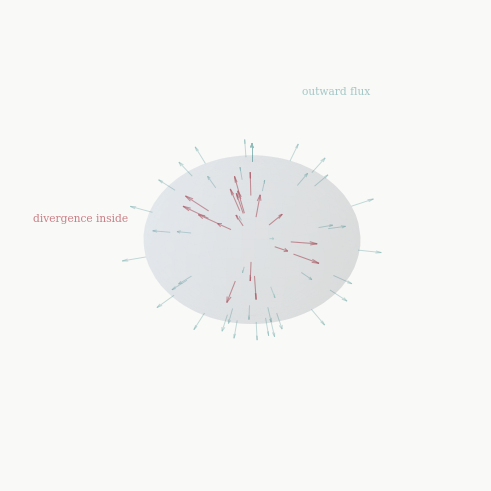
14 The Divergence Theorem
Theorem 12.1 and Theorem 13.1 both relate circulation — the integral of a vector field along a boundary curve — to a curl integral over the enclosed surface. The Divergence theorem is the third member of the family, but it involves a different operation: it relates flux — the integral of a vector field through a closed surface — to the divergence integrated over the enclosed volume. Where Stokes’ theorem is about rotation, the Divergence theorem is about expansion and compression.
The proof has the same character as Green’s theorem: apply the fundamental theorem of calculus in each coordinate direction via Fubini, observe that interior contributions cancel, and what survives is a boundary integral. The geometry is one dimension higher — we are working in \mathbb{R}^3 rather than \mathbb{R}^2 — but the mechanism is identical.
14.1 The Theorem
A regular region \Omega \subset \mathbb{R}^3 is a bounded open set whose boundary \partial\Omega is a piecewise C^1 closed surface, oriented with the outward normal — pointing away from \Omega.
Theorem 14.1 (Divergence theorem) Let \Omega \subset \mathbb{R}^3 be a regular region and F : \overline\Omega \to \mathbb{R}^3 a C^1 vector field. Then \oiint_{\partial\Omega} F \cdot d\mathbf{S} = \iiint_\Omega \nabla \cdot F\, dV.
The left side is the total outward flux of F through the boundary. The right side integrates the divergence — the local volume expansion rate of F — over the interior. The theorem says total outward flux equals total divergence inside, which is exactly what the physical interpretation of divergence suggests: a source inside produces outward flux, a sink produces inward flux, and the total net flux out measures the total net source strength inside.
The proof strategy is the same as for Green’s theorem: prove two simpler identities separately and add them. Here we prove all three components together, since the argument for each is the same.
Proof. It suffices to prove, for each i = 1, 2, 3: \oiint_{\partial\Omega} F_i\, dS_i = \iiint_\Omega \partial_i F_i\, dV, where dS_i is the i-th component of the outward area element d\mathbf{S} = \hat{n}\, dS. We prove the case i = 3; the others are identical.
Suppose first that \Omega is vertically simple: \Omega = \{(x,y,z) : (x,y) \in D,\; \phi(x,y) < z < \psi(x,y)\} where D \subset \mathbb{R}^2 is a Jordan domain and \phi \leq \psi are C^1 functions. By Fubini and the fundamental theorem in z: \iiint_\Omega \partial_z F_3\, dV = \iint_D \int_{\phi(x,y)}^{\psi(x,y)} \partial_z F_3(x,y,z)\, dz\, dA = \iint_D \bigl[F_3(x,y,\psi) - F_3(x,y,\phi)\bigr]\, dA. The boundary \partial\Omega has three pieces: the top surface \Sigma_+ = \{z = \psi(x,y)\} with outward normal pointing upward, the bottom surface \Sigma_- = \{z = \phi(x,y)\} with outward normal pointing downward, and the lateral surface \Sigma_0 (the sides) where the outward normal is horizontal so its z-component is zero. Therefore \oiint_{\partial\Omega} F_3\, dS_3 = \iint_{\Sigma_+} F_3\, dS_3 + \iint_{\Sigma_-} F_3\, dS_3. Parametrise \Sigma_+ by (x,y) \mapsto (x,y,\psi(x,y)): the outward unit normal has positive z-component \hat{n} \cdot e_3 = 1/\sqrt{1 + |\nabla\psi|^2}, and dS = \sqrt{1 + |\nabla\psi|^2}\, dA, so dS_3 = dA. Thus \iint_{\Sigma_+} F_3\, dS_3 = \iint_D F_3(x,y,\psi)\, dA. Similarly, on \Sigma_- the outward normal points downward, giving dS_3 = -dA, so \iint_{\Sigma_-} F_3\, dS_3 = -\iint_D F_3(x,y,\phi)\, dA. Combining: \oiint_{\partial\Omega} F_3\, dS_3 = \iint_D \bigl[F_3(x,y,\psi) - F_3(x,y,\phi)\bigr]\, dA = \iiint_\Omega \partial_z F_3\, dV. For a general regular region \Omega, decompose it into finitely many vertically simple pieces. On interior faces between adjacent pieces, the outward normals point in opposite directions so the flux contributions cancel. Only the exterior boundary survives. Summing over all pieces gives the result. \square
The cancellation on interior faces is the same telescoping mechanism as in Green’s theorem and Stokes’ theorem. The fundamental theorem of calculus in one direction, Fubini to reduce to that one direction, and cancellation of interior boundaries: this is the proof of every integral theorem.
14.2 Consequences
14.2.1 Divergence-free fields
A vector field F is divergence-free (or solenoidal) if \nabla \cdot F = 0 on U. By the Divergence theorem, the outward flux of F through any closed surface \partial\Omega \subset U is zero: \oiint_{\partial\Omega} F \cdot d\mathbf{S} = \iiint_\Omega \nabla \cdot F\, dV = 0. Conversely, if the flux through every closed surface is zero, then \nabla \cdot F = 0 everywhere. The Divergence theorem gives a complete duality: zero divergence inside and zero outward flux through every closed boundary are exactly equivalent.
The analogue with conservative fields is precise. A field F is conservative iff its circulation around every closed curve is zero (Chapter 9). A field F is divergence-free iff its flux through every closed surface is zero. In the chain \nabla \to \operatorname{curl} \to \operatorname{div}, Stokes’ theorem governs the first step and the Divergence theorem governs the second.
On \mathbb{R}^3, every divergence-free field is a curl: if \nabla \cdot F = 0 there exists G with F = \operatorname{curl} G. This is the analogue of the fact that every curl-free field on \mathbb{R}^3 is a gradient. On domains with topological holes neither statement need hold, for the same reasons we saw in Chapter 11.
14.2.2 Green’s identities
Let u, v \in C^2(\overline\Omega). Apply Theorem 14.1 to F = u\nabla v. Since \nabla \cdot (u\nabla v) = \nabla u \cdot \nabla v + u\,\Delta v by the product rule: \oiint_{\partial\Omega} u\,\frac{\partial v}{\partial n}\, dS = \iiint_\Omega (\nabla u \cdot \nabla v + u\,\Delta v)\, dV. Here \partial v/\partial n = \nabla v \cdot \hat{n} is the outward normal derivative of v. This is Green’s first identity: \iiint_\Omega u\,\Delta v\, dV = \oiint_{\partial\Omega} u\, \frac{\partial v}{\partial n}\, dS - \iiint_\Omega \nabla u \cdot \nabla v\, dV. Subtracting the same formula with u and v swapped gives Green’s second identity: \iiint_\Omega (u\,\Delta v - v\,\Delta u)\, dV = \oiint_{\partial\Omega} \left(u\,\frac{\partial v}{\partial n} - v\,\frac{\partial u}{\partial n}\right) dS.
Green’s second identity encodes the self-adjointness of the Laplacian: the left side is symmetric in u and v up to sign, so the right side is too. When u is harmonic (\Delta u = 0), Green’s second identity with v = 1 gives \oiint_{\partial\Omega} \frac{\partial u}{\partial n}\, dS = 0: the total outward normal derivative of any harmonic function integrates to zero over any closed surface. When both u and v are harmonic: \oiint_{\partial\Omega} \left(u\,\frac{\partial v}{\partial n} - v\,\frac{\partial u}{\partial n}\right) dS = 0. These identities are the foundation of the theory of harmonic functions and boundary value problems, which begins properly in a course on partial differential equations.
14.2.3 The volume formula
Setting F = (x, 0, 0) in the Divergence theorem gives \nabla \cdot F = 1 and therefore \operatorname{vol}(\Omega) = \oiint_{\partial\Omega} x\, dS_1, and similarly with F = (0,y,0) or F = (0,0,z). Averaging: \operatorname{vol}(\Omega) = \frac{1}{3}\oiint_{\partial\Omega} (x\, dS_1 + y\, dS_2 + z\, dS_3) = \frac{1}{3}\oiint_{\partial\Omega} \mathbf{x} \cdot d\mathbf{S}. The volume of a region is determined entirely by a surface integral over its boundary. This is the three-dimensional analogue of the area formula from Green’s theorem.
Example. Volume of the ball B(0,R). With \partial B(0,R) = S^2(R) and outward normal \hat{n} = \mathbf{x}/R: \operatorname{vol}(B(0,R)) = \frac{1}{3}\oiint_{S^2(R)} \mathbf{x} \cdot \frac{\mathbf{x}}{R}\, dS = \frac{1}{3R}\oiint_{S^2(R)} R^2\, dS = \frac{R}{3} \cdot 4\pi R^2 = \frac{4}{3}\pi R^3.
14.3 The Two-Dimensional Version
The two-dimensional Divergence theorem — sometimes called the flux form of Green’s theorem — follows immediately from Green’s theorem itself. For F = (P, Q) on a Jordan domain \Omega \subset \mathbb{R}^2 with outward unit normal \hat{n} along \partial\Omega: \oint_{\partial\Omega} F \cdot \hat{n}\, ds = \iint_\Omega \nabla \cdot F\, dA. This follows from Green’s theorem applied to (-Q, P) in place of (P, Q): the left side becomes \oint (-Q\, dx + P\, dy), which is \oint F \cdot \hat{n}\, ds (since if \gamma' = (\dot x, \dot y) then \hat{n} = (\dot y, -\dot x)/\|\gamma'\| and F \cdot \hat{n}\, ds = P\dot y - Q\dot x), and the right side becomes \iint (\partial_x P + \partial_y Q)\, dA = \iint \nabla \cdot F\, dA.
So Green’s theorem and the two-dimensional Divergence theorem are the same theorem, written in different variables. The three-dimensional Divergence theorem is the natural extension to volumes.
14.4 The Complete Picture
We now have all four integral theorems:
The fundamental theorem for line integrals (Chapter 9): \int_\gamma \nabla f \cdot d\gamma = f(b) - f(a). Integrating the derivative of a scalar field along a curve recovers the boundary values.
Green’s theorem (Chapter 10): \oint_{\partial\Omega} F \cdot d\gamma = \iint_\Omega (\operatorname{curl} F) \cdot \hat{k}\, dA. Integrating the curl over a region equals the circulation around its boundary.
Stokes’ theorem (Chapter 11): \oint_{\partial S} F \cdot d\gamma = \iint_S (\operatorname{curl} F) \cdot d\mathbf{S}. The same, for a curved surface.
The Divergence theorem: \oiint_{\partial\Omega} F \cdot d\mathbf{S} = \iiint_\Omega \nabla \cdot F\, dV. Integrating the divergence over a volume equals the outward flux through its boundary.
All four say the same thing at different dimensions: the integral of a certain derivative over a domain equals an integral over the domain’s boundary. The derivative in each case is the next operation in the chain \nabla \to \operatorname{curl} \to \operatorname{div}, and the domains are curves, flat regions, curved surfaces, and volumes respectively.
The proof in each case has the same structure: reduce to the fundamental theorem of calculus in one variable via Fubini, note that interior contributions from adjacent pieces cancel, and sum what remains over the boundary. The mechanism is the same from the simplest to the most complex; only the geometry changes.